I · THE OBJECT · BRITISH MUSEUM
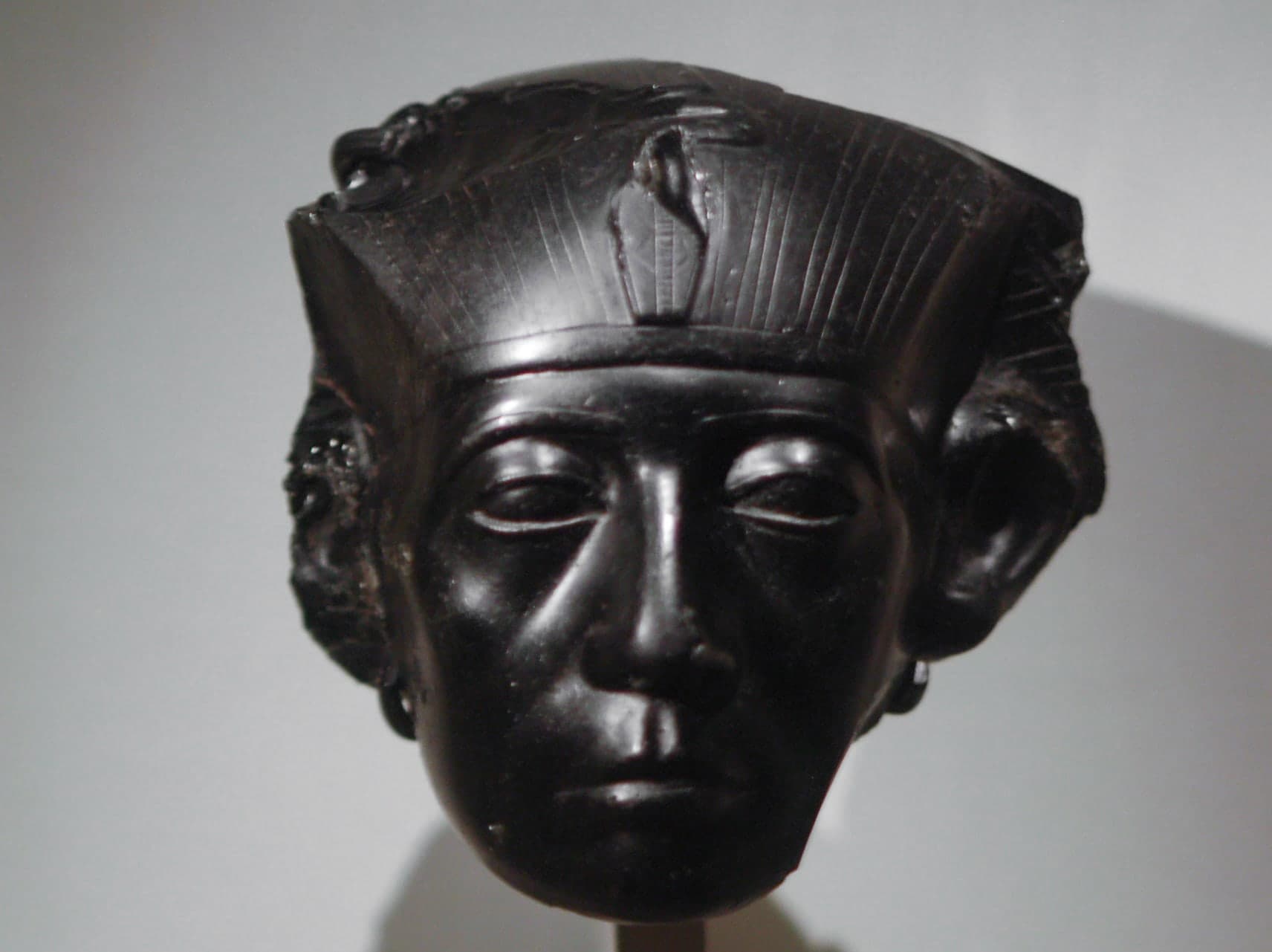
Head of Senwosret III
▶ Listen · narrated
Egyptian kings were carved young and smooth for three thousand years. Then Senwosret III chose to look tired, and the choice was political.
At a glance
- Subject
- Senwosret III (also Senusret III; hellenised as Sesostris III)
- Dynasty
- Twelfth Dynasty, Middle Kingdom
- Reign ended
- Died circa 1839 BC
- Position
- Fifth king of the late Twelfth Dynasty
Look closer
The hooded eyes
The upper lids are heavy and droop slightly at the outer corners. The effect is not damage or wear — it is carved deliberately into the stone. Earlier royal portraits show eyes wide and unlined. This face was meant to look older, or at least as though it had seen effort.
The lined forehead and cheeks
Shallow grooves run horizontally across the brow and bracket the mouth. These are not the accidental marks of age on an old statue. They are part of the original carving. Someone instructed the sculptor to put lines where convention said there should be none.
The heavy jaw
The lower face is broad and the mouth is set in a neutral line, neither smiling nor stern. The overall effect is weight rather than youth. The face does not celebrate physical perfection. It argues something else: endurance, perhaps, or the cost of responsibility.
The story
Egyptian royal portraiture followed a convention for most of its history: the king was shown in idealised youth, ageless and physically perfect. The face was a symbol of divine authority, not a record of what the man looked like. Wrinkles, sagging skin, and other marks of time were omitted. The image said: this power does not age, does not tire, does not end.
Then, during the Twelfth Dynasty, that convention changed. This face shows something different. The eyes are hooded, the lids heavy. The forehead is lined. The cheeks sag slightly. The mouth is set in a way that suggests neither joy nor anger, just a kind of weariness. It is not that the sculptors lost their skill or that the stone was poor. The change was deliberate.
What the face was arguing is harder to say with certainty, but the political context offers a clue. Senwosret III led military campaigns that, according to the record, brought a period of peace and economic prosperity. Those campaigns also reduced the power of regional rulers — the provincial governors who had, in earlier periods, held significant autonomy. The centralisation of power under the king was not automatic. It required effort, enforcement, and probably conflict.
A face that looked tired, that showed the marks of responsibility rather than the glow of divine ease, may have been a way of claiming a different kind of authority. Not the king as untouchable god, but the king as the one who bears the weight of the state. The lined face says: I have done the work. I carry the burden. The shift in portraiture coincides with a shift in the structure of power, and it is hard to believe the two were unrelated.
Senwosret III was deified and honoured with a cult during his own lifetime, which suggests the strategy — if that is what it was — succeeded. The tired face became the face of a god, but a god who had earned it.
The convention did not last. Later dynasties returned to the ageless ideal. But for a period in the Middle Kingdom, the pharaoh was allowed to look human, and the humanity was part of the message.
Why it mattered then
The lined face of Senwosret III coincides with a period of centralisation. Regional rulers, who had held considerable power in earlier periods, were brought under tighter control. The military campaigns that Senwosret III led were not just external — they reshaped the internal structure of the state. A portrait that showed effort rather than effortless perfection may have been a way of justifying that centralisation: the king as the one who works, who sacrifices, who takes on the burden that others cannot or will not carry. The deification of Senwosret III during his own lifetime suggests the message was received. The tired face was not a sign of weakness. It was a claim to a different, perhaps more personal, kind of authority.
Why it matters now
The portrait is a reminder that political imagery is not neutral. The choice to show a king as ageless or as marked by time is a choice about what kind of power is being claimed. Senwosret III's face argues that authority can be earned through visible effort, that the marks of responsibility can be a source of legitimacy rather than a flaw to be hidden. That argument has echoes in later political portraiture across cultures: the leader who is seen to suffer for the people, who wears the cost of office on their face. The convention did not last in Egypt, but the idea — that a face can argue for a kind of power — remains legible.
The surprising detail
Senwosret III was deified and honoured with a cult during his own lifetime, which was rare. The tired, lined face that breaks with the ageless ideal of earlier royal portraiture did not prevent his elevation to divine status — it may, in fact, have been part of what made it possible. The face that showed effort became the face of a god.
What is disputed
The interpretation of the lined, tired face as a deliberate political statement is widely accepted, but the exact reasoning behind the shift in portraiture is not recorded in contemporary texts. Scholars infer the connection between the new portrait style and the centralisation of power under Senwosret III, but direct evidence of intent is absent. The convention itself is clear; the motivation remains a matter of interpretation.
Remember this
The tired face was not a flaw. It was an argument about what kind of authority the king was claiming.
Test yourself
Why might a king choose to be shown with a lined, tired face rather than the ageless perfection of earlier royal portraits?
Because the lined face argues for a different kind of authority. An ageless face claims divine perfection — power that simply is, without effort or cost. A tired face claims power that has been earned through work and sacrifice. In a period when Senwosret III was centralising power and reducing the autonomy of regional rulers, a face that showed the weight of responsibility may have been a way of justifying that centralisation: the king as the one who bears the burden that others cannot. The fact that he was deified during his own lifetime suggests the argument worked. The choice of how a ruler is shown is never neutral — it is always making a claim about the source and nature of their power.
Go deeper
Image: Movses, CC BY-SA 4.0. Licence: CC BY-SA 4.0. Source.