I · THE OBJECT · BRITISH MUSEUM
Shebna Inscription
▶ Listen · narrated
Someone powerful enough to commission a rock-cut tomb left an inscription warning grave robbers. The line naming him is gone, but scholars think they know who he was.
At a glance
- Type
- Proto-Hebrew inscription
- Found
- Silwan village, outside Jerusalem, 1870
- Finder
- Charles Simon Clermont-Ganneau
- Current location
- British Museum
Look closer
The break falls exactly where the name would be
The inscription is damaged at the precise point where ancient convention would have placed the tomb owner's identity. Whether the break happened by chance or was deliberate is not recorded, but the result is the same: the text survives as a warning and a curse, but the person it memorialises is anonymous. The stone preserves the formula but not the subject.
A curse formula with parallels elsewhere
The text shares what has been described as a remarkable similarity with the inscription on the Tabnit sarcophagus from Sidon. Both are tomb warnings, both threaten anyone who disturbs the burial, and both follow conventions that appear to have been shared across the region. The Shebna text is not unique in its content, but in its survival: Hebrew monumental inscriptions from this period are rare.
Proto-Hebrew script
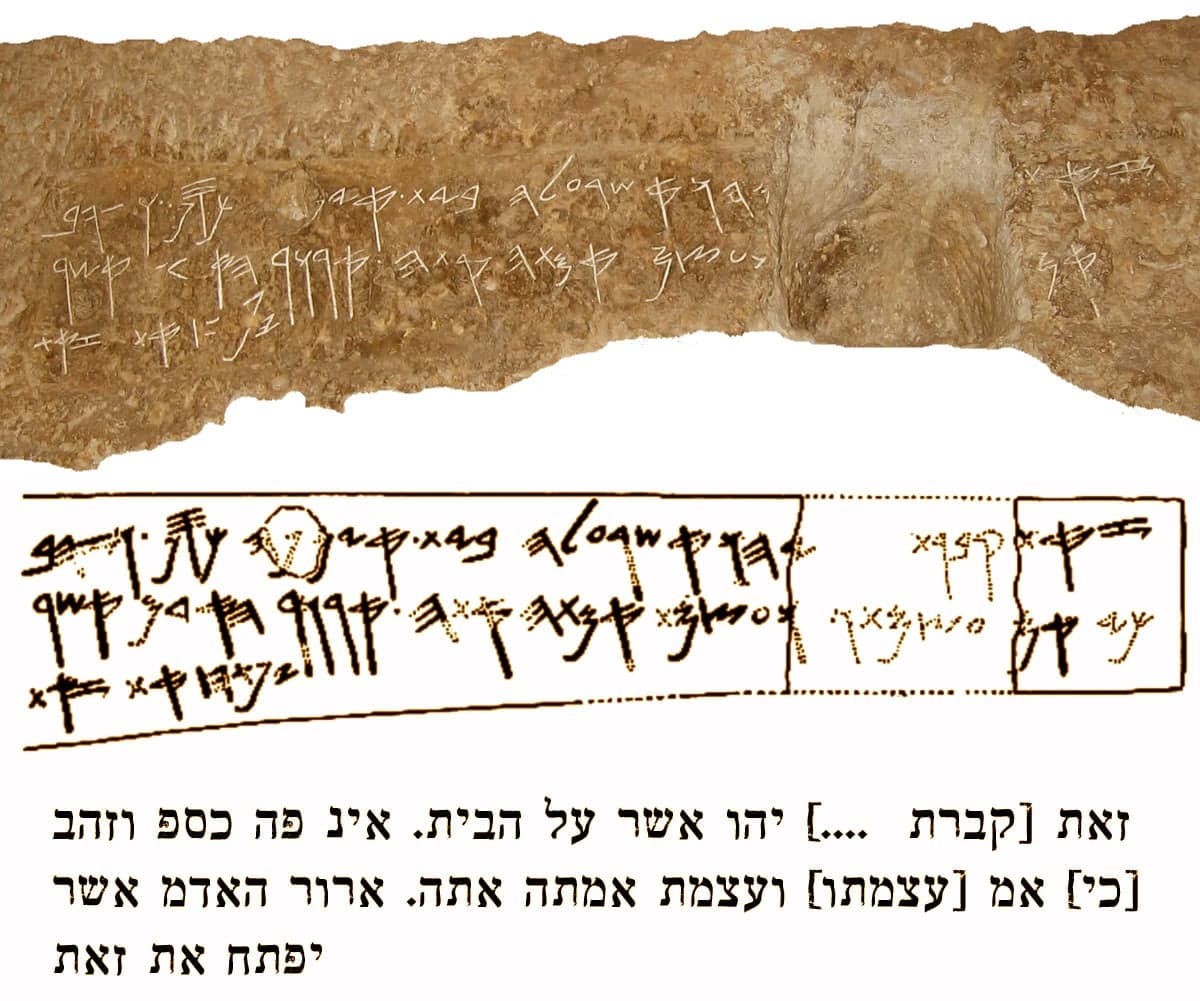
The inscription is carved in Proto-Hebrew, a script used in the kingdoms of Israel and Judah before the Babylonian exile. After the exile, Hebrew began to be written in the square Aramaic script still used today. This earlier script is visibly different: the letter forms are more pictographic, closer to Phoenician, and they appear in monumental contexts — on stone, not just ink on papyrus.
The story
In 1870, Charles Simon Clermont-Ganneau found a broken stone inscription in the village of Silwan, outside Jerusalem. The stone had been reused in later construction, removed from its original setting above a rock-cut tomb. After changing hands, it was acquired by the British Museum in 1871.
The inscription is a tomb warning, carved in Proto-Hebrew script. It identifies the deceased as a royal steward — someone who managed the household or estate of the king — and it warns against disturbing the burial. The text follows a formula common to tomb inscriptions in the region: it states who is buried, threatens anyone who opens the tomb, and curses grave robbers. The Tabnit sarcophagus from Sidon uses a similar structure, and the similarity has been noted by scholars.
The stone is broken at the line where the steward's name would have appeared. Without that name, the inscription cannot be directly linked to a known individual from historical records. Biblical scholars have proposed a connection to Shebna, a royal steward mentioned in the Bible, on the basis of a verse in which a prophet admonishes a steward for building a conspicuous tomb, carved high in the rock. The description matches the type of tomb the inscription would have marked, and the title matches the one in the text. The identification remains a conjecture, not a certainty, but it is the reason the inscription is often called the Shebna Inscription.
Clermont-Ganneau wrote decades later that this discovery, along with another inscription found in Silwan, predated the more famous Siloam inscription found in a tunnel. He noted that these earlier finds were what allowed scholars to see, for the first time, an authentic example of Hebrew monumental writing from the period of the Kings of Judah. The Siloam inscription, though better known, came later.
The inscription is catalogued as KAI 191 in a scholarly reference work that collects and numbers ancient inscriptions. That designation places it within a wider corpus of texts used to study the development of Hebrew and related scripts.
Why it mattered then
A rock-cut tomb was expensive. Carving an inscription above it was a further statement of status, and the choice to carve it in stone rather than paint it or leave it unmarked suggests permanence was intended. The text itself is functional: it warns that the tomb contains only the bones of the steward and his slave woman, and it curses anyone who opens it. That combination — identification, inventory, and curse — follows a template used elsewhere in the region, suggesting that tomb inscriptions were not invented individually but followed shared conventions. The title "royal steward" places the occupant within the administration of the Judahite monarchy. A steward managed property, collected revenue, or oversaw a household. The role carried authority, and the tomb's prominence — cut high into rock, visible, marked with an inscription — reflects that authority. If the biblical identification is correct, the prophet's criticism suggests that such tombs could be read as displays of wealth or ambition, conspicuous enough to attract moral scrutiny.
Why it matters now
The inscription is evidence for how Hebrew was written in the period before the Babylonian exile, when the script still resembled Phoenician and had not yet shifted to the square Aramaic letters used in later centuries. Physical examples of that script on stone are uncommon, and this one was found in a controlled archaeological context — or as controlled as mid-nineteenth-century excavation allowed — rather than appearing on the antiquities market with no recorded origin. The identification with Shebna, though unproven, has made the inscription a reference point in biblical archaeology. It is one of a small number of inscriptions that might — emphasis on might — correspond to a named individual in the Bible. That possibility has kept it in scholarly discussion, even though the break in the stone means the correspondence cannot be confirmed. The inscription is useful whether or not it names Shebna: it shows what a royal steward's tomb looked like, what language was used to protect it, and what script was standard in Jerusalem in the period of the Kings of Judah.
The surprising detail
Clermont-Ganneau, who found the inscription, noted decades later that it had been discovered before the Siloam inscription, even though the Siloam text became far better known. He observed that people did not generally recognise this fact. The Siloam inscription, found in a water tunnel, tells a dramatic story of engineering and was more complete. The Shebna inscription is broken, its key line missing, and its text is a formulaic warning rather than a narrative. The more complete, more narrative text overshadowed the earlier find, even though both are rare examples of Hebrew monumental writing from the same period.
What is disputed
The identification with Shebna rests on a single biblical verse mentioning a royal steward criticised for building a prominent tomb. The title matches, and the tomb type matches, but the stone is broken where the name would have been carved. The connection is plausible but not provable, and the inscription is significant regardless of whether it names Shebna or another steward.
How it got here
The inscription was found in Silwan in 1870 by Charles Simon Clermont-Ganneau and passed through various hands before being purchased by the British Museum in 1871. It was removed from its original setting above a rock-cut tomb and had been reused in later construction at the time of discovery. No repatriation claim is recorded in the material provided.
Remember this
A royal steward's tomb inscription, broken where his name would be, but possibly matched to a biblical verse that criticises him for building it.
Test yourself
The inscription is often called the Shebna Inscription, but the name Shebna does not appear on the stone. Why do scholars use that name?
Because a verse in the Bible describes a prophet admonishing a royal steward named Shebna for carving himself a conspicuous tomb high in the rock. The inscription comes from exactly that kind of tomb, and the title in the text matches the one in the verse. The identification is not certain — the stone is broken where the name would be — but the circumstantial match is close enough that the name Shebna has stuck. It is a conjecture, not a fact, and the inscription would be significant even without the biblical connection. But the possibility of linking an archaeological object to a named individual in the Bible has kept that name in use.
Go deeper
Image: תמר הירדני (Transferred by Matanya /Originally uploaded by תמרה ), Attribution. Licence: Attribution. Source.