I · THE OBJECT · BRITISH MUSEUM
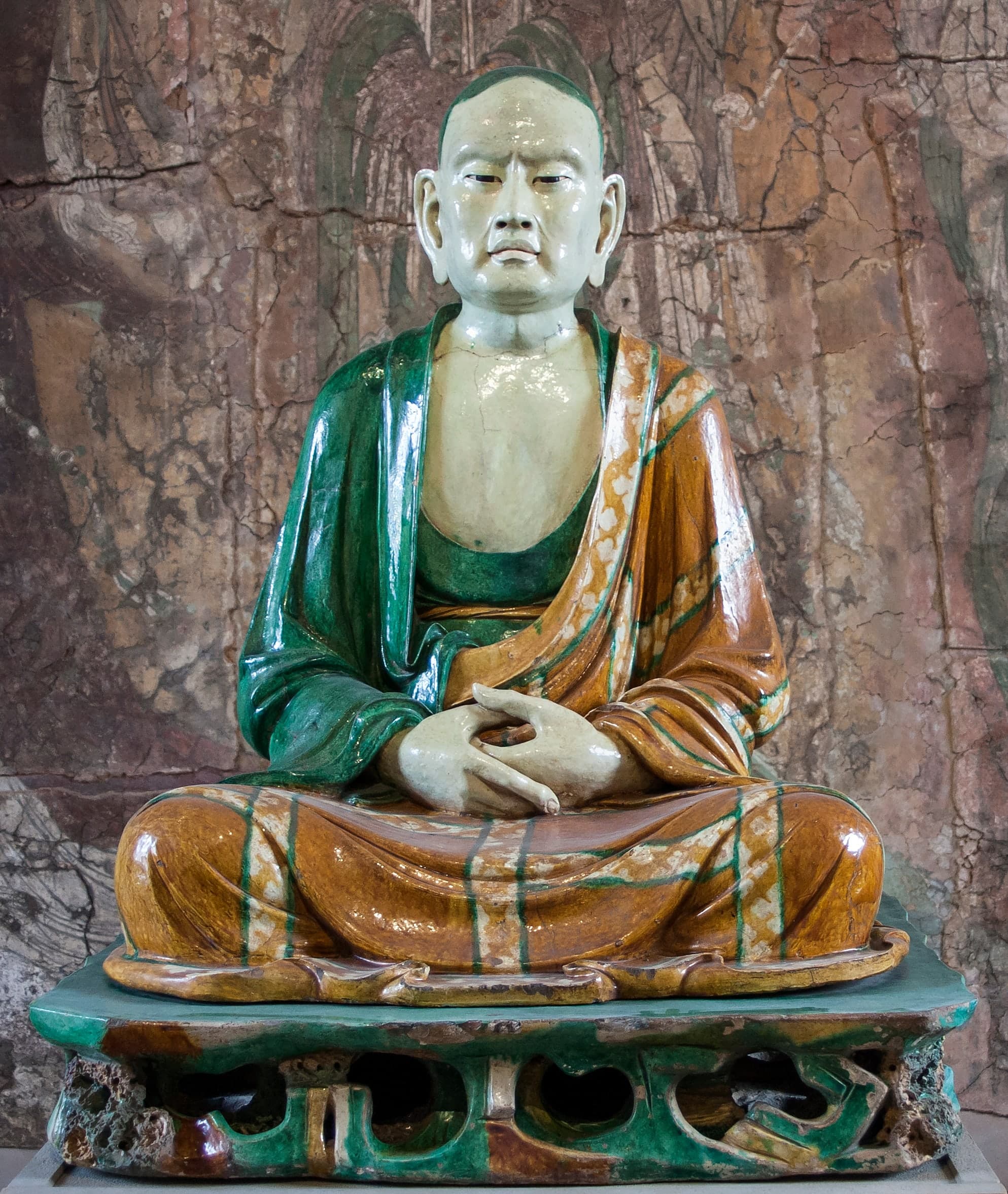
Seated Luohan from Yixian
▶ Listen · narrated
Someone modelled this from a person. The clay was fired, glazed, and set in a temple hall. Then the record goes quiet for eight hundred years.
At a glance
- Origin
- Liao dynasty
- Material
- Glazed pottery
- Scale
- Life-size
- Inventory number
- 1913,1221.1
Look closer
Sculpted individuality
The face is not a type. The features are specific: the set of the mouth, the shape of the eyelids, the modelling of the cheekbones. Scholars have noted that each figure in the set has this kind of individuality, as though modelled from life. Some have suggested they may be portraits of contemporary monks, though the evidence for that is thin. What is clear is that the sculptor worked to capture the sense of a particular person, not a generalised holy figure.
The openwork base
The figure sits on a base carved to resemble rock, with openings piercing through it. This is not decorative accident. In paintings, luohans are often shown perched on small mountain peaks, a reference to the remote retreats where ascetic monks withdrew from the world. The rocky base brings that iconography into three dimensions, suggesting the mountain without depicting it literally.
Elongated earlobes
The earlobes are stretched and pendulous, longer than any living ear. This is one of the few traditional marks of Buddhist iconography the sculptor retained. Long earlobes signify the heavy jewellery the Buddha wore as a prince before his renunciation, and they became a standard sign of enlightened beings in Buddhist art. Here they sit alongside otherwise naturalistic features, a small anchor to tradition in an otherwise individuated face.
The story
Luohan is the Chinese term for an arhat, one of the historical disciples of the Buddha. As Buddhist tradition developed, especially in East Asia, the number of arhats expanded and their status rose. Groups of sixteen, eighteen, or five hundred luohans were said to await the arrival of Maitreya, the Future Buddha, and these groups became common subjects in Buddhist art. Each luohan in the smaller groupings was given a name and a personality.
This figure is one of a set discovered in caves at Yi County, south of Beijing, apparently in the early twentieth century. At least eight statues were originally found, and ten are now accounted for in collections around the world. One large fragment was thought to have been destroyed in Berlin during World War II but was rediscovered in the State Hermitage Museum in St Petersburg in 2001. Others are held in London, New York, Toronto, Boston, Philadelphia, Kansas City, Paris, and Japan. There may be fragments from the same set in other collections.
The full set is thought by most scholars to have numbered sixteen or eighteen figures, matching the typical Chinese groupings, though this is described by some as speculative. The circumstances of the find and the route by which the figures reached the art market have been the subject of scholarly investigation, but the details have not been entirely clarified. The alleged findspot in the caves does not seem to have been the original location. The set was probably made to stand on platforms along the walls of a luohan hall in a temple, though which temple is unknown.
The figures are life-size and made of glazed pottery. The glaze and the modelling are both exceptional. Each figure has been described as having a sculpted-from-life individuality. The faces are naturalistic, with only the elongated earlobes following traditional Buddhist iconography. Some figures have green hair, a departure from naturalism whose meaning is not recorded. The openwork bases, carved to resemble rock, were intended to suggest mountains, echoing the way paintings often show luohans perched on small peaks in mountain retreats.
The British Museum acquired this example in 1913, the year reflected in its inventory number. How it reached London, and through whose hands, is part of the larger pattern of dispersal that followed the discovery. The set has been described as an important group of ceramic sculpture, and the individuality of the figures has led to the suggestion that they may also be portraits of notable monks from the period, though the evidence for that remains thin.
Why it mattered then
A life-size glazed figure of a Buddhist disciple, set in a temple hall, was a devotional object and a teaching tool. Visitors to the temple would have walked past these figures, arranged along the walls, and the individuality of each face would have reinforced the idea that these were not abstract symbols but beings who had lived, practised, and attained enlightenment. The naturalism — the sense of a particular person — made the spiritual achievement feel accessible, not remote. The choice to depict luohans rather than Buddhas or bodhisattvas is itself meaningful. Luohans occupied a middle ground in the Buddhist hierarchy: enlightened, but not fully transcendent, and still engaged with the world in some traditions. They were figures a monk or a layperson could aspire to emulate. The decision to give each one a distinct face and personality, rather than a standardised iconographic type, suggests a temple community interested in the human dimension of spiritual discipline. The technical achievement mattered too. Glazed pottery figures of this scale and quality required resources, skill, and institutional support. A temple that commissioned such a set was demonstrating both its wealth and its commitment to the arts as a form of devotion. The figures would have been visible evidence of the temple's standing.
Why it matters now
The set survives as evidence of a sculptural tradition that combined technical mastery with a commitment to naturalism unusual in religious art of the period. The individuality of the faces, the quality of the glazing, and the scale of the figures make them a reference point for understanding what was possible in ceramic sculpture during the Liao dynasty. The dispersal of the set is also instructive. The figures were found, apparently in the early twentieth century, and then sold. They are now in ten known collections across four continents, with the possibility of fragments in others. This pattern of discovery, sale, and scattering is not unique to this set, but the scale and quality of the objects make the case visible. The circumstances of the find have been investigated but not entirely clarified, and the original location of the temple is unknown. The set is now studied in pieces, with scholars working across institutions to reconstruct what was once a unified group. The rediscovery of the fragment in St Petersburg in 2001, long thought destroyed, is a reminder that dispersed collections are not static. Objects reappear, attributions shift, and what is known about a set can change. The Yixian luohans are studied not only for what they are, but for what their dispersal reveals about how objects move, how records are kept or lost, and how collections are built.
The surprising detail
One of the figures, a large fragment, was thought to have been destroyed in Berlin during World War II. It was assumed lost for more than half a century. Then, in 2001, it was rediscovered in the State Hermitage Museum in St Petersburg. How it got there, and why it was not recognised earlier, is part of the still-unclear history of the set's dispersal. The rediscovery meant that ten figures are now accounted for, rather than nine.
What is disputed
The circumstances of the find are not fully clear. The figures are said to have been discovered in caves at Yi County in the early twentieth century, but the details of the discovery and the route by which they reached the art market have been investigated without being entirely clarified. The alleged findspot does not seem to have been the original location, and the temple for which the set was made is unknown. Most scholars think the full set numbered sixteen or eighteen figures, matching typical Chinese groupings, but this has been described as speculative.
How it got here
The British Museum acquired this figure in 1913. It is one of at least ten figures from the same set now held in collections in London, New York, Toronto, Boston, Philadelphia, Kansas City, Paris, St Petersburg, and Japan. The set was apparently discovered in caves at Yi County, south of Beijing, in the early twentieth century, then sold and dispersed. The circumstances of the discovery and the subsequent movement of the figures to the international art market have been the subject of scholarly investigation, but the full sequence of ownership and sale has not been entirely clarified.
Remember this
Life-size, glazed, and modelled with the specificity of portraits — a set made to suggest that enlightenment was not abstract, but particular.
Test yourself
Why might a temple commission life-size figures with individualised faces, rather than smaller, standardised devotional images?
Scale and individuality both work to close the distance between the viewer and the subject. A life-size figure occupies the same physical space as a person, and a face modelled with specificity — rather than as a generalised type — suggests a being who lived and practised in a particular body. For a temple visitor, this combination would make the luohans feel less like remote symbols and more like exemplars: people who had achieved enlightenment through discipline, and whose example could be followed. The choice to individualise the figures suggests a teaching strategy that valued the human dimension of spiritual attainment, not just its abstract possibility.
Go deeper
Image: This image was produced by me, David Castor ( user:dcastor ). The pictures I submit to the Wikipedia Project are released to the public domain. This gives you the right to use them in any way you like, without any kind of notification. This said, I would still appreciate to be mentioned as the originator whenever you think it complies well with your use of the picture. A message to me about how it has been used would also be welcome. You are obviously not required to respond to these wishes of mine, just in a friendly manner encouraged to. (All my photos are placed in Category:Images by David Castor or a subcategory thereof.), CC0. Licence: CC0. Source.