The Girl Who Measured the Stars

A Discovery Tale about Light, Patterns, and Curiosity in the Night Sky

⭐ Astronomy πŸ“… Early 1900s πŸ‘©β€πŸ”¬ Henrietta Leavitt

A Room Full of Stars

Henrietta Leavitt

Henrietta Leavitt, astronomer and "computer" at Harvard Observatory

In the early 1900s, a young woman named Henrietta Leavitt worked at the Harvard College ObservatoryA special place with telescopes used to study the stars and planets. Every day, she sat at a wooden desk surrounded by thousands of glass photographic platesPieces of glass used in early astronomy to record images of the night sky β€” snapshots of the night sky captured by giant telescopesTools that make faraway objects, like stars, look closer.

Each glass plate was covered with tiny white dots. But to Henrietta, those dots weren't just marks of light β€” they were stars, each with a story.

She used a magnifying glass and ruler to measure their brightness. Her job title was "computer." Back then, computers weren't machines β€” they were people who did careful mathematical work by hand.
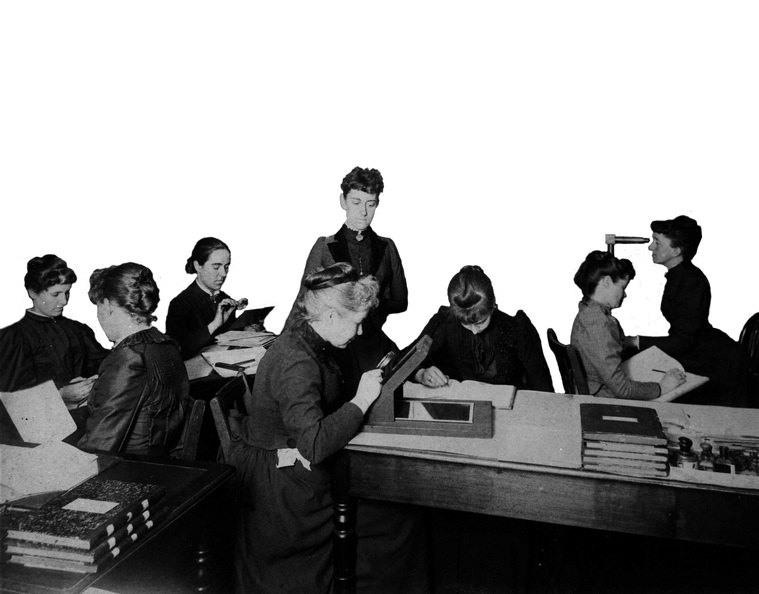
Harvard Observatory computers examining photographic plates

Women "computers" at Harvard Observatory examining photographic plates of stars

"Every dot is a sun," Henrietta whispered, "and every sun might have worlds of its own."

The Flickering Mystery

The Large Magellanic Cloud galaxy

The Large Magellanic Cloud - a nearby galaxy where Henrietta discovered variable stars

One night, while studying a cluster of stars in the Magellanic Clouds (small galaxiesHuge groups of stars, gas, and dust held together by gravity near our own), Henrietta noticed something strange. Some stars seemed to blink β€” bright, then dim, then bright again.

She marked them carefully and measured how long it took for each star to change. One star flickered every two days, another every ten.

She began to wonder β€” what did the blinking mean?

To her, these stars were like clocks in the sky, beating with a steady rhythm. No one had ever understood their patternSomething that repeats in the same way each time before.

The Discovery

After months of measuring, Henrietta noticed a connection: The brighter the star, the longer its blinking cycle.

It wasn't random β€” it was a pattern.

✨ Henrietta's Realization:

"The universe keeps time with light."

She wrote her findings in a short paper titled "Periods of 25 Variable StarsStars that get brighter and dimmer in a repeating pattern." Few noticed at first. But years later, astronomers realized her discovery was a key to something huge: the size of the universe.

By comparing the magnitudeThe measure of how bright a star appears of those "variable stars," scientists could measure how far away galaxies were β€” something that had seemed impossible before.

The Universe Expands

Years later, another scientist named Edwin Hubble used Henrietta's dataInformation that scientists collect and study to show that galaxies are moving away from us β€” meaning the universe is expandingGrowing larger or stretching outward. He gave her full credit, calling her work "the foundation of all cosmic measurements."

Though Henrietta never became famous in her lifetime, her careful measurements changed astronomy forever.

πŸ”­ A Scientist's Tribute:

"She measured the sky," one astronomer said, "and found the scale of the universe."

A Legacy Written in Light

Henrietta passed away in 1921, never knowing that her discovery would help map billions of galaxies.

Today, telescopes in space still use her Leavitt Law to measure the distance to stars. Every time you look up at the night sky, you see her legacySomething important left behind that continues to influence others shining back.

πŸ’« Henrietta's Words:

"Even the smallest observation can open the largest window."

And somewhere, in the silent flicker of distant stars, her pattern still beats β€” bright, dim, bright again β€” a rhythm written across the cosmos.

πŸ€” Discussion Questions

1. How did Henrietta discover her pattern among the stars?

Think about the careful measurements she made and what she noticed.

2. Why was her work important to later scientists?

Consider how Edwin Hubble used her discoveries.

3. What do you think it means that the universe is still expanding?

Imagine galaxies moving farther apart over time.

4. How can patience and curiosity help people make new discoveries?

Think about how Henrietta spent months carefully measuring stars.

πŸ”­ Try This Science Activity!

Star Blink Simulation

Create your own "variable stars" and discover patterns just like Henrietta Leavitt did! This activity helps you understand how scientists use light patterns to learn about stars.

πŸ“‹ What You'll Need:
  • A small flashlight or phone flashlight
  • A stopwatch or timer (phone works great)
  • A dark room or closet
  • Paper and pencil to record your observations
  • A friend or family member to help (optional)
⭐ Steps to Follow:
  1. Create Different Star Patterns: In a dark room, turn your flashlight on and off at different speeds. Try these patterns:
    • β€’ Fast blink: 1 second on, 1 second off
    • β€’ Medium blink: 2 seconds on, 2 seconds off
    • β€’ Slow blink: 5 seconds on, 5 seconds off
  2. Observe and Record: Have someone else create patterns while you observe. Can you figure out the pattern just by watching?
  3. Measure the Period: Time how long it takes for one complete cycle (on, then off, then back to on). This is called the "period" of the variable star.
  4. Change the Brightness: Try using different brightness settings on your light. Does a brighter "star" look different from a dimmer one with the same pattern?
  5. Create Your Own Data: Make a chart showing different star patterns and their periods, just like Henrietta did!
πŸ’‘ Questions to Explore:
  • β€’ If you saw this light far away in space, what could it tell you?
  • β€’ How would you know if two "stars" were blinking with the same pattern?
  • β€’ Why might it be important to measure these patterns very carefully?
  • β€’ How is your flashlight pattern like a real variable star? How is it different?

Real Science Connection: Real variable stars change brightness because they physically expand and contract, like a beating heart. Some pulse every few days, others every few weeks. By measuring these periods very carefully, just like you did with your flashlight, Henrietta discovered that brighter stars have longer periods. This pattern - called the Leavitt Law - became one of the most important tools in astronomy!

Look Up Tonight: On a clear night, go outside and look at the stars. Most stars appear to shine steadily, but some really do vary in brightness! With patience and careful observation - just like Henrietta - you might notice patterns in the night sky too.

πŸ“š Science Vocabulary

Hover over highlighted words in the story to see definitions

Observatory

A special place with telescopes used to study the stars and planets

Variable Star

A star that gets brighter and dimmer in a repeating pattern

Magnitude

The measure of how bright a star appears

Pattern

Something that repeats in the same way each time

Galaxy

A huge group of stars, gas, and dust held together by gravity

Telescope

A tool that makes faraway objects, like stars, look closer

Photographic Plate

A piece of glass used in early astronomy to record images of the night sky

Data

Information that scientists collect and study

Expand

To grow larger or stretch outward

Legacy

Something important left behind that continues to influence others