The Sound of the Deep
A Discovery Tale about Ocean Exploration, Sound Waves, and the Secrets Beneath the Sea
Follow marine scientist Lani Okimoto as she listens to the hidden symphony of the ocean and discovers how sound reveals mysteries of the deep.
The Ocean That Hides
The ocean covers more than two-thirds of Earth, yet humans have explored less than five percent of what lies below. There are places in the deep sea that no human eye has ever seen — valleys deeper than Mount Everest is tall, mountains taller than any on land, and creatures stranger than science fiction.
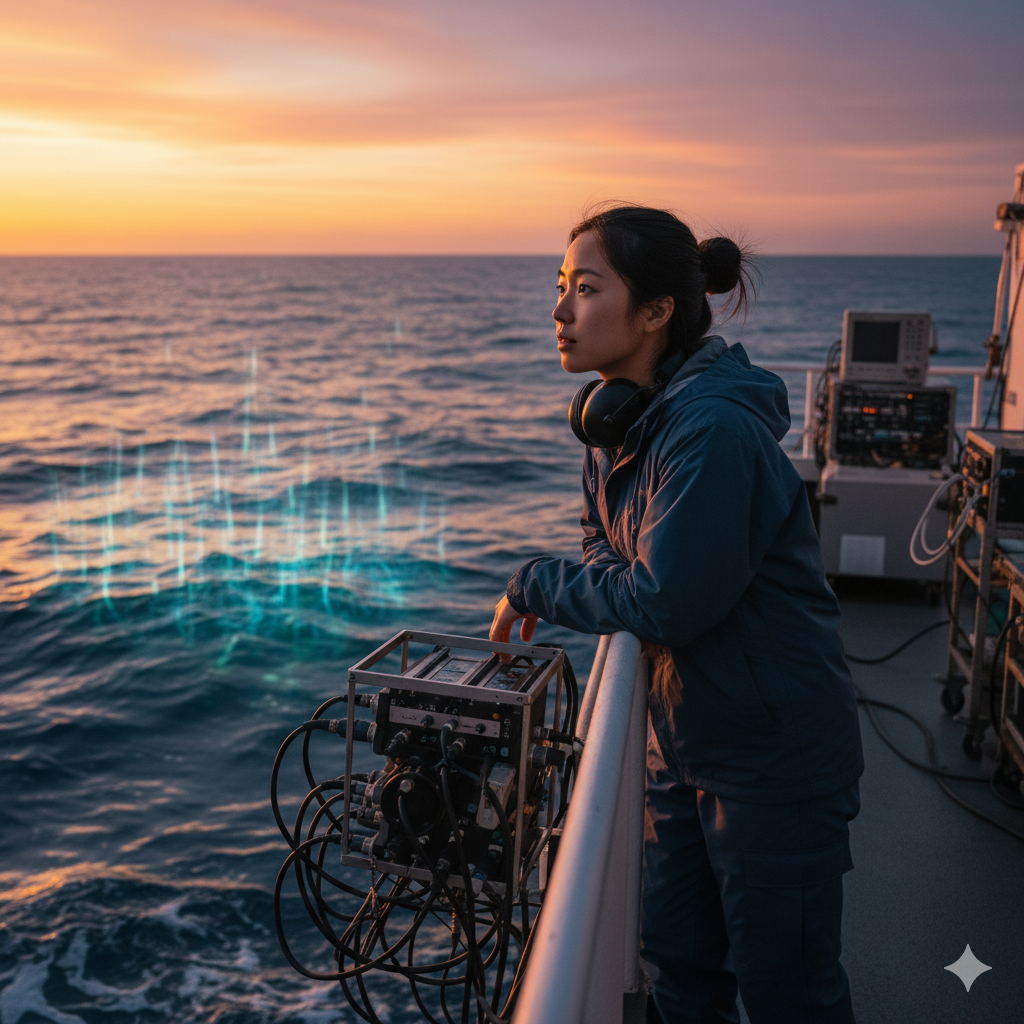
Lani Okimoto preparing to listen to the ocean's secrets
In a research ship drifting over the Pacific, a young scientist named Lani Okimoto leaned over the railing and gazed at the endless blue. The sea looked calm on the surface, gentle waves lapping against the hull. But she knew it was never truly silent.
Somewhere below, whales were singing love songs that could travel thousands of miles. Ships were rumbling as they crossed shipping lanes. Shrimp were snapping their claws like underwater fireworks. And the Earth itself was whispering as tectonic plates shifted slowly beneath the ocean floor.
Lani worked for an ocean research laboratory studying sound wavesA vibration that moves through air or water and can be heard — vibrationsA quick back-and-forth motion that creates sound that travel through water much faster than they do through air. In fact, sound moves about four times faster in water than in air!
🌊 Why Sound Matters Underwater:
In the deep ocean, there's almost no light. Sunlight can only penetrate about 200 meters down. Below that depth, it's pitch black — darker than the darkest night you've ever experienced.
But sound? Sound can travel for hundreds or even thousands of miles through the water. That's why ocean animals — and ocean scientists — rely on sound to navigate, communicate, and explore their world.
"If you want to know the ocean," Lani liked to tell her students, "you have to listen to it. The ocean speaks in a language of sound."
The First Recording
Lani carefully lowered a device called a hydrophoneA microphone that records sounds underwater — an underwater microphone — into the deep blue on a long cable. As it sank deeper and deeper, the noises changed.
Near the surface, she heard the crackling of snapping shrimp — they create tiny bubbles with their claws that collapse with loud pops. She heard the playful clicks and whistles of dolphins communicating with each other as they swam by the ship.
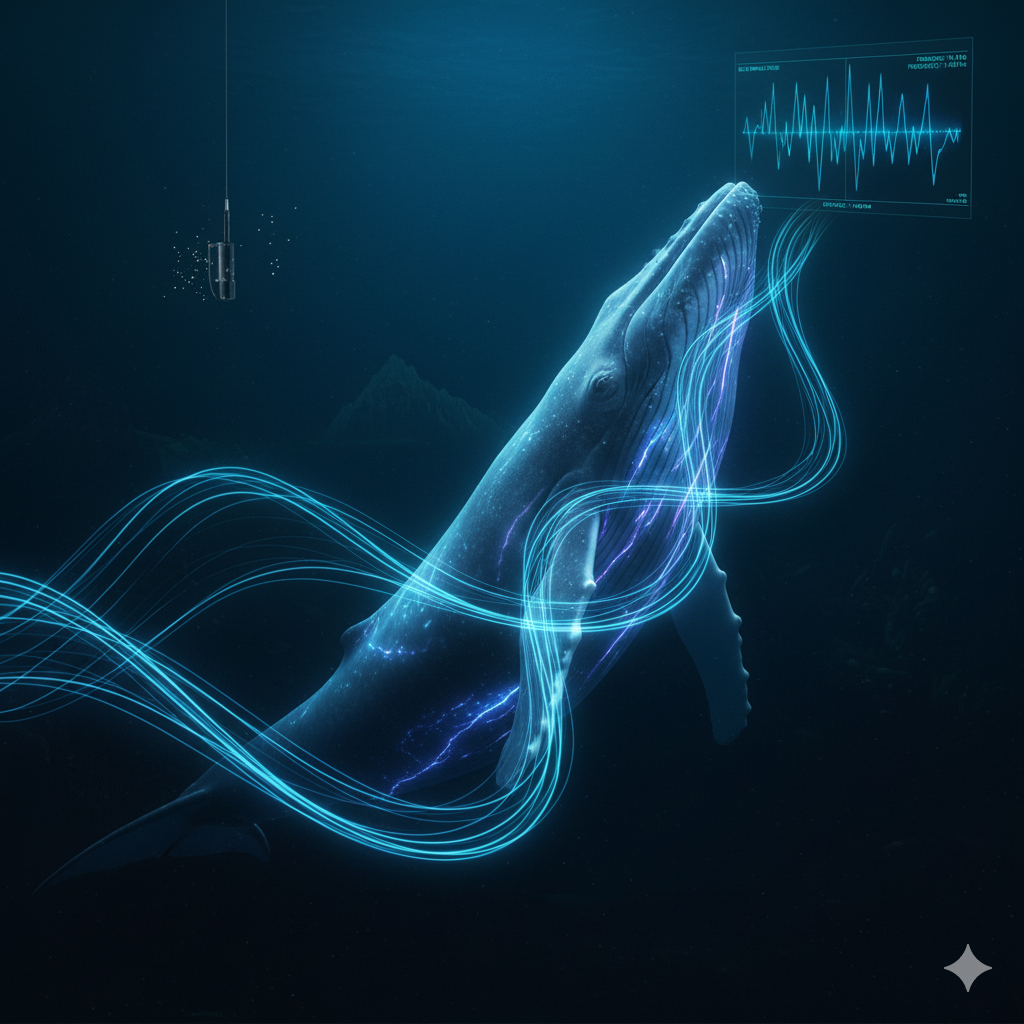
A blue whale's song traveling through the ocean
Deeper down, the sounds became more mysterious. A low hum rumbled like the heartbeat of the ocean itself — the distant sound of waves breaking on a shore hundreds of miles away.
Her computer displayed the sounds as wavy lines called sonogramsA picture made from sound waves showing what the sound looks like. Each sound had its own unique pattern — sharp spikes for clicks, smooth curves for whale songs, jagged lines for ship engines.
Suddenly, a long, mournful note appeared on her screen — a sound so deep and powerful it seemed to shake the very water around the hydrophone. The frequencyHow fast a sound wave vibrates; high frequency makes a high pitch, low makes a deep sound was incredibly low — far lower than humans can usually hear without special equipment.
"That's a blue whale," she whispered, her eyes lighting up. "The largest animal that has ever lived on Earth — talking to another whale miles away."
She smiled, listening to the haunting melody. Even though the whale was swimming thousands of meters below the surface, in complete darkness, its voice reached her like an echo through time. Blue whales can hear each other across entire ocean basins — sometimes over 1,000 miles apart!
🐋 The Language of Whales:
Different whale species have different "songs." Humpback whales sing complex patterns that can last for hours and change each year, like humans creating new music. Blue whales produce the loudest sound made by any animal on Earth — up to 188 decibels! That's louder than a jet engine.
Scientists believe whales use these songs to find mates, stay in touch with their pods, navigate across oceans, and maybe even to share information about food sources. We're still learning their language!
The Mystery Boom
One day, Lani's team picked up a strange sound that made everyone in the lab stop what they were doing. It was a boom that didn't match any ship engine, submarine motor, or whale call they had on record.
The sound echoed across the ocean floor, bouncing off seamountsAn underwater mountain formed by volcanic activity — underwater mountains that rise from the seafloor but don't reach the surface. Each time it echoed, the sound changed slightly, telling scientists about the shape and distance of these hidden mountains.
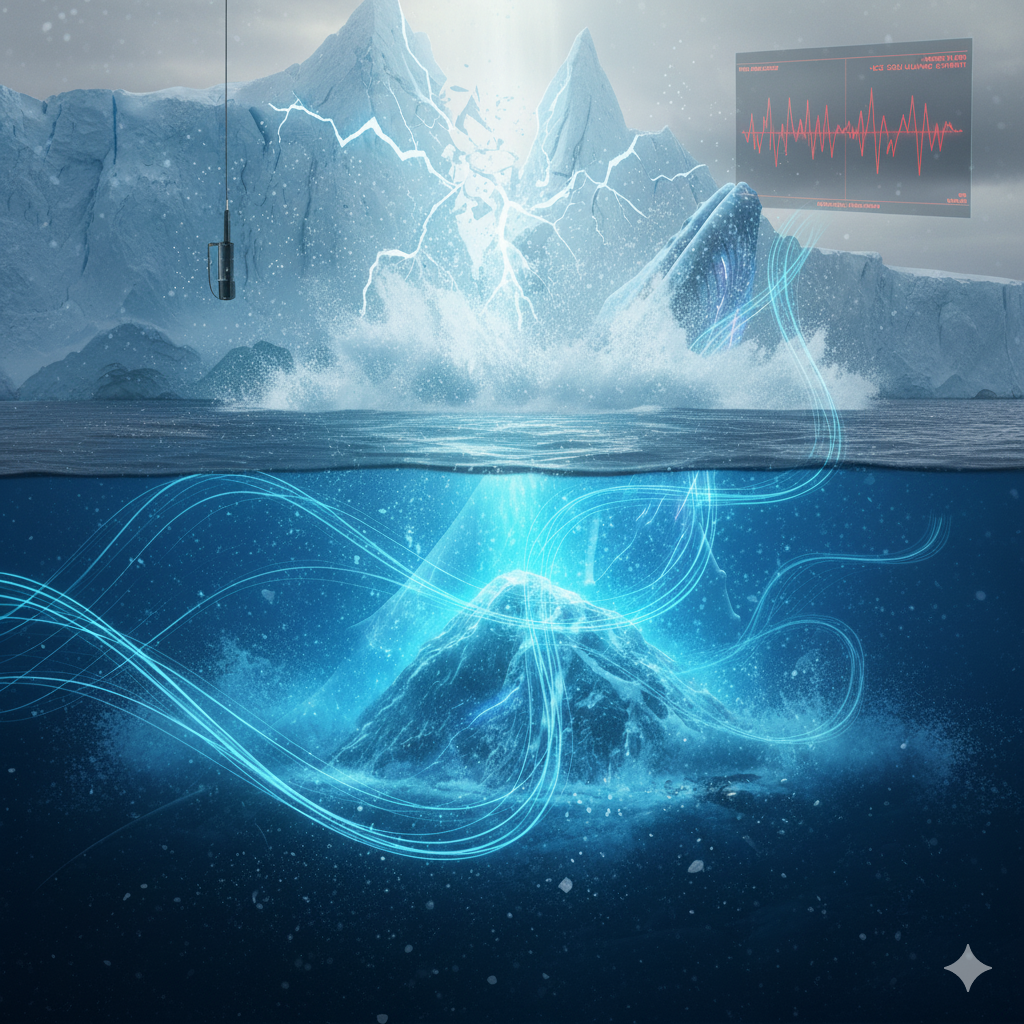
The source of the mystery boom — icebergs calving in Antarctica
The crew grew quiet as they replayed it over and over, each person trying to identify the source.
"Could it be an earthquake?" someone asked. Underwater earthquakes happen when tectonic plates shift, and they can create powerful sound waves that travel around the world.
Lani checked the seismic data from earthquake monitoring stations. No — the frequency was too low and too regular. Earthquakes make sharp, sudden sounds. This was different — it pulsed slowly, almost rhythmically, like something breathing.
For days they listened, comparing their recording to a vast library of ocean sounds collected over decades. They ruled out volcanic activity, nuclear submarine sonar, underwater construction, and even secret military testing.
Finally, a match appeared in the archives. The sound was similar to one recorded by scientists decades earlier — they had called it the BloopA real mysterious underwater sound scientists later found came from icebergs breaking.
When the Bloop was first recorded in 1997, it was so loud that hydrophones over 5,000 kilometers apart all picked it up. Some people thought it might be a giant sea creature, unknown to science. But years of research revealed the truth.
It wasn't a monster at all — it was the sound of massive icebergs breaking apart in Antarctica, a process called "calving." As global temperatures rise, these events are becoming more common.
🧊 Why Iceberg Sounds Matter:
"Even ice has a voice," Lani said as she explained their finding to the team. "And that voice is telling us something important about our changing climate. By listening to how often icebergs break apart, we can track how fast ice sheets are melting. The ocean is full of stories — if you know how to hear them."
Seeing with Sound
Lani didn't just listen to natural ocean sounds. She also studied sonarA system that uses sound waves to map or find things underwater, a technology that sends sound waves through water and measures how long they take to bounce back.
It works like this: her ship sends out a pulse of sound — a "ping" — that travels down through the water. When the sound wave hits something — the ocean floor, a school of fish, a shipwreck — it bounces back like an echo. By measuring how long the echo takes to return, the computer can calculate exactly how far away the object is.
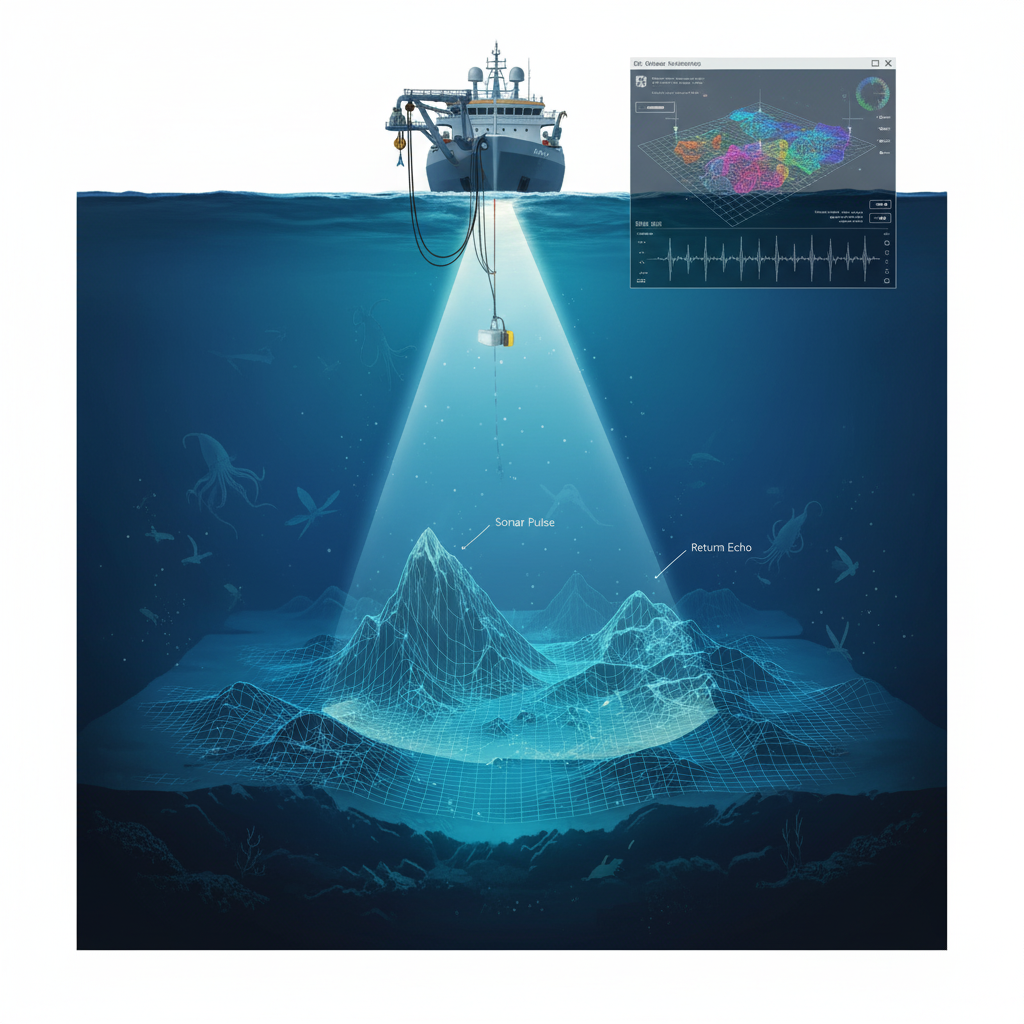
Painting the ocean floor with sound — sonar reveals hidden landscapes
This helped her map the shape of the ocean floor — towering underwater cliffs, vast valleys called trenchesA very deep part of the ocean floor, and volcanoes hidden in the dark. The deepest trench, the Mariana Trench, plunges nearly 11,000 meters down — deep enough to swallow Mount Everest with room to spare!
On her screen, the ocean bottom appeared in glowing colors. Blues represented deep trenches where the seafloor drops away. Greens showed the mid-depths. Yellows marked rising slopes. And reds highlighted tall underwater ridges and seamounts.
"It's like painting with sound," she told her students when they visited the lab. "We're creating art and science at the same time."
Sonar had helped scientists discover entire ecosystems no one knew existed — hydrothermal vents where superhot water erupts from the ocean floor and strange creatures thrive without sunlight. It revealed ancient shipwrecks from hundreds of years ago, perfectly preserved in the cold darkness. It found coral reefs growing on seamounts, and even underwater lakes where dense saltwater pools at the bottom of the sea, separate from the water above!
🗺️ Mapping the Unknown:
- • We have better maps of Mars than we do of our own ocean floor
- • Only about 20% of the ocean floor has been mapped in detail
- • Sonar can work in complete darkness where cameras can't
- • The ocean floor has mountains, canyons, and volcanoes just like land
- • New species are discovered on the ocean floor almost every week
Each discovery reminded Lani why her work mattered. "We can't protect what we don't understand," she said. "And we can't understand what we can't see — or hear."
The Message from the Deep
One night, while everyone else on the ship had gone to sleep, Lani stayed up on deck. She needed time to think, to process everything they'd heard that day.
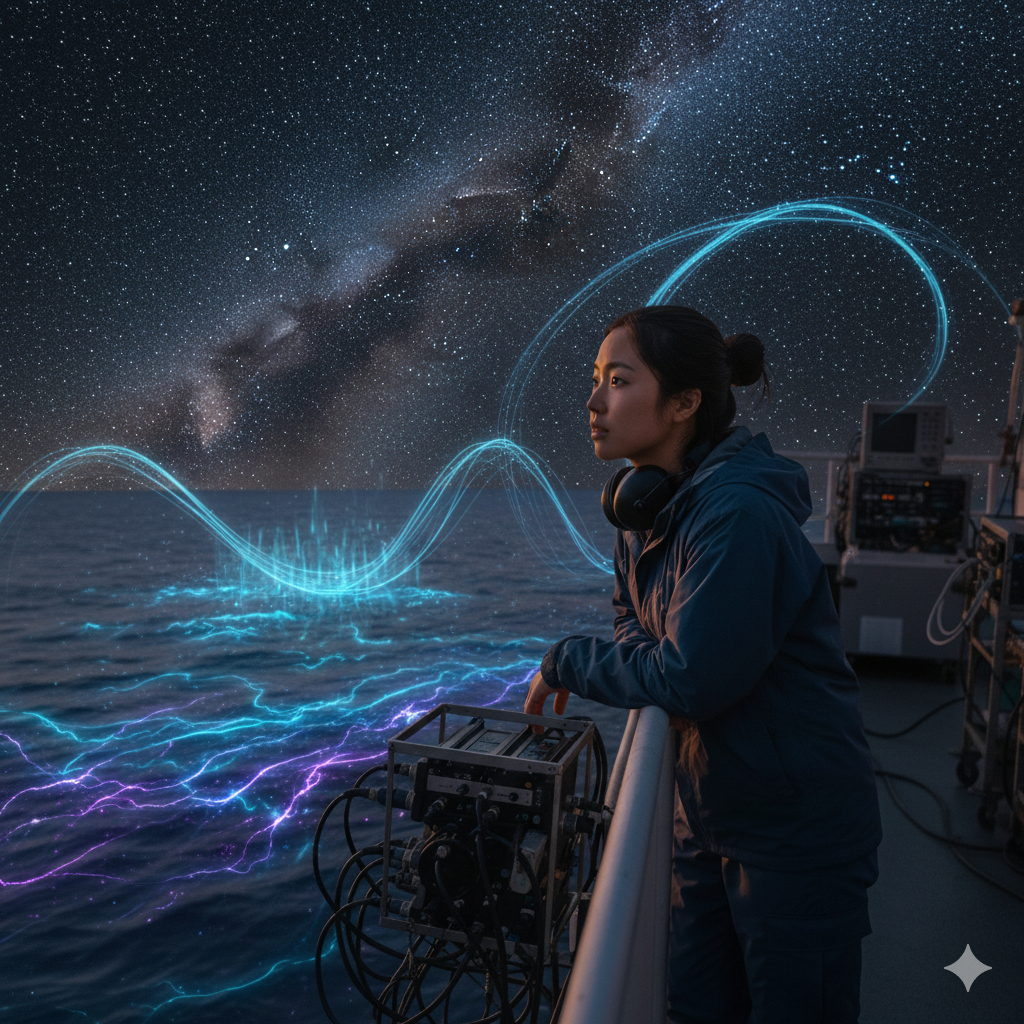
Lani listening to the ocean's symphony under a starlit sky
The stars shone brilliantly above — thousands of them visible far from any city lights. The Milky Way stretched across the sky like a river of light. Below, the sea murmured and whispered, its surface reflecting the stars like a dark mirror.
She put on her headphones and played back the day's recordings at slow speed so she could hear every detail. The sounds washed over her like a symphonyMany different sounds working together, like music:
Whale songs — deep and mournful, calling for their young or searching for mates across vast distances.
Snapping shrimp — creating a crackling chorus like underwater rain.
Fish grunting and croaking as they communicated with their schools — yes, many fish actually make sounds!
Crabs clicking their claws in territorial disputes.
Waves breaking against distant coral reefs, each reef creating its own unique rhythm.
Rumbling earthquakes from deep within the Earth, reminding her that the ocean floor is alive with geological activity.
Even the sound of rain hitting the surface, each drop creating its own tiny splash that could be detected far below.
Each sound told her something about life beneath the waves. Each one was a piece of a story — about migration patterns, about ecosystems, about the health of the ocean, about the planet itself.
🎵 The Ocean's Symphony:
"The ocean is a symphony," she said softly to herself, watching the stars ripple on the gentle waves. "And we've only heard the first note. There are sounds we haven't recorded yet, species we haven't discovered, secrets we haven't uncovered. Every time we listen, we learn something new about our planet."
When Lani returned to shore after that expedition, she couldn't stop thinking about what she'd learned. She began a program to teach kids how to build their own simple hydrophones and listen to local oceans, lakes, and rivers.
She visited schools with her recordings, letting students hear the sounds of the deep. Their eyes would light up when they heard whale songs for the first time. They would laugh at the crackling of shrimp. They would lean forward, fascinated, when she played the mysterious booms and rumbles.
"The next great discovery might come from someone still in school," she told them. "It might come from you. All you have to do is listen."
🌍 Why Ocean Sound Research Matters:
- • Helps us track climate change by monitoring ice melting and ocean temperatures
- • Protects marine life from harmful human noise pollution
- • Reveals new species and ecosystems we never knew existed
- • Maps the ocean floor to help ships navigate safely
- • Monitors earthquakes and tsunamis to warn coastal communities
- • Teaches us how animals communicate and adapt to their environment
Years later, one of Lani's students would go on to discover a new whale communication pattern. Another would map an underwater volcano using sonar. A third would build better hydrophones that caused less disturbance to marine life.
And Lani? She still sails out on research ships, still drops her hydrophones into the deep, still listens to the ocean's endless song. Because there are still mysteries to solve, questions to answer, and an entire world beneath the waves waiting to share its secrets.
All you have to do is listen.
🧠 Science Vocabulary
Hydrophone
A microphone that records sounds underwater.
Sonar
A system that uses sound waves to map or find things underwater.
Sound Wave
A vibration that moves through air or water and can be heard.
Frequency
How fast a sound wave vibrates; high frequency makes a high pitch, low makes a deep sound.
Sonogram
A picture made from sound waves showing what the sound looks like.
Seamount
An underwater mountain formed by volcanic activity.
Bloop
A real mysterious underwater sound scientists later found came from icebergs breaking.
Trench
A very deep part of the ocean floor.
Vibration
A quick back-and-forth motion that creates sound.
Symphony
Many different sounds working together, like music.
🔬 Try It Yourself: Water Sound Test
Explore How Water Changes Sound
Discover how the amount of water affects the sounds objects make!
Materials Needed:
- 3-4 identical glasses or bottles
- Water
- Metal spoon
- Measuring cup (optional)
- Notebook to record observations
Instructions:
- Fill the first glass almost full with water
- Fill the second glass halfway
- Fill the third glass with just a small amount of water
- Leave the fourth glass empty
- Gently tap the side of each glass with the spoon
- Listen carefully to the pitch (how high or low) each sound is
- Record what you hear
🤔 Think About It:
- • Which glass made the highest sound?
- • Which made the lowest sound?
- • Why do you think more water makes a deeper sound? (Hint: more water means slower vibrations!)
- • Can you arrange the glasses to play a simple tune?
- • How is this similar to how sound travels through the ocean at different depths?
Extension Activity: Make a Simple Hydrophone
Create a basic underwater listening device:
- Fill a large bowl or bathtub with water
- Place a balloon over one end of a cardboard tube (like from paper towels)
- Hold the balloon end underwater
- Have someone tap objects in the water or tap the container's sides
- Listen through the open end of the tube — sound travels through water into the balloon, which vibrates!
- Try it in a pool or calm pond (with adult supervision) for even better results
💬 Discussion Questions
1. Why do scientists use sound instead of light to study the ocean?
Think about: How far does light travel underwater? How far does sound travel? What happens in the deep ocean where there's no sunlight?
2. What kinds of sounds can be heard under the sea?
Consider: What animals make sounds? What natural events create sounds? How do human activities affect ocean sounds?
3. How does sonar help us discover new places?
Reflect: How does sonar work? What has sonar helped us find? Why is mapping the ocean floor important?
4. What can we learn about Earth by listening carefully?
Explore: How do ocean sounds tell us about climate change? What can whale songs teach us? Why does protecting the ocean's "soundscape" matter?