The Secret Life of Trees
A Discovery Tale about Forests, Connection, and the Hidden Language of Nature
Discover the amazing underground network that lets trees communicate, share resources, and care for one another like a family.
The Whispering Forest
In a quiet valley in the Pacific Northwest, a young girl named Nia loved to walk through the forest behind her house. Towering cedars, firs, and maples stretched high into the sky. When the wind blew, their leaves rustled like soft voices.
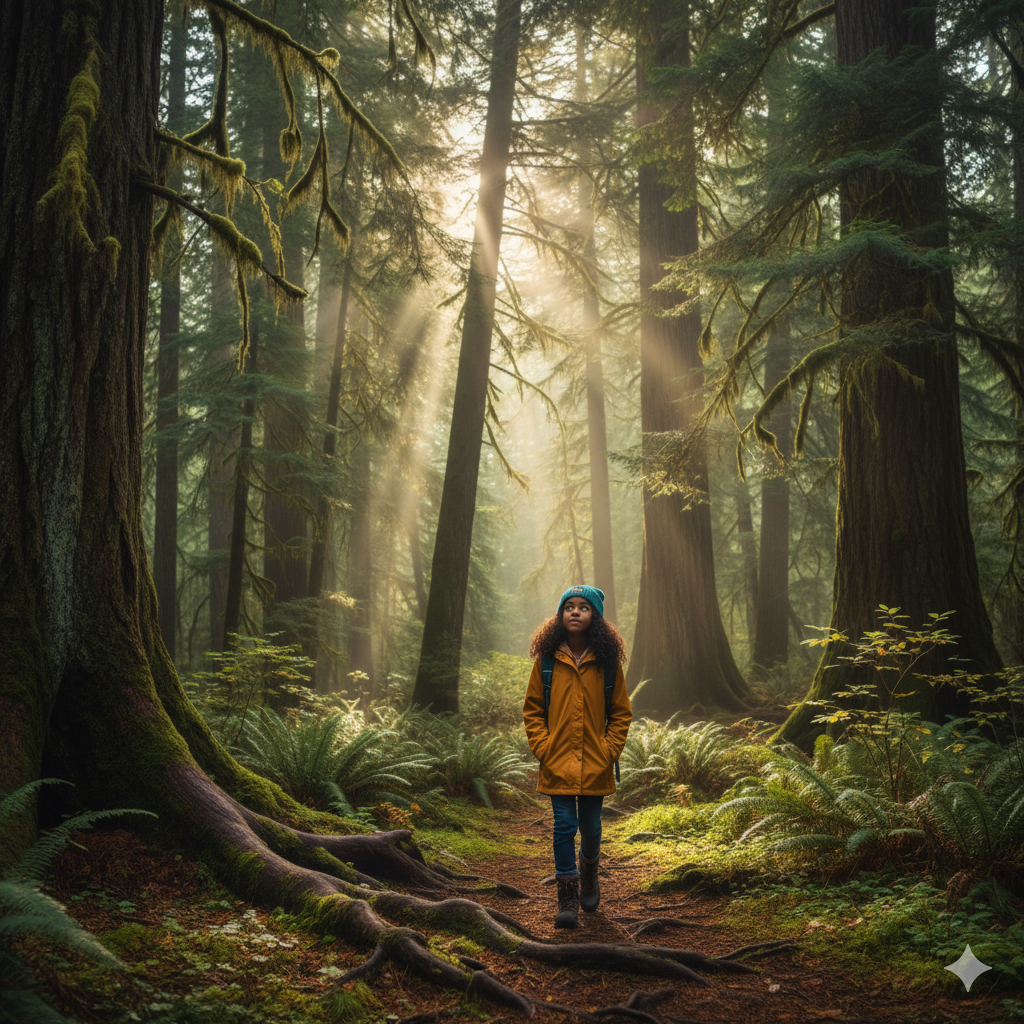
Nia walking among the towering cedars and firs, sunlight streaming through the canopy
Her grandmother used to say, "If you listen closely, the trees will tell you stories."
Nia wasn't sure what that meant — until one summer afternoon when she met Dr. Rivera, a forest ecologist who studied how trees communicate.
"Trees communicate?" Nia asked in disbelief when Dr. Rivera first explained her work.
Dr. Rivera knelt down and placed her hand on the forest floor. "They do — just not with words. They use an incredible underground network that scientists are only beginning to understand."
🌲 What is a Forest Ecologist?
A forest ecologist is a scientist who studies how all the living things in a forest — trees, plants, animals, insects, and fungi — interact and depend on each other. They want to understand how forests stay healthy and how we can protect them.
The Underground Network
Dr. Rivera invited Nia to help with an experiment. Together they dug carefully around the base of an old Douglas fir. Beneath the soil, they saw thin, white threads weaving between the roots like delicate lace.
"It looks like spiderwebs!" Nia said, her eyes wide with wonder.
Dr. Rivera smiled. "That's called myceliumTiny thread-like parts of fungi that spread underground and connect plants — it's part of a fungusA type of living thing that includes mushrooms and molds that connects the trees underground. Some people call it the 'Wood Wide Web.'"
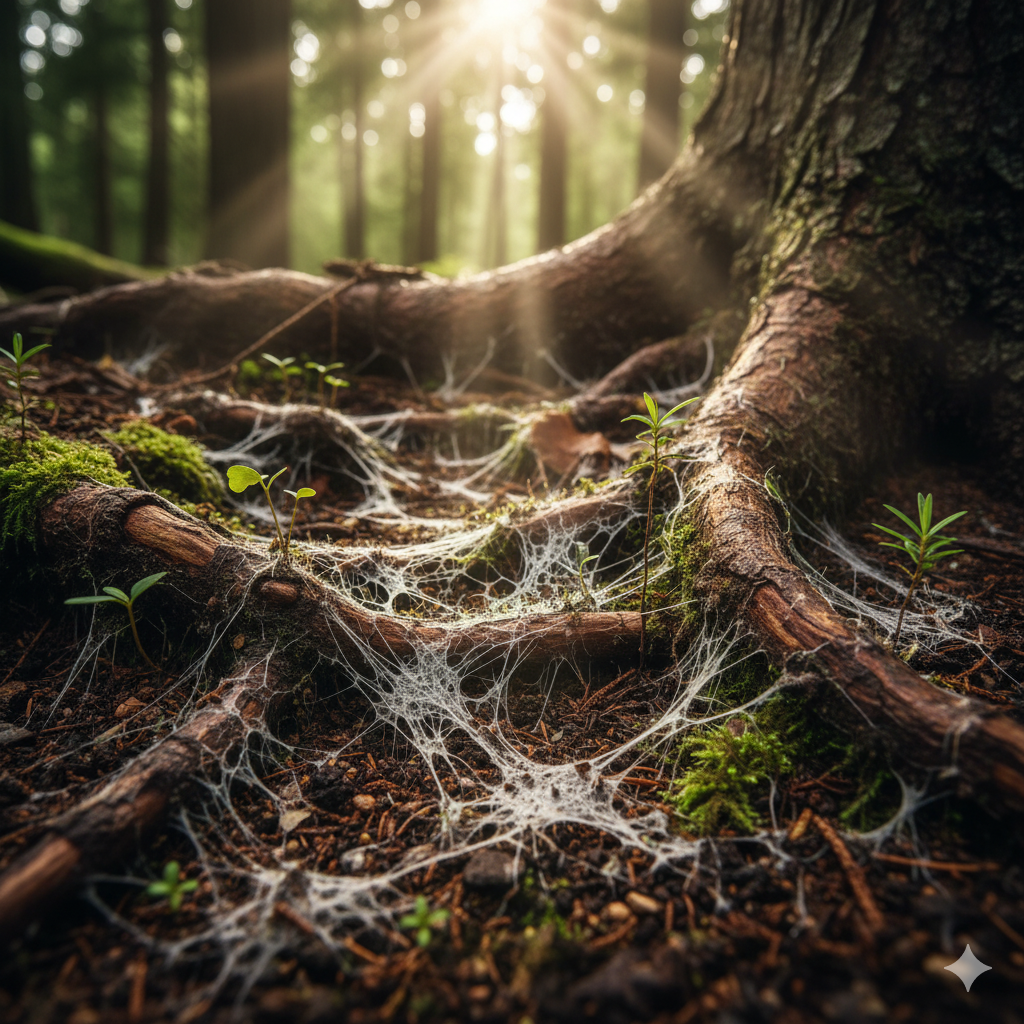
The "Wood Wide Web" - mycelium threads connecting tree roots beneath the forest floor
Through these tiny threads, trees share nutrientsThe food or materials that living things need to grow and stay healthy, water, and even messages. If one tree is sick, others can send help through the network.
Nia was amazed. "You mean they actually talk to each other?"
"In their own way," said Dr. Rivera. "They don't use words like we do. They use chemistryThe science of how substances interact and change and electricityThe flow of energy that can carry signals or power machines — sending chemical signals through the fungal network, just like signals travel through our brains."
🔬 How the Network Works:
The fungus and the tree help each other. The fungus can't make its own food from sunlight like trees can, so the tree shares sugar with it. In return, the fungus spreads far through the soil and helps the tree absorb water and minerals. It's called a "partnership" — both benefit!
But here's the amazing part: the fungal network connects multiple trees, creating a living internet beneath the forest floor. Through this network, trees can send carbon, nitrogen, phosphorus, and even warning signals about insects or disease.
Dr. Rivera showed Nia research photos of forests where scientists had injected radioactive tracers into one tree. Within days, the tracers appeared in neighboring trees dozens of feet away — proof that the trees were sharing resources through the underground web.
The Tree in Trouble
A few days later, Nia noticed that her favorite maple tree had brown, wilting leaves even though all the others around it were bright green and healthy.
She told Dr. Rivera, who brought special sensors to place around the maple's roots. The readings showed something remarkable: nearby trees were sending more carbon and water through the fungal network toward the struggling maple.
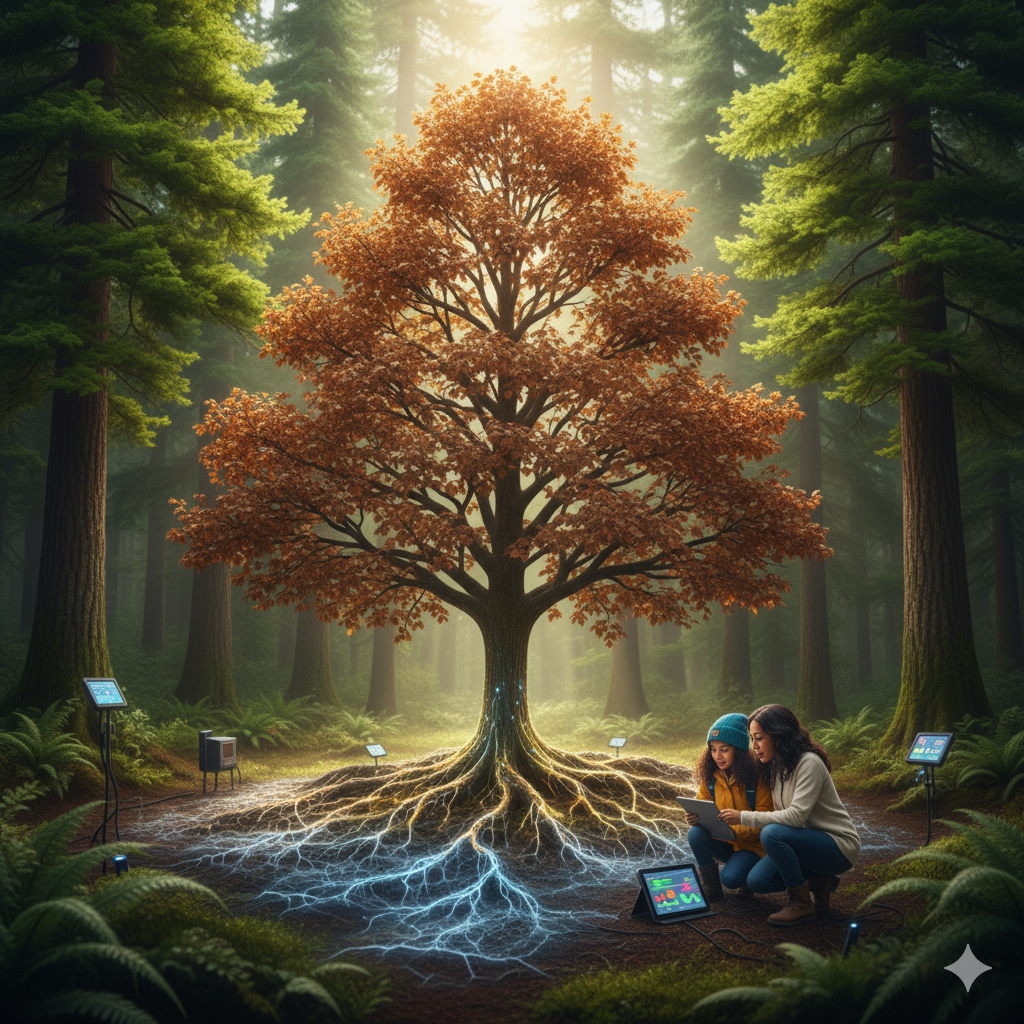
The maple in trouble - neighboring trees sending nutrients through their underground connections
"They're looking out for one another," Dr. Rivera said. "Older trees, called mother treesAn older, larger tree that helps feed and protect smaller trees nearby, share energy with younger saplings growing in their shade. And when a tree is stressed or sick, the forest responds."
Nia thought about how her grandmother always brought soup to sick neighbors. "The forest takes care of its family too," she said softly.
"Exactly," Dr. Rivera nodded. "A forest is like a community. Trees that grow together, survive together. They're stronger as a group than any single tree could be alone."
🌟 Mother Trees:
The biggest, oldest trees in a forest are called "mother trees" or "hub trees." They can be connected to hundreds of other trees through the fungal network. They help young seedlings survive by sharing up to 40% of their carbon! When a mother tree is cut down, many smaller trees nearby may struggle or die because they lose this vital support.
Over the next two weeks, Nia checked on the maple every day. Slowly, its leaves began to green up again. The forest had helped it heal.
The Forest Breathes
Over the next few weeks, Nia helped Dr. Rivera measure the air around the trees using special instruments. She learned that forests don't just stand still — they breathe.
During the day, trees take in carbon dioxide (CO₂)A gas that animals breathe out and plants take in to make oxygen from the air. Using energy from sunlight, they convert it into sugar for food — and release oxygenThe gas that people and animals breathe; made by plants for animals and people to breathe.
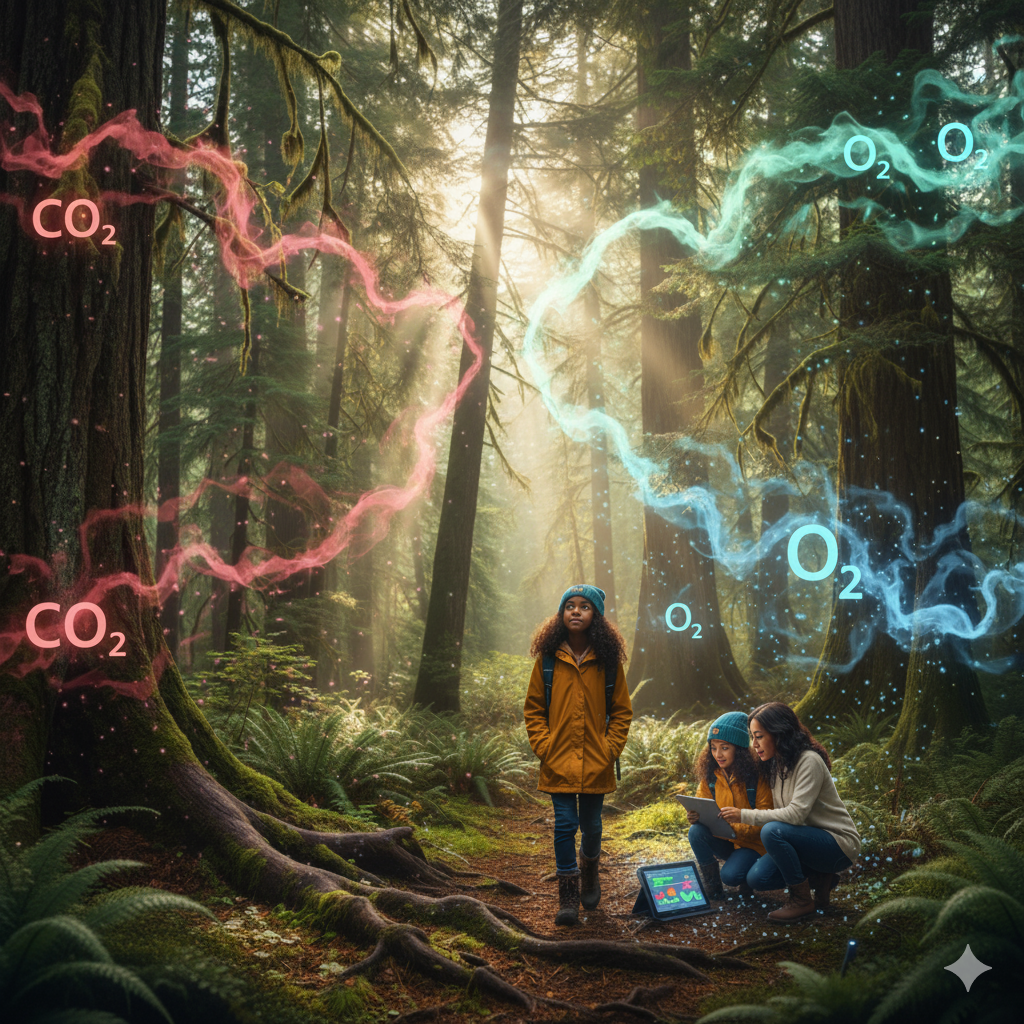
The forest breathes - taking in CO₂ and releasing oxygen in a continuous cycle
"One large tree can produce enough oxygen for two people to breathe for a whole year," Dr. Rivera explained.
Nia looked up at the towering firs above her. "So every breath I take... the forest gave me that?"
"Yes," Dr. Rivera said. "And when you breathe out carbon dioxide, the trees use it to grow. You and the forest are connected in an invisible circle."
Every part of the forest was connected, Nia realized: roots to fungi, trees to air, air to animals, animals to seeds, seeds back to soil. Nothing was separate. Everything flowed in cycles.
"It's like a big circle," Nia said.
"Exactly," Dr. Rivera nodded. "Nature is full of circles — not straight lines. What leaves one tree becomes food for another. What dies becomes soil. What grows feeds the next generation. Scientists call this an ecosystemA community of living and non-living things that work together in nature — everything working together."
🔄 Forest Cycles:
Water Cycle: Trees pull water from the soil, release it into the air, which forms clouds and rain.
Carbon Cycle: Trees absorb CO₂, store carbon in their wood, and release oxygen.
Nutrient Cycle: Dead leaves fall, decompose, feed the soil, which feeds new growth.
Life Cycle: Seeds grow into trees, trees make seeds, continuing the forest for generations.
The Lesson of the Trees
When autumn came, the leaves turned brilliant shades of red, orange, and gold. Nia sat beneath the old maple — now fully recovered and healthy — and listened.
The forest was quiet. No voices, no words. But somehow, it felt more alive than ever.
She closed her eyes and imagined the roots beneath her feet — whispering through the mycelium, sharing stories and strength, sending help to those who needed it.
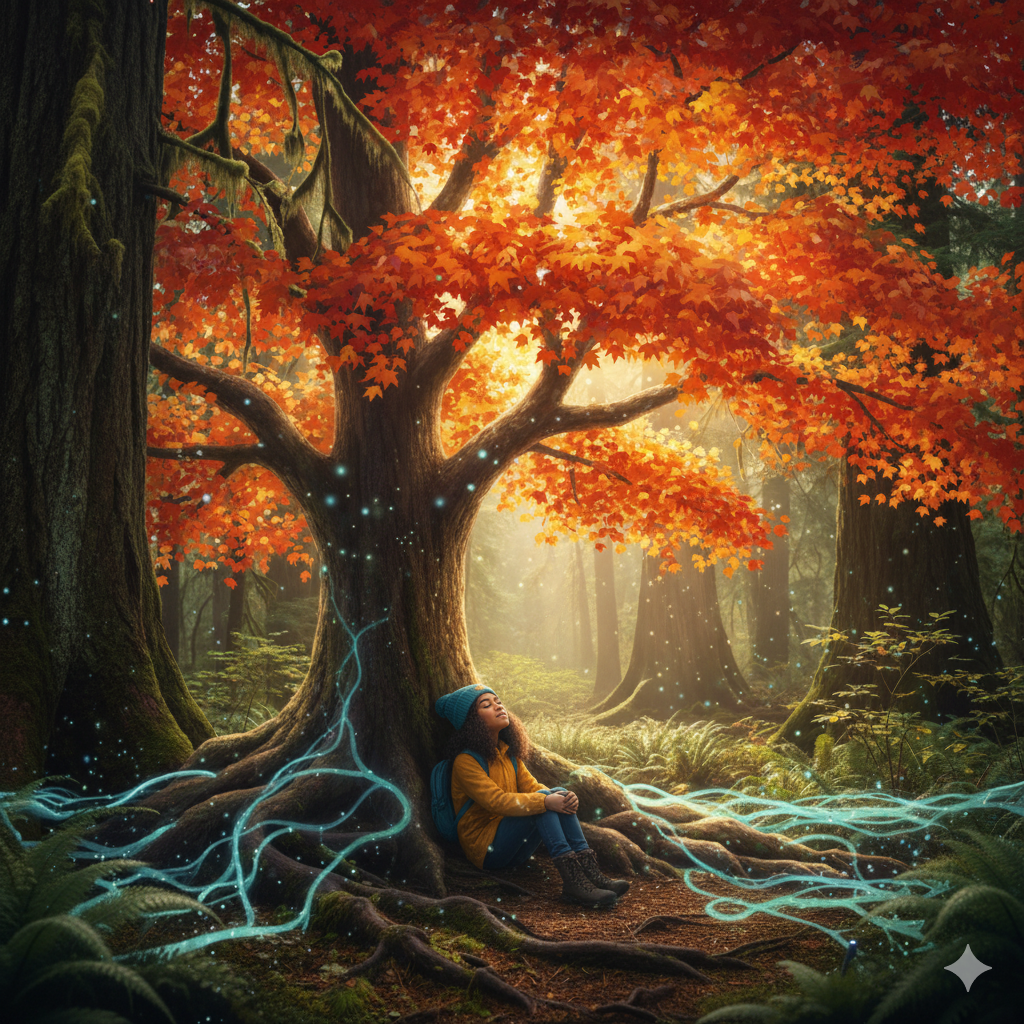
Nia listening to the forest's quiet language beneath the autumn maple
"Thank you," she said aloud, not sure who — or what — she was talking to.
The wind moved gently through the branches above, making the leaves dance and shimmer. For a moment, it sounded like an answer — a soft rustling that seemed to say, you're welcome.
Nia smiled. Her grandmother had been right all along. The trees did tell stories. You just had to know how to listen.
🍂 What We Can Learn:
Trees teach us about cooperation, not competition. They show us that helping others makes everyone stronger. They remind us that we're all connected — every person, animal, and plant on Earth shares the same air, water, and soil. When we take care of nature, we take care of ourselves.
The Network of Life
Years later, Nia became a forest scientist herself, following in Dr. Rivera's footsteps. She studied how trees heal damaged soil, how forests store carbon to fight climate changeChanges in Earth's weather patterns caused by too much heat-trapping gas in the air, and how planting connected forests — not just individual trees — can restore entire ecosystems.
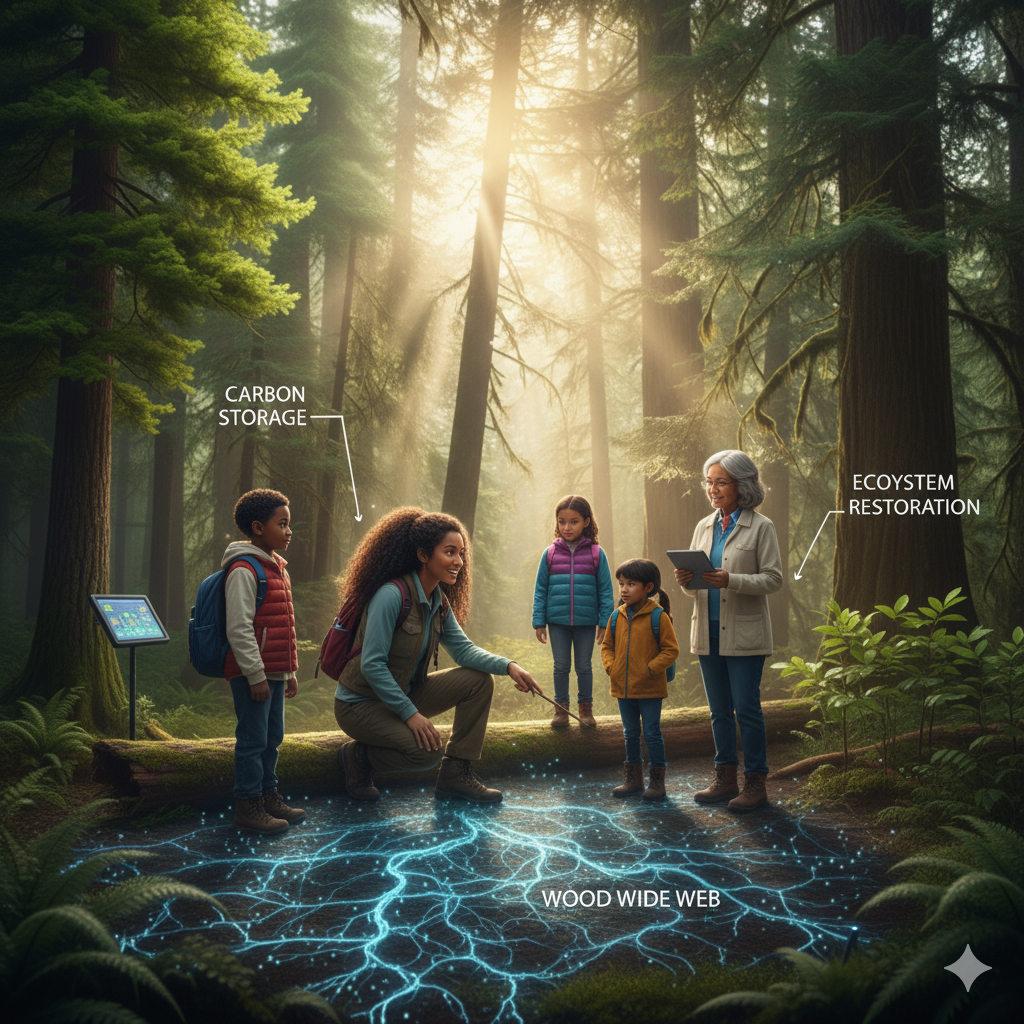
Dr. Nia teaching the next generation about the secret language of trees
Whenever she spoke to students, she told them:
🌍 Nia's Message:
"The forest is one big family. Every living thing plays a part — the towering fir, the tiny mushroom, the busy squirrel, the quiet moss. When we protect the trees, we protect the air we breathe, the water we drink, and the animals that share our world. We protect ourselves."
And she still remembered that summer when she first heard the forest's secret language — the one that doesn't need words at all.
It speaks in the rustle of leaves, the strength of roots, and the generous sharing that happens in the darkness below our feet.
It reminds us that we are never alone. We are all part of the same living network — the beautiful, breathing web of life on Earth.
🌱 How You Can Help:
- • Plant native trees in your community
- • Protect existing forests from being cut down
- • Learn about the plants and animals in your local ecosystem
- • Reduce, reuse, and recycle to lower demand for paper and wood products
- • Spend time in nature and share what you learn with others
🧠 Science Vocabulary
Mycelium
Tiny thread-like parts of fungi that spread underground and connect plants.
Nutrients
The food or materials that living things need to grow and stay healthy.
Ecosystem
A community of living and non-living things that work together in nature.
Fungus
A type of living thing that includes mushrooms and molds.
Carbon Dioxide (CO₂)
A gas that animals breathe out and plants take in to make oxygen.
Oxygen
The gas that people and animals breathe; made by plants.
Mother Tree
An older, larger tree that helps feed and protect smaller trees nearby.
Chemistry
The science of how substances interact and change.
Electricity
The flow of energy that can carry signals or power machines.
Climate Change
Changes in Earth's weather patterns caused by too much heat-trapping gas in the air.
🔬 Try It Yourself: String Network Activity
Build Your Own "Wood Wide Web"
Create a model of how trees share resources through the underground fungal network!
Materials Needed:
- 4-6 chairs or objects to represent trees
- Ball of yarn or string
- Colored beads, buttons, or small pieces of paper
- Scissors
Instructions:
- Place chairs in a circle to represent trees in a forest
- Tie yarn between the chairs, creating a web of connections (this represents the mycelium network)
- Make sure each "tree" connects to at least 2-3 others
- Use colored beads or paper to represent nutrients:
- Blue = water
- Green = nutrients
- Yellow = sugars/energy
- Red = warning signals
- Practice "sending" resources along the strings from one tree to another
- Try this: Cut one or two strings and see how it affects the network's ability to share
🤔 Think About It:
- • What happens when one tree (chair) needs help? How do others respond?
- • What happens if one part of the web is cut or damaged?
- • Which trees have the most connections? (These are like "mother trees")
- • How does having multiple pathways make the forest stronger?
- • How is this like friendship or community in real life?
Extension Activity: Forest Walk
Visit a local forest, park, or wooded area with an adult. Bring a notebook and try to observe:
- How many different types of trees can you find?
- Can you spot any mushrooms growing near tree roots?
- Do you see any trees helping each other (like one providing shade for smaller ones)?
- What animals depend on the trees for food or shelter?
- Sit quietly and listen. What sounds do you hear?
💬 Discussion Questions
1. How do trees "talk" to one another?
Think about: What is the mycelium network? What kinds of messages or resources do trees send? How is this similar to or different from how humans communicate?
2. What does the forest teach us about helping others?
Consider: How do mother trees help younger trees? What happened when Nia's maple was sick? How can we apply these lessons to our own communities?
3. Why are fungi important to the forest?
Reflect: What would happen to trees without the fungal network? How do trees and fungi help each other? Can you think of other partnerships in nature?
4. What can people learn from how trees share and support each other?
Explore: How does cooperation make the forest stronger? What might happen if we treated our communities more like forests? Why is it important to protect forests for future generations?