The Workshop That Never Slept

Edison's "Invention Factory" at Menlo Park, New Jersey
In the late 1800s, a town called Menlo Park in New Jersey glowed faintly at night — not from streetlights, but from the windows of one man's workshop.
Inside, Thomas Alva Edison was wide awake. His hair was messy, his hands stained with oil and dust, and his desk was cluttered with hundreds of glass bulbs, wires, and tools.
While the rest of the world slept, Edison and his team of assistants worked through the night. They called their lab the InventionA new creation made through imagination and hard work Factory — a place where ideas came to life.
"There's a way to make light without fire," Edison said one night. "And we're going to find it."
He wanted to create a light bulb that would last — one that could safely glow for hours and change the world forever.
But before Edison's famous midnight breakthrough, he had to overcome something even more difficult than the science itself: countless failures, exhaustion, and the temptation to give up.
A Thousand Tries
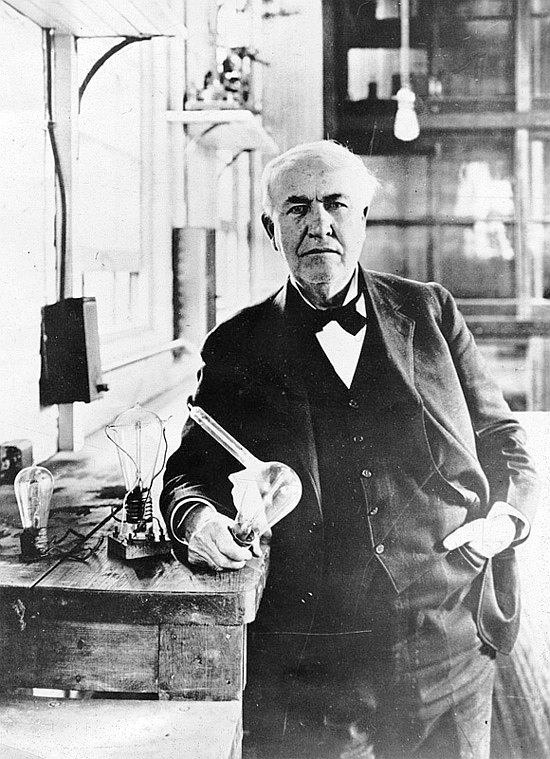
Edison testing hundreds of different filament materials
The problem was the filamentThe thin wire inside a light bulb that glows when electricity passes through it — the tiny wire inside the bulb that glows when electricityThe energy that powers lights, machines, and devices passes through it. Every material Edison tried either burned up too fast or broke apart.
His notebook filled with lists of materials he had tested: platinum (too expensive and melted), bamboo (burned unevenly), cotton thread (too weak), even horse hair (broke instantly).
Each experimentA test done to discover something new required careful preparation. Edison would seal the filamentThe thin wire inside a light bulb that glows when electricity passes through it inside a glass bulb, pump out all the air to create a vacuum, connect it to his batteryA device that stores and provides electric power, and flip the switch. Sometimes the filamentThe thin wire inside a light bulb that glows when electricity passes through it would glow for a few seconds. Other times, it would explode in a shower of sparks.
His assistants grew tired. One sighed, "Mr. Edison, we've failed again. Maybe electric light just isn't possible."
Edison smiled, his eyes twinkling in the lamplight.
💡 Edison's Philosophy:
"No, we've just found another way that doesn't work. We're one step closer to the way that does."
He believed that every mistake brought him one step closer to success. His persistenceNot giving up, even when something is hard — his refusal to quit — would prove to be his greatest strength.
The Breakthrough
One evening in October 1879, after more than 1,000 experiments, Edison tried a new approach. He took a piece of ordinary cotton sewing thread and placed it in a special oven where it could be heated without oxygen. This process, called carbonizationTurned into carbon by heating something without air, making it strong and heat-resistant, made the thread much stronger and more resistant to heat.
The carbonizedTurned into carbon by heating something without air, making it strong and heat-resistant thread was now thin, black, and incredibly delicate. Edison carefully curved it into a horseshoe shape and sealed it inside a glass bulb. Using a special pump, his team removed all the air from inside the bulb, creating a vacuum so the filamentThe thin wire inside a light bulb that glows when electricity passes through it wouldn't burn.
As twilight fell over Menlo Park, Edison connected the bulb to his power source.
"Here we go again," muttered one assistant.
Edison flipped the switch.
The Midnight Moment

An early Edison bulb with carbonized filament - the breakthrough that changed the world
A soft golden glow filled the room. The filamentThe thin wire inside a light bulb that glows when electricity passes through it shimmered with warm light — one minute, two minutes, five minutes... and it kept glowing.
Everyone in the laboratoryA place where scientists test and build ideas stopped what they were doing. The room fell silent except for the faint hum of the electric currentThe flow of electricity through a wire.
"It's still burning," whispered one assistant, his voice filled with wonder.
They stayed up all night watching that tiny light. Hour after hour, it continued to glow steadily, casting dancing shadows on the workshop walls. Some assistants dozed in their chairs. Others took notes, recording every detail.
The bulb shone for 13 and a half hours before finally fading. But those hours proved what everyone had doubted: electric light could last. It was practical. It was real.
✨ The Moment of Discovery:
Edison leaned back in his chair, exhausted but proud. "Gentlemen," he said quietly, "we have made light."
But Edison knew 13 hours wasn't enough. He immediately began improving his design, testing different types of carbonizedTurned into carbon by heating something without air, making it strong and heat-resistant materials. Within weeks, he created bulbs that lasted over 40 hours. By the following year, his bulbs could burn for over 1,200 hours — nearly 50 days!
Lighting the World
Having a working light bulb was only the beginning. Edison realized that for electric light to truly change the world, people needed a way to power those bulbs. He couldn't just sell light bulbs — he had to build an entire electrical system.
In 1882, Edison opened the Pearl Street Power Station in New York City, the world's first commercial power plant. Underground cables carried electricityThe energy that powers lights, machines, and devices through the streets of Manhattan. When Edison threw the switch on September 4, 1882, 400 light bulbs flickered to life in homes and offices across lower Manhattan.

The Pearl Street Power Station - the world's first commercial power plant that brought electricity to Manhattan in 1882
The response was immediate and overwhelming. People who saw electric light for the first time gasped in amazement. No more smoky oil lamps. No more dangerous gas lights. No more candles that could start fires. Electric light was clean, safe, and bright.
📰 A Newspaper's Wonder:
"We will no longer live by the sun," one newspaper wrote. "Edison has made the night our friend."
Within a few years, electric lights began appearing in cities around the world. Theaters stayed open later. Factories could operate around the clock. Students could read at night without straining their eyes. The electric light bulb didn't just illuminate rooms — it transformed how people lived, worked, and dreamed.
The Inventor's Legacy
Edison didn't stop with the light bulb. Over his lifetime, he received 1,093 patents for his inventionsNew creations made through imagination and hard work. He created the phonograph (the first machine to record and play back sound), improved the telephone, developed motion picture cameras, and pioneered the modern research laboratoryA place where scientists test and build ideas.
But despite all these achievements, Edison always emphasized one thing above all else: the importance of hard work and never giving up.
🌟 Edison's Famous Words:
"Genius is one percent inspirationA new idea that motivates you to create something and ninety-nine percent perspiration."
What Edison meant was simple: having a great idea is important, but the real work comes from testing it, failing, learning, and trying again. Success comes from persistenceNot giving up, even when something is hard — from being willing to fail a thousand times to find the one way that works.
He showed that failure isn't the end — it's a step toward discovery. Every "failed" experiment taught him something valuable. Every broken filamentThe thin wire inside a light bulb that glows when electricity passes through it brought him closer to the answer.
Today, every time a light bulb shines — whether it's the old-fashioned kind with a glowing filamentThe thin wire inside a light bulb that glows when electricity passes through it or a modern LED — it reminds us of that long night in Menlo Park. It reminds us of Edison and his team, refusing to give up, watching a tiny thread glow in the darkness.
That single light didn't just illuminate a workshop. It lit the way forward for all of humanity, proving that with persistenceNot giving up, even when something is hard, curiosity, and hard work, we can turn even our brightest dreams into reality.