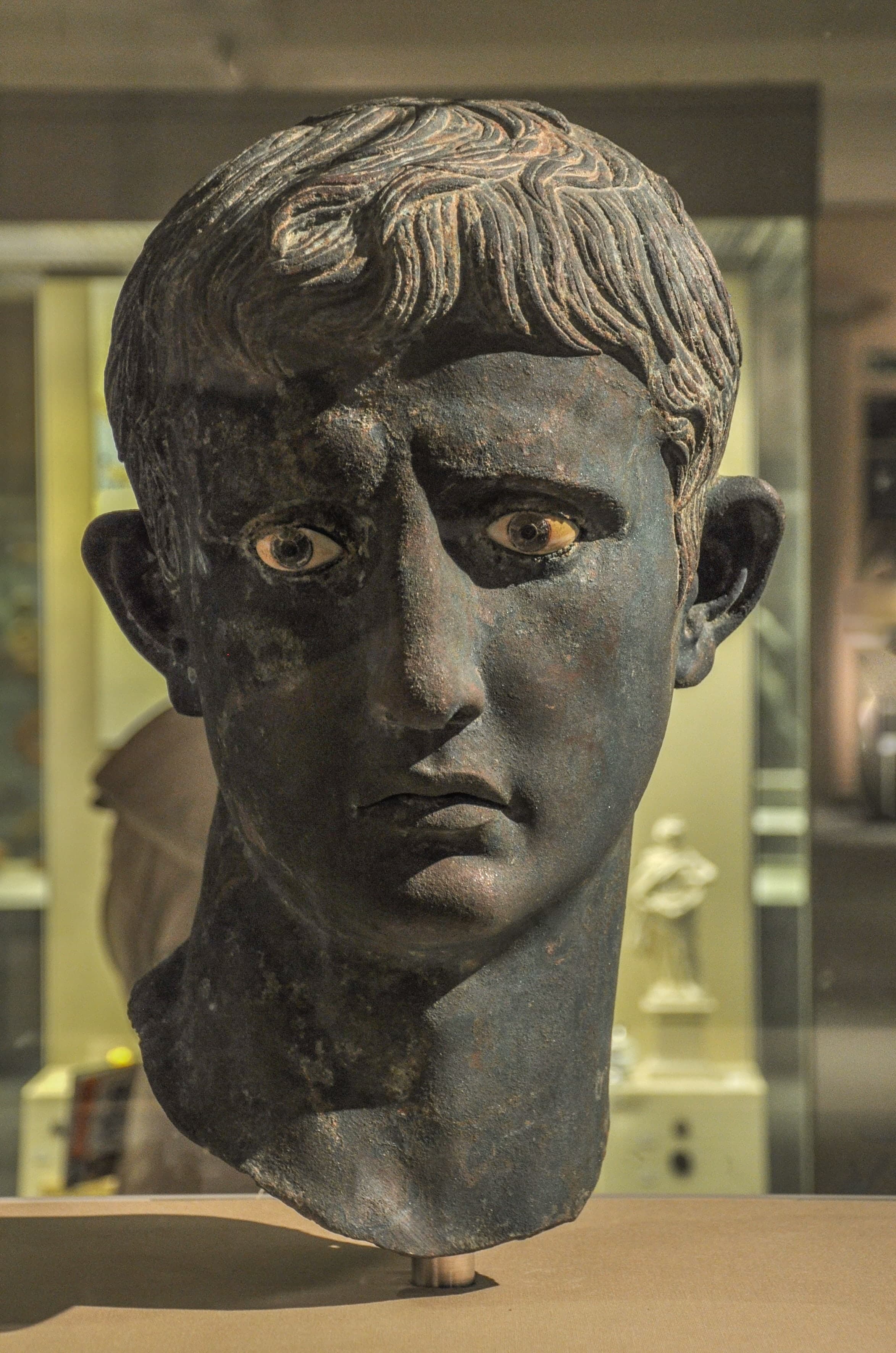
I · THE OBJECT · BRITISH MUSEUM
The Meroë Head of Augustus
▶ Listen · narrated
This head was made to command respect. It was stolen, carried south into Kush, and buried beneath a temple threshold — positioned so feet would strike it daily.
At a glance
- Date
- 26 BC
- Material
- Bronze, glass, calcite
- Height
- 46.2 cm
- Found
- Meroë, 1910
- Museum number
- 1911,0901.1
Look closer
The eyes still see
The eyes are inlaid. White calcite forms the whites, and glass — now weathered but originally bright — formed the irises. Bronze portrait heads were often left with empty sockets, to be fitted with stone or glass later, and the technique gave the face a directness that paint could not. The gaze is level and the pupils would have caught light differently depending on where you stood. The effect, for a Roman viewer, was presence: the emperor looking back.
Larger than life
The head stands 46.2 centimetres tall, roughly half again the height of an adult human head. It was not made to sit on human shoulders. This was part of a full statue, probably twice life-size or more, designed to be seen from below — mounted on a high plinth in a public square or temple precinct. The proportions are exact, but the scale announces authority before the features do.
Buried deliberately, positioned precisely
The head was found in 1910 beneath the threshold step of a temple in Meroë. It was not discarded or hidden in haste. It had been placed carefully under the entrance, where anyone entering the building would walk over it. The placement was intentional, and the intent was humiliation: a trophy converted into pavement, the face of Rome pressed into the dirt of Kush.
The story
In 26 BC, someone in Roman Egypt — perhaps in a newly built forum, perhaps in a temple precinct — commissioned a bronze portrait of Augustus. The face is idealised but recognisable: the short fringe, the broad forehead, the slight turn of the head that Roman sculptors used to suggest alertness without strain. The statue would have stood on a stone base, inscribed with titles, and passersby would have understood what they were looking at without reading a word.
Two years later, in 24 BC, forces from the Kingdom of Kush raided Roman Egypt. Kush, centred on the city of Meroë in what is now Sudan, had been a power in the region for centuries, and Rome's arrival in Egypt after the defeat of Cleopatra had brought the two into direct contact. The raid went deep: forces from Kush took prisoners, pulled down statues, and carried objects back south. Among them was this head, severed from its body and taken as plunder.
What happened next is recorded not in text but in archaeology. The head travelled to Meroë, the royal city, and was brought to a temple. There it was buried — not in a storeroom, not in a pit outside the walls, but directly beneath the threshold step at the entrance. Everyone who entered the temple would step on it. The act was not casual. The head had to be positioned, the step lifted and replaced, the work coordinated. It was a deliberate inversion: the image that commanded Roman viewers to look up now lay underfoot in Kush.
The head stayed there for nineteen centuries. In 1910, excavations at Meroë uncovered it, still in place beneath the step. The bronze was intact, the features undamaged by the burial. The eyes — white calcite and glass — were still inlaid, and the surface bore the dark patina of long burial but no corrosion that obscured the modelling. It was removed and eventually entered the British Museum's collection in 1911.
The making and the unmaking are both visible in the object. The craftsmanship is precise: the hair is rendered strand by strand, the skin surface is smooth without being featureless, and the slight asymmetry of the face — one eye fractionally narrower than the other — suggests a portrait taken from life or from a closely observed model. But the break at the neck is rough, the edges bent and torn where the head was wrenched from the body. The violence of the separation is still legible.
No ancient text describes this particular statue or its removal. The broader conflict is mentioned by Roman historians: forces from Kush raided southern Egypt and Augustus sent a retaliatory expedition, but the sources do not list what was taken. The burial under the temple step is known only because the head was found there, and the interpretation — that it was a deliberate act of symbolic domination — rests on the context of the find, not on any written account.
Why it mattered then
The burial was a statement, and the audience was local. Roman portraits functioned as political infrastructure: they made the emperor present in places he would never visit, and they required gestures of respect that reinforced the social order. To deface or remove such an image was to refuse that order, and to bury it underfoot was to reverse it entirely. For the people entering the temple in Meroë, the act would have been legible. They would have known what lay beneath the step — the knowledge would have been part of the point. Every entry became a repetition of the original victory, a daily reminder that Rome's claim to authority did not extend here. The head was not destroyed because destruction would have ended the statement. Burial kept it present, pinned in place, perpetually defeated. The broader conflict between Rome and Kush was short. After the raid in 24 BC, Rome mounted a counter-raid, and the two powers negotiated terms. Kush retained its independence, and the border was settled without further fighting. The head remained where it had been buried, and the temple continued in use. The statement it made was local and enduring, not a provocation aimed at Rome but a claim made in Kush's own terms, for an audience in Kush.
Why it matters now
The head survives because it was buried, and it was preserved by the act meant to humiliate it. Bronze was valuable and usually recycled: statues were melted down when the metal was needed, and few Roman bronzes survive intact. This one endured because it was taken out of circulation, removed from any context where it might be repurposed, and placed where it could not be moved without dismantling the building above it. The find context is as significant as the object. The head is often described as a masterwork of Roman portraiture, and it is: the modelling is confident, the proportions are exact, and the inlaid eyes give the face a presence that photographs struggle to convey. But what makes it more than a fine example of its type is the fact that it was stolen, carried hundreds of miles, and buried with care beneath a temple step. The biography of the object — made in Roman Egypt, looted by Kush, buried in Meroë, excavated in 1910, and now held in London — is inseparable from its meaning. It also raises questions that Roman material usually does not. Roman portraits survive in large numbers, and they are usually interpreted within Roman contexts: what they communicated to Roman viewers, how they functioned in Roman spaces, what they reveal about Roman ideals of authority and representation. This head was taken out of that context deliberately, by people who had their own response to those ideals. The act of burial in Kush is as much a part of the object's history as the Roman act of making it, and both are preserved in what survives.
The surprising detail
The head was found in 1910, and the discovery was made during excavations at Meroë. The location — directly beneath the threshold step of a temple — meant the burial could be dated to the period when the temple was in use, and the context made the interpretation clear. But no ancient text mentions this specific statue, and the identification as Augustus rests on the style of the portrait and the hairstyle, which matches other known images of the emperor. The head itself carries no inscription, and if it had been found in a different context, the identification might have been less certain.
What is disputed
The identification as Augustus is based on the style and the distinctive hairstyle, which matches other portraits of the emperor, but the head itself carries no inscription. The broader raid in 24 BC is mentioned by Roman historians, but no ancient source describes the taking or burial of this particular statue, so the narrative rests on the archaeological context of the find rather than on textual evidence.
How it got here
The head was excavated in 1910 at Meroë and entered the British Museum's collection in 1911. It was taken as war plunder by forces from the Kingdom of Kush in 24 BC, and its removal from Roman Egypt and burial in Kush are acts recorded in the object's physical history rather than in any transfer of legal title. The head is now part of the museum's permanent collection, and there is no current repatriation claim on public record, but its biography — made in Roman Egypt, looted to Kush, excavated by a British team in Sudan, and held in London — reflects the layered colonial and imperial histories of the region.
Remember this
A portrait made to command respect, stolen and buried so that feet would strike it daily — and preserved by that burial for two thousand years.
Test yourself
Why does the fact that this head was found beneath a temple step, rather than in a storage pit or a rubbish dump, matter for how we interpret it?
Because the location shows the burial was not casual or practical — it was symbolic. A storage pit would suggest the head was being kept out of sight, and a rubbish dump would suggest it was simply discarded. But a threshold step is a place everyone entering the temple would cross, and burying the head there meant every entry required stepping on the face of Augustus. The placement made the act of humiliation repeatable and public, and it required effort: the step had to be lifted, the head positioned, and the step replaced. The archaeological context tells us the burial was deliberate and that the insult was the point, not a side effect. Without that context, we would have a fine Roman portrait. With it, we have evidence of how one kingdom responded to Roman power.
Go deeper
- Meroë Head · Wikipedia
- Meroë Head — Wikidata · Wikidata
- The Meroë Head of Augustus — collection record · britishmuseum.org
Image: Aiwok, CC BY-SA 3.0. Licence: CC BY-SA 3.0. Source.