I · THE OBJECT · BRITISH MUSEUM
The Throne of Weapons
▶ Listen · narrated
A throne made of weapons that were meant to kill. The chair exists because the guns were given up, and because someone chose to record that surrender in metal.
At a glance
- Date
- 2002
- Creator
- Cristóvão Canhavato
- Type
- Sculpture
- Material
- Welded firearms
Look closer
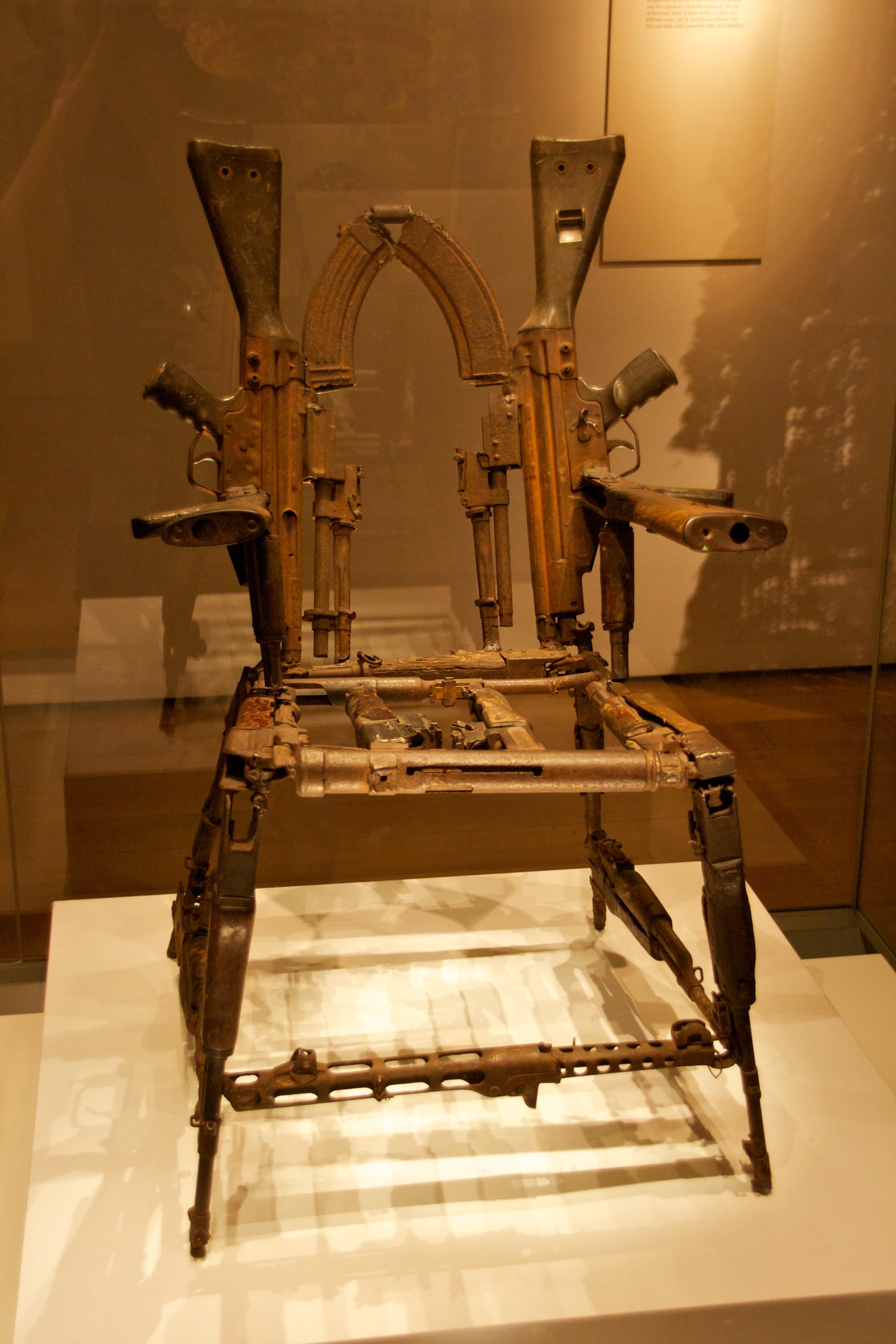
The seat and arms are rifle stocks and barrels
The chair is built from the parts of actual firearms: wooden stocks form the seat and back, metal barrels curve into armrests, trigger guards become structural joints. The weapons are recognisable as weapons even after being cut and welded into furniture. That visibility is the point — the sculpture does not disguise what it is made from.
Welded, not carved
Canhavato worked by welding and cutting metal, not by casting or carving. The guns were already manufactured objects; he disassembled them and joined the parts into a new form. The welds are visible where barrel meets stock, where one gun's components lock into another's. The chair is an assembly, not a casting or a single piece of worked material.
A throne, not just a chair
The proportions and the high back give it the form of a throne rather than an ordinary seat. That choice connects it to older ideas about power and authority — the object a ruler sits on to give orders. Here the throne is made from the tools that enforced and resisted authority during the war, now rendered into something you sit on rather than fire.
The story
Mozambique's civil war ended, and programmes were established to collect weapons and take them out of circulation. Canhavato, working as an artist, took decommissioned guns — rifles that had been handed in and were no longer in use — and welded them into sculptures.
The Throne of Weapons is one of those sculptures. It is a chair, high-backed and formal in proportion, built entirely from the components of firearms. Wooden rifle stocks form the seat and backrest. Metal barrels curve into arms and legs. Trigger mechanisms, sights, and other metal parts are welded together to hold the structure. The guns are cut apart and reassembled, but they remain recognisable: you can see what they were.
The work was made in 2002, years after the war ended. It is a sculpture, but it is also furniture — it has the form of a usable chair, even if its function is symbolic rather than practical. The title calls it a throne, not just a chair, which connects it to older forms of ceremonial seating and to ideas about authority and rule.
Canhavato signed the work. It was acquired by the museum with his knowledge and consent, which makes it unusual in a collection where many objects were taken during colonial rule or purchased from dealers without the maker's involvement. The work is contemporary, made by a living artist in a post-conflict setting, and it arrived in the collection through a process that involved the creator directly.
The material itself carries the history. These were working firearms, used during the war, then handed in and decommissioned. They were not symbolic weapons or replicas; they were the actual tools of the conflict, rendered inert and repurposed. The sculpture records that process of disarmament in a permanent form.
Why it mattered then
The work was made after the war ended, at a moment when the physical remnants of the conflict — the guns themselves — were still present and still being collected. Disarmament programmes were active, and the question of what to do with the weapons was a practical one, not a historical curiosity. Turning guns into sculpture was one answer to that question. It made the weapons unusable without simply destroying them. It kept them visible, as a record of what had been handed in, but transformed them into objects that could not be fired. The throne form, with its associations of authority and ceremony, reframed the guns as something other than tools of violence. For Canhavato and others working in similar ways, the sculptures were both a response to the immediate post-war environment and a way of marking the end of the conflict in material terms. The work was made in a context where the war was recent memory, not distant history, and where the presence of the guns was still a live issue.
Why it matters now
The sculpture sits in a museum collection built largely on objects taken during colonial rule or acquired without the consent of the people who made them. The Throne of Weapons is different: it was made recently, by a named and living artist, and acquired through a process that involved him directly. That makes it a deliberate counterweight in the collection, an example of an object that arrived through consent rather than appropriation. It also remains legible as a post-conflict object. The guns are still recognisable, and the act of turning them into a throne still carries the meaning it had when it was made: that weapons can be repurposed, that authority can take forms other than violence, that the end of a war can be recorded in metal and wood. The work has been displayed in various contexts since it was made, and it has been described as eloquent — a word that suggests it communicates clearly without needing extensive explanation. The material and the form do the work: you can see what it is made from, and you can see what it has been made into.
The surprising detail
The sculpture has been called the museum's most eloquent object, a phrase that suggests it communicates more directly than many older or more fragmented works in the collection. That clarity comes from the material: the guns are still recognisable, and the transformation from weapon to throne is visible in the structure itself. The work does not require specialist knowledge to read; the message is in the metal.
How it got here
The Throne of Weapons was created by Cristóvão Canhavato in 2002 and acquired by the British Museum with his knowledge and consent. This makes it unusual in a collection where many objects were taken during colonial rule or purchased without the maker's involvement. The work was made from decommissioned weapons collected after Mozambique's civil war and represents a deliberate acquisition of contemporary African art through a process that involved the artist directly.
Remember this
Guns welded into a throne: a post-war sculpture that records disarmament in metal, and an object acquired with the maker's consent.
Test yourself
Why does the sculpture keep the guns recognisable rather than melting them down or disguising them completely?
Because the visibility of the weapons is part of the work's meaning. If the guns were melted and recast, the sculpture would be about transformation in the abstract — material becoming something new. By keeping the rifles recognisable — barrels, stocks, triggers still visible in the structure — the work records what was handed in and what it has become. The viewer can see both the weapon and the throne at once, which makes the act of repurposing explicit rather than implied. The material carries the history, and that history is legible because the guns have not been erased, only reassembled.
Go deeper
Image: Photograph by Mike Peel ( www.mikepeel.net ).. Licence: CC BY-SA 4.0. Source.