III · THE WORK · ART HISTORY
Malevich's Black Square
▶ Listen · narrated
A square of black paint, nearly a metre across, cracked with age to show writing and colour underneath. What was it meant to replace?
At a glance
- Artist
- Kazimir Malevich
- Date
- 1915
- Dimensions
- 79.5 × 79.5 cm
- Medium
- Oil on canvas
- Collection
- Tretyakov Gallery, Moscow
- Movement
- Suprematism
Look closer
The crazed craquelure revealing lower layers
The black surface has cracked with age, forming a network of fine lines — craquelure — that reveals paint underneath. The cracks show colour beneath the black, and X-ray analysis has disclosed an inscription hidden under the surface layer. What the inscription says and whether Malevich intended it to remain hidden are questions the physical evidence raises but does not settle. The painting is not a single unbroken field but a palimpsest, one image laid over others.
The square not quite square, not quite centred
The black shape is not geometrically square. Its sides are slightly unequal, and the angles are not quite right angles. Nor is it centred on the canvas: it sits slightly off-centre, higher and to the right. Whether this was deliberate or the result of freehand painting is not recorded. The effect is that what appears at a distance to be a pure geometric form reveals itself, on close looking, to be painted by hand, with the small irregularities that implies.
The white border as active ground
The white around the square is not bare canvas but painted white, applied as deliberately as the black. The border is uneven in width on all four sides, wider at the bottom and right than at the top and left. This makes the white an active element rather than empty background — it presses against the black, and the two shapes define each other. The painting is not a black square on nothing; it is black paint and white paint in a specific, unbalanced relationship.
The story
Kazimir Malevich completed Black Square in 1915, an oil painting on canvas measuring 79.5 centimetres on each side. It shows a black quadrilateral on a white ground, both painted. The work was made in the Russian Empire and is held by the Tretyakov Gallery in Moscow.
Malevich called the painting the zero point of painting. By this he meant a reduction to the simplest elements: form, without reference to anything outside the canvas. In his manifesto for Suprematism — the movement he founded and to which this painting belongs — he wrote that the work was part of a struggle to free art from what he called the ballast of the objective world. No landscape, no figure, no object: only shape and colour, arranged to produce an effect he compared to that of religious art.
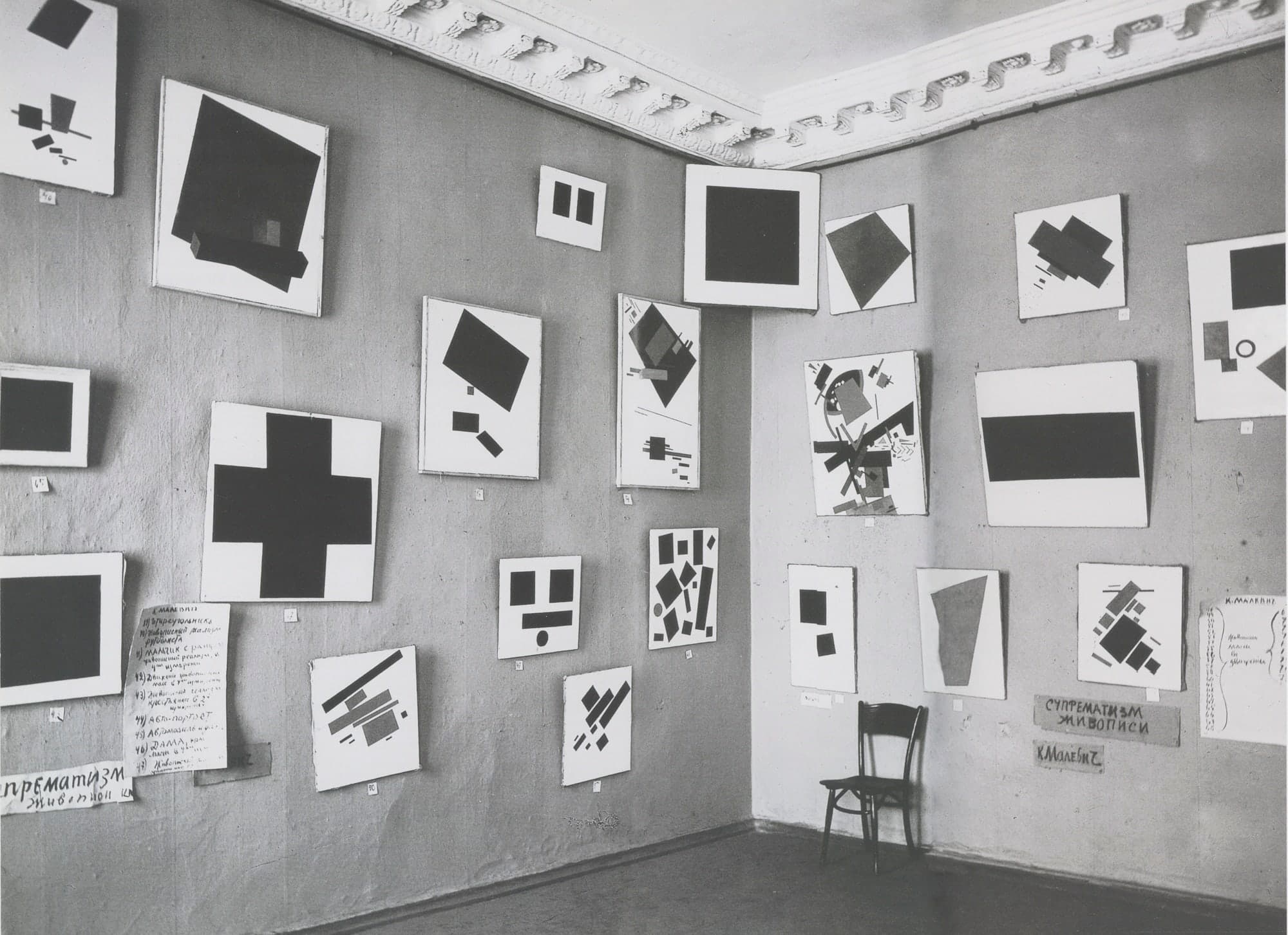
The comparison was not metaphorical. When Black Square was shown publicly in 1915, at an exhibition in Petrograd called The Last Futurist Exhibition 0,10, Malevich hung it high in the corner of the room. This is the placement reserved in a Russian home for the icon — the sacred image before which one prays. The gesture was deliberate: the painting was to occupy the space of the holy image, not beside it but instead of it.
Malevich painted three other versions of the composition, in 1923, 1929, and sometime between the late 1920s and early 1930s. Each differs slightly in size and texture. The 1915 version, the subject of this lesson, is the one Malevich described as his breakthrough.
The surface has crazed over time. The black paint has cracked into a fine web of lines, and through the cracks one can see colour underneath. X-ray imaging has revealed an inscription beneath the black layer. What it says and why Malevich covered it are not recorded in the sources available here. The painting is visibly layered, one surface over others, though it presents itself as a single plane.
The black shape is not a perfect square. Its sides are unequal, its angles slightly off. It sits above centre on the canvas, and the white border around it varies in width. These irregularities are visible on close inspection, though from a distance the form reads as geometric. Whether the imperfections were intended or are the natural result of painting by hand is not documented.
Why it mattered then
Malevich made Black Square during the period when Russian artists were working to dismantle the assumptions of representational painting. The question they posed was whether painting needed to show anything at all — whether it could function as pure form, addressing the viewer without the mediation of a recognisable subject. Malevich's answer was Suprematism, and Black Square was the work he identified as the origin of that movement. The painting was a declaration: that form alone could carry meaning, that the vocabulary of painting could be reduced to shape and colour and still produce an effect as powerful as narrative or likeness. The decision to hang it in the icon corner made the claim explicit. The icon is the most potent image in Russian culture, a window onto the divine. By placing a black square in that position, Malevich was not simply making a painting; he was proposing a replacement for religious art. The work was to be understood as an object of contemplation, emotionally direct, requiring no interpretation because it referred to nothing outside itself. Whether viewers in 1915 experienced it that way or found the gesture provocative or empty is not recorded here, but the placement ensured the question could not be avoided.
Why it matters now
Black Square remains a reference point for any art that reduces its means to a minimum. Minimalist painting and sculpture in the decades after Malevich's death returned repeatedly to the problem he set: whether a work can be stripped to its simplest elements and still function as art, and what happens when it is. The painting also raises questions that have not resolved. One is whether abstraction can carry the emotional weight Malevich claimed for it — whether a black square can do what an icon does. Another is what it means for a painting to refer to nothing. Malevich said the work was free of the objective world, but it is a square, and squares exist in the world; it is black paint on white canvas, and both are materials with associations. Whether pure form is possible, or whether every mark carries meaning from outside itself, is a question the painting poses without settling. The craquelure and the hidden layers add a further dimension. The surface that was meant to be irreducible has cracked to show what is underneath. The zero point has a history, visible in its ageing. This makes the painting a record of its own making and unmaking, which may or may not be what Malevich intended but is what the object has become.
The surprising detail
The black paint has cracked with age, and through the cracks you can see colour underneath. X-ray analysis revealed an inscription hidden beneath the black layer. What the inscription says is not recorded in the available sources, and whether Malevich intended it to remain hidden or expected it eventually to be found is not documented. The painting that was meant to be a zero point — a reduction to pure form with no reference to anything else — turns out to contain writing and earlier images, layered beneath the surface that faces us.
What is disputed
What the hidden inscription says and whether Malevich intended it to remain concealed are not recorded in the available sources. The slight irregularities in the square's shape and placement — whether deliberate or the result of freehand painting — are likewise not documented. The painting's reception at the 1915 exhibition, beyond the fact of its display, is not detailed here.
Remember this
Malevich hung a black square in the corner where a Russian home would hang its icon, and called it the zero point of painting.
Test yourself
Malevich wrote that Black Square was meant to free art from the objective world, but he also compared its intended effect to that of religious art. Are those two aims compatible, or do they contradict each other?
They are compatible if religious art is understood as Malevich seems to have understood it: as an image that works directly on the viewer's emotions without requiring interpretation or narrative. An icon in Russian tradition is not primarily a story or a symbol to be decoded; it is a presence, meant to be experienced rather than read. If that is the model, then a painting free of the objective world — one that shows no recognisable thing — can still function as a religious image does, by addressing the viewer immediately, through form and colour alone. Whether that effect is actually achieved by a black square is a separate question, and one on which viewers have disagreed since 1915. But the two aims do not logically contradict each other. Malevich was proposing that pure form could do what sacred images do, not that it would do something entirely different.
Go deeper
Image: Фотография Ателье Буллы Unknown Unknown [ 1 ], Public domain. Licence: Public domain. Source.