III · THE WORK · ART HISTORY
Inca Stonework at Machu Picchu and Cusco
▶ Listen · narrated
The stones have no mortar. Some have a dozen angles. The walls survived earthquakes that flattened the Spanish buildings built on top of them.
At a glance
- Architectural tradition
- Inca, inheriting methods from Tiwanaku
- Principal sites
- Cusco, Machu Picchu, Sacsayhuamán, Ollantaytambo
- Construction method
- Polygonal blocks fitted without mortar
- Design principle
- Using topography and local materials as part of the structure
Look closer
The twelve-angled stone locking its neighbours
In Cusco, one block in a street wall has twelve separate angles, each meeting a different neighbour. The stone is not decorative — it is structural, locked into the wall by the geometry of its edges. Each angle was ground to fit the block beside it, creating a joint so tight that a knife blade will not enter. The block cannot be pulled out without dismantling the stones around it, and those stones cannot move without shifting their own neighbours. The complexity is a solution: an irregular stone locks more securely than a regular one.
Walls battered inward for seismic stability
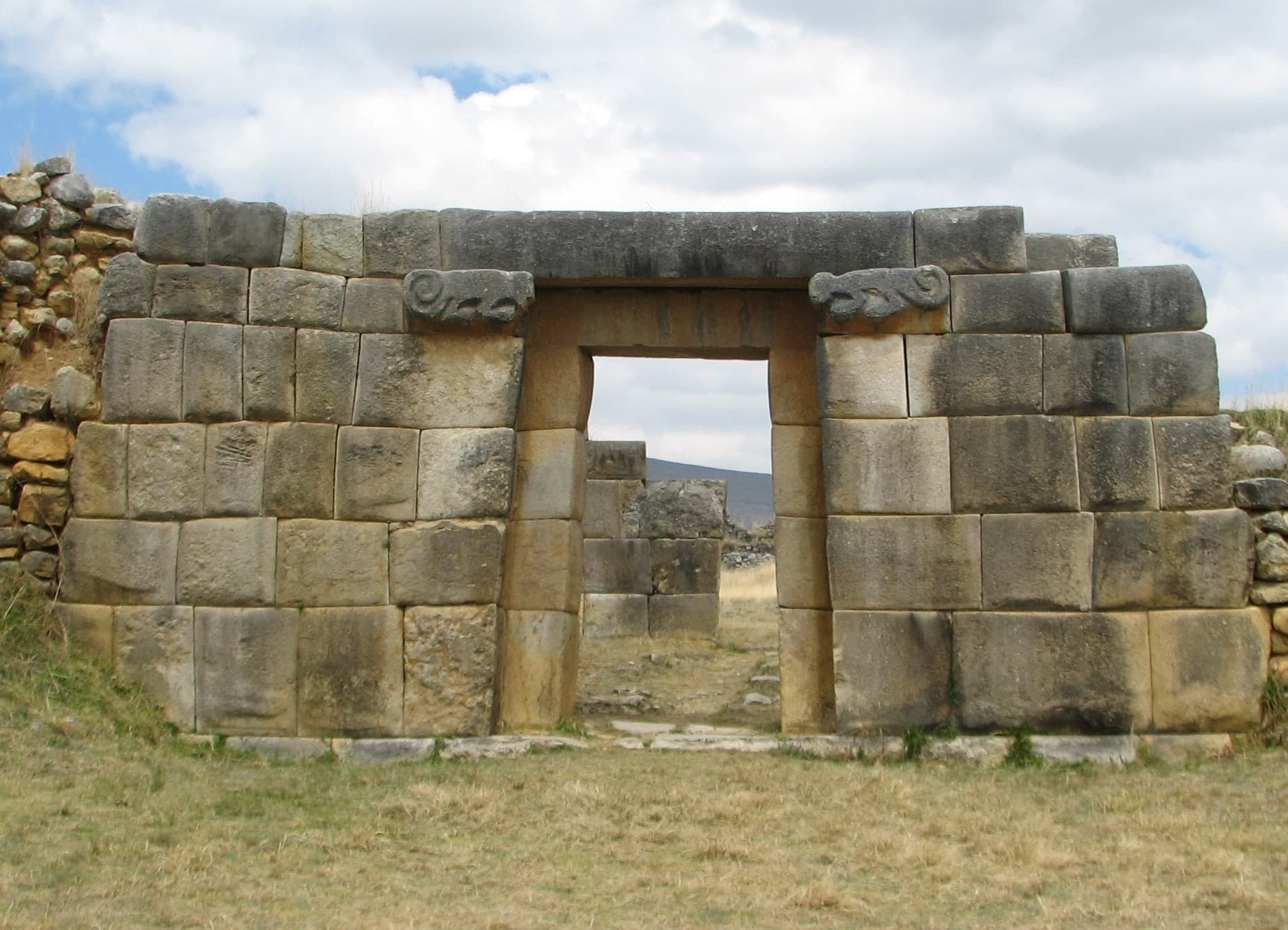
Inca walls lean inward — the face is not vertical but tilted back, so the top of the wall is narrower than the base. This is called batter. It lowers the centre of gravity and makes the wall less likely to topple outward when shaken. The inward tilt also helps the blocks settle into each other under their own weight. Spanish colonial buildings in Cusco, built with vertical walls and mortar, collapsed in earthquakes that left the Inca walls standing. The batter is visible in photographs: the wall plane recedes as it rises.
Pillowed faces with recessed joints
The face of each block bulges slightly outward, and the joint between blocks is set back, forming a shallow groove. This is called a pillowed or cushioned face. The effect is that each stone reads as a distinct volume, and the wall surface is not flat but textured with low relief. The recessed joint may also reduce stress concentration at the contact points during ground movement. The technique is consistent across sites: the same pillowed profile appears at Machu Picchu, at Sacsayhuamán, and in the walls of Cusco.
The story
The blocks are granite, andesite or limestone, depending on what was available at the site. They are not cut to a standard size or shape. Instead, each block is irregular, with three to twelve angles, and each angle is ground to fit the specific block beside it. The joints are so tight that mortar was not used — and in an earthquake zone, this turns out to be an advantage.
The method, as far as it can be reconstructed from the walls themselves and from accounts recorded after the Spanish conquest, involved pounding and grinding rather than sawing. Masons used river stones as hammers to batter the surface of the block, then ground the edges with abrasive sand and smaller stones. The process was slow. A block was shaped roughly, then set in place and checked against its neighbours. It was removed, adjusted, set again, removed again. The cycle repeated until the fit was exact.
No mortar means the blocks can move slightly when the ground shakes, then settle back. The walls flex rather than crack. The polygonal geometry helps: because each block locks into several neighbours at different angles, the wall distributes stress across the entire surface rather than concentrating it at a few points. The batter — the inward tilt of the wall face — lowers the centre of gravity and resists toppling.
The result is that Inca walls in Cusco have survived earthquakes that destroyed the Spanish colonial buildings constructed on top of them. In some streets, the lower courses are Inca stonework, still fitted without mortar, and the upper storeys are Spanish masonry, rebuilt after successive collapses.
The same techniques appear at Machu Picchu, at the fortress of Sacsayhuamán above Cusco, and at Ollantaytambo. The architectural style is consistent across the Inca road system, which ran along the western length of the continent. The roads and the buildings along them were a form of imperial assertion: the stonework was a visible marker of Inca control.
The Inca inherited building methods from Tiwanaku, a culture that built in dressed stone in present-day Bolivia from the second century BCE. What the Inca added, or refined, was the use of topography as part of the design. Walls follow the contours of hillsides. Buildings are set into natural rock outcrops, with the bedrock itself forming part of the structure. At Machu Picchu, some walls rise from boulders that were shaped in place rather than moved.
How much of the technique was calculation and how much was empirical trial is not recorded. The masons left no written accounts, and the Spanish chroniclers did not describe the process in detail. What survives is the stonework itself, and the fact that it has not fallen.
Why it mattered then
The stonework was a demonstration of state control. The Inca empire expanded rapidly in the fifteenth century, and the road system that connected it required not just engineering but visible authority. The walls, with their fitted blocks and pillowed faces, were immediately recognisable as Inca construction. They marked territory. The technique also solved a practical problem. The region is seismically active, and buildings that cannot flex will crack. Mortar is rigid; it holds blocks in place until the stress exceeds its strength, and then it fails suddenly. A wall without mortar, with blocks that can shift slightly and resettle, survives longer. The Inca method was not decorative — it was structural, adapted to the conditions of the ground. The use of local stone and local topography reduced the cost of transport. Blocks were quarried near the building site when possible, and the natural rock was incorporated into the design rather than cleared away. This was efficient, but it also meant that each site was specific to its location. The architecture was not standardised in the sense of being identical everywhere, but it was standardised in its principles: battered walls, polygonal blocks, no mortar, integration with the landscape.
Why it matters now
The walls are still standing, and they are still studied. Structural engineers have analysed the seismic performance of Inca masonry, and the principles — flexible joints, distributed stress, low centre of gravity — are recognised as sound. The technique is not replicable at scale, because it requires slow, manual fitting of irregular blocks, but the underlying logic is applicable. The sites themselves are also still in use, in the sense that they are inhabited by tourists and by the descendants of the people who built them. Cusco is a city with Inca walls in its streets. Machu Picchu is a royal estate that has become a pilgrimage site for a different kind of visitor. The stonework has outlasted the empire that built it, and it has outlasted the Spanish colonial buildings that were constructed on top of it. What the walls demonstrate is that a solution to a local problem — how to build on unstable ground with the materials at hand — can be more durable than a solution imported from elsewhere. The Spanish brought European masonry techniques, with mortar and vertical walls, and those techniques failed in the conditions of the Andes. The Inca technique, developed in the same conditions, did not.
The surprising detail
In Cusco, some streets have walls where the lower courses are Inca stonework — polygonal blocks fitted without mortar — and the upper storeys are Spanish colonial masonry. The Spanish did not demolish the Inca walls; they built on top of them. Then the earthquakes came. The colonial masonry collapsed and was rebuilt, collapsed again and was rebuilt again, while the Inca courses at the base remained intact. The result is a vertical stratigraphy of failure and survival: the older technique, at the bottom, supporting the repeated attempts of the newer one above it.
What is disputed
The construction method is reconstructed from the stonework itself and from accounts recorded after the Spanish conquest, but no detailed contemporary description of the process survives. The degree to which the seismic stability was understood by the builders, as opposed to being an emergent property of the technique, is not recorded.
Remember this
The blocks have no mortar because the walls were built to flex, not to resist. That is why they are still standing.
Test yourself
Why does the absence of mortar make Inca walls more stable in an earthquake rather than less?
Mortar creates a rigid bond between blocks. When the ground shakes, the entire wall moves as a single unit, and if the stress exceeds the strength of the mortar, the wall cracks suddenly and can collapse. Without mortar, each block can shift slightly relative to its neighbours, absorbing the movement rather than resisting it. The tight fit between the irregular, polygonal faces means the blocks do not separate — they are locked by their geometry — but they can adjust their position fractionally and then settle back. The wall flexes as a system of interlocking parts rather than fracturing as a brittle mass. This is why Inca walls in Cusco survived earthquakes that destroyed the Spanish colonial buildings constructed on top of them, even though those buildings used mortar.
Go deeper
Image: I, AgainErick. Licence: CC BY-SA 3.0. Source.