III · THE WORK · ART HISTORY
Turner's Rain, Steam and Speed
▶ Listen · narrated
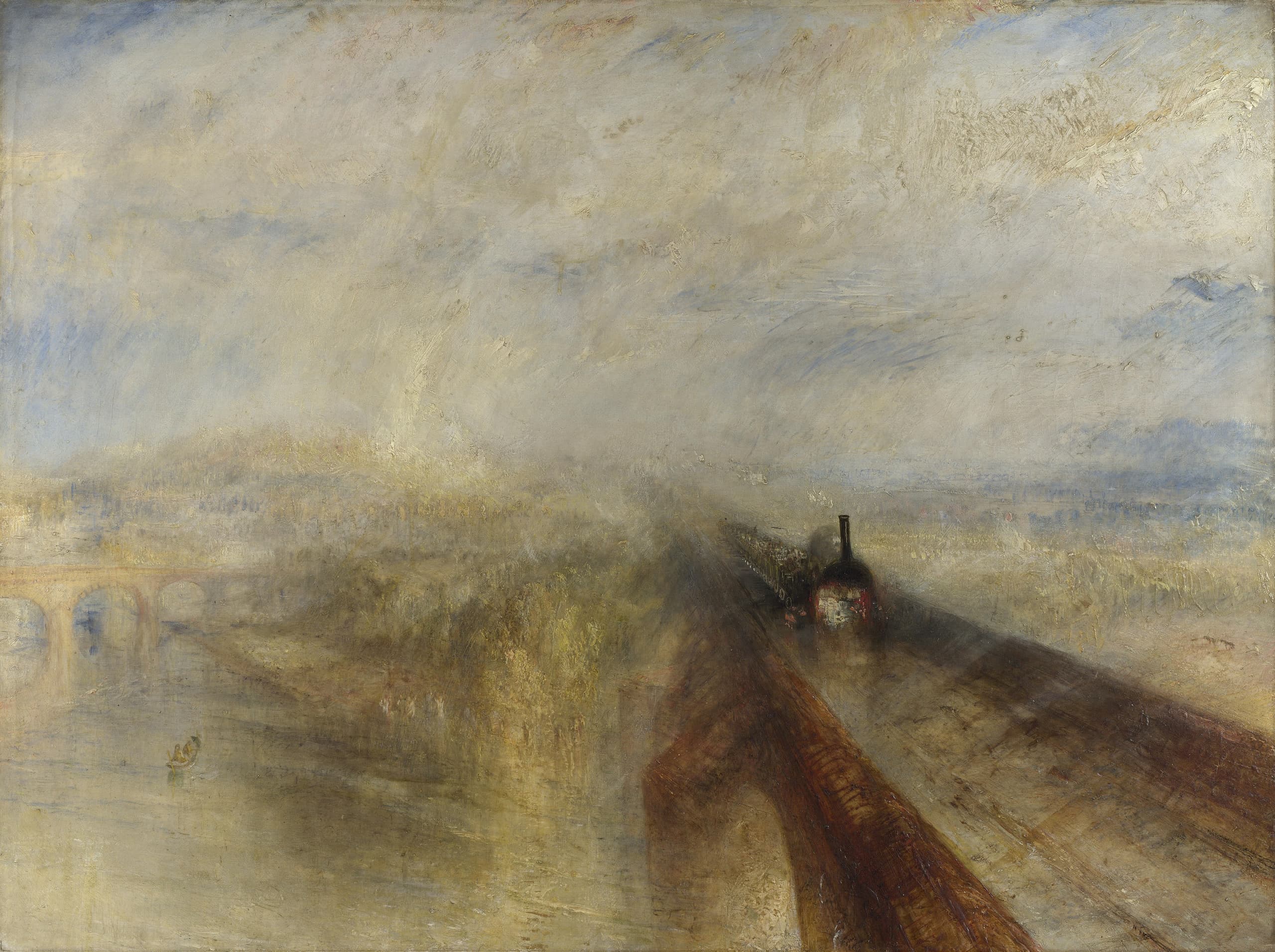
A hare runs ahead of a locomotive on the track. One is made of iron, the other of a few flicks of brown paint, and Turner has made them equally solid.
At a glance
- Artist
- J. M. W. Turner
- Date
- 1843
- Medium
- Oil on canvas
- Dimensions
- 91 × 121.8 cm
- Collection
- National Gallery, London
Look closer
The hare on the rails
A brown hare runs along the track ahead of the locomotive, low to the ground, ears back. It is painted with a few strokes of darker paint against the pale stone of the bridge, but it is more clearly defined than almost anything else in the picture. Turner has given it a sharp silhouette while the rain, the river, the far bank and even parts of the train itself blur into weather. The hare is faster than the engine, or at least it is still ahead.
The locomotive's firebox
The darkest shape in the painting is the black rectangular firebox of the locomotive, a solid block of shadow at the front of the engine. Everything around it — the steam, the rain, the bridge, the sky — is rendered in loose, wet strokes that blend into one another. The firebox holds its edge while the rest of the picture dissolves. It is the mechanical heart of the scene, the thing generating the speed, and Turner has painted it with a firmness he has withheld from everything else.
The stone bridge dissolving
The arches of the bridge on the left are built of stone, but Turner has painted them so that they seem to be coming apart in the rain and steam. The masonry loses its edges as it recedes, the blocks blurring into streaks of colour. You can see the structure — the curve of the arch, the line of the parapet — but the material itself appears to be dissolving. The old stone and the weather have been given the same loose, wet handling, so that the bridge seems to be made of the same substance as the storm.
The story
Turner painted a locomotive crossing a bridge in a rainstorm by making almost everything in the picture dissolve. The train is moving from right to left across the canvas, steam pouring from its stack, rain falling in streaks across the scene. The bridge beneath it — stone arches spanning the river — loses definition as it recedes into the weather. The far bank, the sky, the water below are all rendered in loose, blurred strokes that run into one another. The painting was made in 1843, using oil paint on canvas.
The one thing that does not dissolve is the hare. It runs ahead of the locomotive on the track, a small brown shape painted with a few clear strokes, more solid than the train itself. Turner has given it a defined silhouette while letting the rain, the steam, and the landscape blur together. The hare is faster than the engine, or at least it is still ahead on the rails.
The painting was exhibited at the Royal Academy in 1844. The handling of the paint was loose enough that some viewers thought it unfinished. Turner was working with oil paint in a way that let the strokes remain visible, that let colours blend wet into wet on the canvas, that did not smooth the surface into a uniform finish. The effect was to make the rain, the steam, and the speed visible as movement rather than as static objects.
The darkest shape in the painting is the locomotive's firebox, a black rectangle at the front of the engine. It holds its edge while everything else — the steam pouring from the stack, the rain streaking across the scene, the stone of the bridge — is painted with strokes that blur and merge. The firebox is the mechanical centre, the source of the power, and Turner has painted it with a firmness he has withheld from the rest of the picture.
The bridge is stone, but Turner has painted it so that it appears to come apart in the weather. The arches lose their edges as they recede, the masonry blurring into streaks of colour. You can see the structure, but the material seems to be dissolving into the same substance as the rain and steam. The old stone and the new machine are both being overtaken by the weather, or by the paint itself.
The painting is now in the collection of the National Gallery in London. It measures 91 centimetres high by 121.8 centimetres wide. The movement it is associated with is Impressionism, though that term was not in use when Turner painted it.
Why it mattered then
The painting was made in 1843, when railways were still new enough to be a subject of argument and fascination. The line depicted was part of the Great Western Railway, which had been built in the previous decade. Steam locomotives were changing the experience of distance and time in ways that were still being absorbed. Turner exhibited the painting at the Royal Academy in 1844, in a context where the handling of paint was expected to be smooth and the subject clearly legible. The loose, wet strokes and the blurred edges were a departure from that expectation. Some viewers thought the picture unfinished. Others recognised that Turner was attempting to paint speed and weather as experiences rather than as static scenes — that the dissolution of form was the point, not a failure of technique. The tension between the old stone bridge and the new locomotive, between the hare and the machine, between the natural storm and the mechanical steam, was legible to viewers in 1844 as a picture of change. The railway was overtaking the older landscape, but Turner has painted it so that both are overtaken by the weather, by the rain and steam that blur everything except the animal running ahead on the track.
Why it matters now
The painting is still discussed as an attempt to paint speed and weather as visible forces rather than as background. Turner made the rain, the steam, and the motion of the train into the substance of the picture itself, not by depicting them clearly but by handling the paint so that it behaves like weather — wet, blurred, dissolving edges and forms. The hare running ahead of the locomotive has remained a memorable detail because it reverses the expected relationship between the natural and the mechanical. The animal is faster than the engine, or at least it is still ahead, and it is painted more clearly than the train. Turner has made the machine dissolve into weather while the hare holds its form. The painting is also discussed in relation to Impressionism, a movement that developed later in the century and that shared Turner's interest in loose handling of paint and the depiction of light and weather. The date on the painting is 1843, decades before the term Impressionism was coined, but the techniques Turner used — wet paint, visible brushstrokes, blurred edges — are associated with that movement. Whether Turner influenced the Impressionists directly, or whether they arrived at similar techniques independently, is a matter of historical debate that the painting itself does not settle.
The surprising detail
The hare running ahead of the locomotive on the track is a detail that has puzzled viewers since the painting was exhibited. A hare can run at about 70 kilometres per hour in short bursts, which is faster than the trains of the 1840s could manage on that stretch of track. Turner has painted it as though it is genuinely ahead of the engine, not fleeing hopelessly but holding its lead. The animal is more clearly defined than the machine chasing it, a reversal of the expected relationship between the natural and the mechanical. Whether Turner saw a hare on the track, or whether he added it as a deliberate contrast to the locomotive, is not recorded.
What is disputed
The painting is associated with the movement called Impressionism in the verified data, but this is anachronistic: Turner painted it in 1843, and the term Impressionism was not coined until the 1870s. The relationship between Turner's techniques and those of the later Impressionists is a matter of art-historical interpretation, not a settled fact. The painting may have been made earlier than 1843, though that is the date recorded.
Remember this
Turner painted speed by making almost everything dissolve — except the hare, which he painted more clearly than the train.
Test yourself
Why has Turner painted the locomotive's firebox with a firm edge while letting the rest of the train blur into steam and rain?
The firebox is the source of the locomotive's power — the place where coal is burned to produce the steam that drives the engine. By painting it with a firm edge while letting everything else blur, Turner has marked it as the mechanical centre of the scene, the thing generating the speed and the steam. Everything around it — the rain, the bridge, even the rest of the locomotive — is painted with loose, blurred strokes that suggest movement and dissolution. The firebox holds its form because it is the origin of the motion, not part of it. Turner has used the handling of the paint to show the difference between the source of power and its effects.
Go deeper
- Rain, Steam and Speed – The Great Western Railway · Wikipedia
- Rain, Steam and Speed – The Great Western Railway — Wikidata · Wikidata
Image: J. M. W. Turner, Public domain. Licence: Public domain. Source.