III · THE WORK · ART HISTORY
Goya's The Third of May 1808
▶ Listen · narrated
Goya painted an execution that happened in 1808, but he painted it in 1814, after the occupiers had gone. What changed in those six years is in the picture.
At a glance
- Artist
- Francisco Goya
- Date
- 1814
- Dimensions
- 268 × 347 cm
- Medium
- Oil on canvas
- Location
- Museo del Prado, Madrid
Look closer
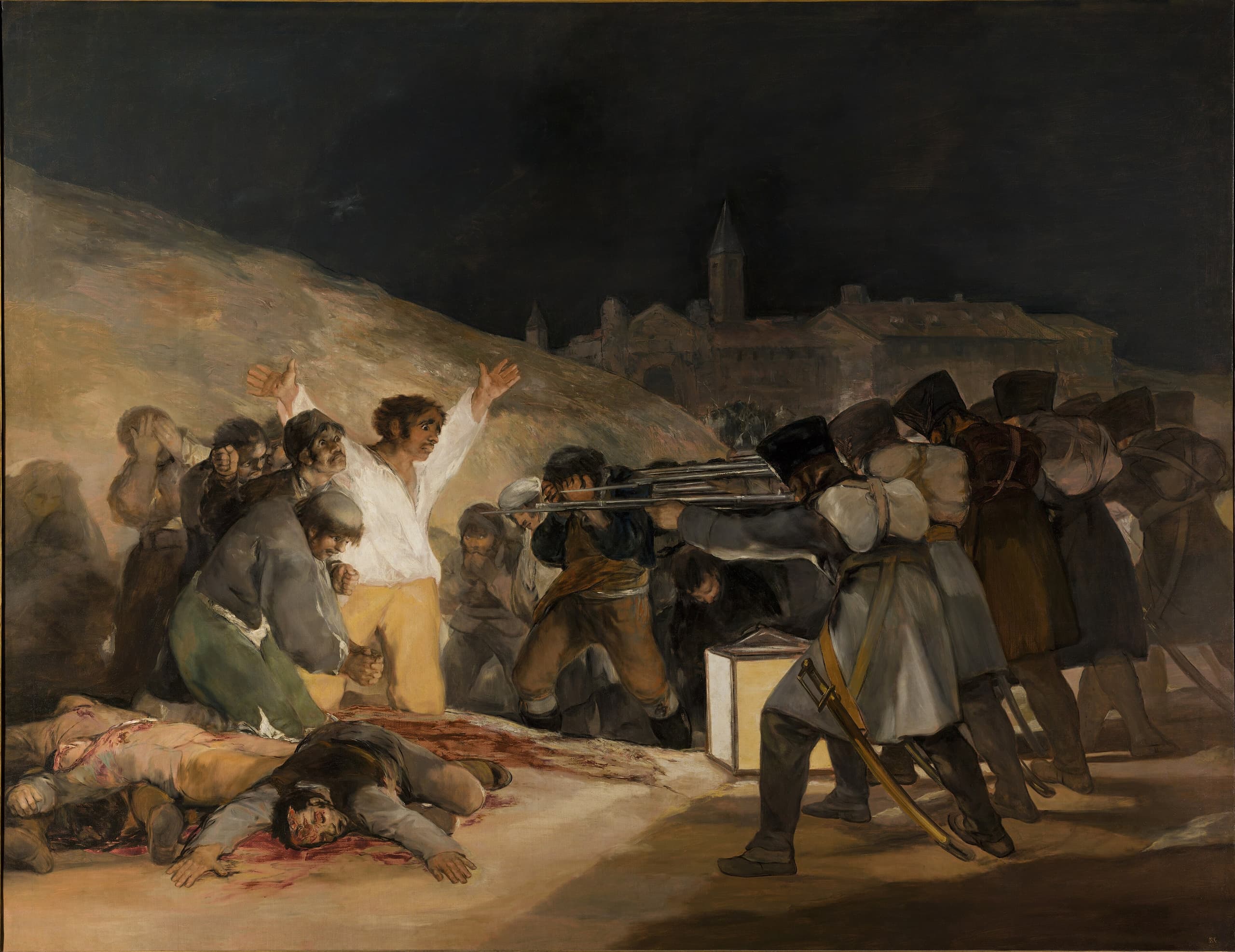
The lantern as the picture's only light source
A square lantern sits on the ground between the condemned and the soldiers. Everything in the painting is lit by it: the white shirt glows, the hillside falls into darkness, and the pool of light stops exactly where the composition needs it to stop. Goya has made the lamp the hinge of the scene. It belongs to the executioners — they brought it, they set it down — but it illuminates the victim. The device that makes the killing possible is also the device that makes us look at the man being killed.
The mark on the raised right palm
The man in white has his arms spread wide, and on his right palm there is a dark mark. It sits where the nail wound would be in images of the crucifixion. Goya has not made him Christ — the face is particular, the body is thick, the pose is desperate rather than composed — but he has quoted the stigmata clearly enough that a viewer in 1814 would recognise the reference. The man is being shot for resisting an occupying army, and Goya has marked him with the sign of martyrdom.
Faceless, uniform soldiers
The firing squad is a single mass of blue coats, white straps, black shakos and rifle barrels, all angled the same way. Not one face is visible. Goya has turned them away or shadowed them or cropped them out of the frame. They are a machine, not a group of individuals, and the painting offers no access to what they might be thinking or whether they hesitate. The choice makes them more frightening, but it also makes a point about what occupation does: it turns men into functions.
The story
On the second and third of May 1808, Madrid rose against the occupying French army, and the uprising was suppressed. Civilians were shot in the streets and on the hillsides outside the city. Goya did not paint the event at the time. He painted it six years later, in 1814, after the French had been driven out and the Spanish monarchy restored.
The painting shows an execution by lamplight. A man in a white shirt and yellow trousers kneels on the hillside with his arms flung wide. To his right, other prisoners wait: one kneels with his hands over his face, another stares, a monk prays. To his left, bodies lie in pools of blood. In front of him, a line of soldiers aims rifles at his chest. The light comes from a single lantern on the ground between them.
Goya was sixty-eight when he painted this. He had been court painter to the Spanish king, and he had lived through the occupation. What he saw during those years is not fully recorded, but the paintings he made afterward show someone who had seen atrocities and wanted them remembered in a particular way: not as heroic sacrifices but as murders, chaotic and specific and inexcusable.
The composition is deliberate. The victim is off-centre, lit like a stage actor, his shirt so bright it pulls your eye before you take in anything else. The soldiers are a dark wall, turned into silhouettes by the angle of the light. Between them the lantern sits on bare earth, a square of practical yellow light that makes the violence possible and makes it visible at the same time. Everything outside that pool of light — the city, the watching crowd hinted at in the distance, the hillside itself — falls away into darkness. Goya has built the picture so that you look where he wants you to look, and what he wants you to look at is the man who is about to be killed.
The white shirt is a choice. So is the pose, arms spread, and so is the dark mark on the right palm, in the position of the stigmata. Goya has not turned the man into a saint — the face is twisted with fear, the body is ungainly, the mouth is open — but he has made the reference to crucifixion clear enough that a viewer would not miss it. The man is being executed for resisting an army, and Goya has given him the sign of a martyr.
The painting was commissioned by the provisional Spanish government shortly after the French withdrawal. Goya proposed it himself. It was painted as a pair with another canvas, The Second of May 1808, which shows the street fighting the day before. Both were meant as public history paintings, records of resistance and reprisal. What Goya delivered was not a monument. It was an image of state violence, specific and unbearable, lit by a lamp the killers brought with them.
Why it mattered then
The painting was made for a newly restored government that wanted the occupation remembered as a national resistance. Goya gave them that, but he did not make it comfortable. The Second of May shows the street fighting — chaotic, violent, but at least mutual. The Third of May shows the aftermath: unarmed men shot in batches on a hillside, by lamplight, with no suggestion that this was a battle or that the condemned had any chance of survival. It is a painting about reprisal, not combat. It was commissioned as a public history painting, which in 1814 meant it was supposed to serve a political function. The provisional government wanted the events of May 1808 memorialised as the beginning of Spanish resistance. What Goya painted was not a call to arms or a martyrology in the usual sense. It was an execution scene, and it was composed to make you feel implicated: the light comes toward you, the victim looks past you, and the soldiers are anonymous. The painting does not let you take a side from a distance. It puts you in the scene, at night, on the hillside, while men are being shot. Whether the government got what it wanted is not recorded. The paintings were hung in public spaces, but they were not widely reproduced or discussed in Goya's lifetime. They were not unknown, but they were not central to how the war was remembered in Spain during the nineteenth century. That changed later.
Why it matters now
The painting is now read as a turning point in how war is depicted. It does not show a battlefield or a heroic last stand. It shows a killing, and it shows it in a way that makes the killing ugly and specific rather than noble. The victim is not a warrior; he is a man in a white shirt with his arms out, lit by a lantern the soldiers brought. The executioners are not individuals; they are a line of rifles and blue coats with no faces visible. Goya has taken the machinery of history painting — the large canvas, the dramatic light, the reference to Christian martyrdom — and used it to paint something history painting did not usually show: the moment when state violence is applied to a particular body, and the fact that it is state violence does not make it less terrible. That approach has been borrowed many times since. The composition — a lit victim facing a dark mass of executioners — appears in paintings by Édouard Manet and Pablo Picasso, among others. The peace symbol, designed by Gerald Holtom, was inspired by the pose of the man in the white shirt. The painting is cited as a reference point for images of execution and protest from the nineteenth century onward. It is treated as the template for a particular kind of political art: the kind that does not ask you to admire the sacrifice but to look at the violence and understand what is being done. What keeps it current is not the historical event but the structure of the image. A man is about to be killed by soldiers who have no faces. The light that lets us see him is the same light that lets them aim. That is not a statement about 1808. It is a statement about how power works, and it has not stopped being applicable.
The surprising detail
The painting was commissioned by the provisional government at Goya's own suggestion. He proposed it, which means he asked to paint it. That is unusual. History paintings of this scale were normally commissioned by institutions that specified the subject, and the subject was normally a victory or a founding myth or a moment of collective virtue. Goya proposed a painting of an execution carried out by an occupying army, six years after the fact, and he proposed it to the government that had just replaced that army. What he delivered was not a monument to resistance but a close view of men being shot on a hillside, with no suggestion that their deaths achieved anything except their deaths. The government accepted it, and it was hung in public. Whether anyone in 1814 found that as strange as it sounds now is not recorded.
What is disputed
The exact date of the executions depicted is recorded — third of May 1808 — but which execution site Goya painted, and whether he witnessed any of the killings himself, is not documented. The title refers to shootings that took place at several locations around Madrid. The painting is sometimes said to show the executions at Príncipe Pío hill, but that identification comes from later tradition rather than from Goya's own records.
Remember this
Goya painted an execution, not a battle, and he lit it with the lamp the executioners brought.
Test yourself
The lantern is the only light source in the painting, and Goya has placed it on the ground between the condemned man and the firing squad. Why does that placement matter to how we read the scene?
Because the lantern belongs to the soldiers — they brought it, they set it there — but the light falls on the victim, not on them. The same device that makes the execution possible, by letting the soldiers see their target in the dark, also illuminates the man for us. Goya has made the tools of violence into the tools of witness. The lamp is practical: it is there because you cannot shoot accurately in the dark. But its position means that what we see most clearly is not the soldiers or their authority but the man they are about to kill. The painting is structured so that the apparatus of state violence lights up its own victim, and we are made to look at him whether we want to or not.
Go deeper
Image: Francisco Goya, Public domain. Licence: Public domain. Source.