I · THE OBJECT · BRITISH MUSEUM
The Sutton Hoo Shoulder-Clasps
▶ Listen · narrated
These clasps fastened a warrior's leather armour. The gold is local, but the red stones inside travelled further than the warrior likely did.
At a glance
- Date
- 7th century
- Culture
- Anglo-Saxon
- Findspot
- Sutton Hoo, Suffolk, England
- Discovery
- 1938 ship burial excavation
Look closer
Cloisonné: cells before colour
The red pattern is not painted or enamelled. It is built from thousands of individual garnet pieces, each cut to fit a gold cell. The goldsmith soldered thin walls of gold onto a gold backing plate, creating a grid of compartments. Then garnet was cut to size for each cell and set into it. The technique is called cloisonné — from the French word for a partition. At arm's length the joins between cells are invisible, which means the cutting and fitting were done to tolerances a fraction of a millimetre wide.
Stepped pyramids in gold
Look at the curved ends of each clasp. The surface is not flat. It rises in a series of stepped gold frames, each one smaller than the last, forming a shallow pyramid. The garnet cells follow the same geometry, stepping inward. This is not decoration added to a surface: it is architecture in miniature, built up in layers. The effect is that light catches the edges of the steps, so the clasp reads as a sculptural object, not a flat one.
Boar heads in profile
At the squared-off end of each clasp, two small boar heads face outward in profile. They are three-dimensional castings in gold, with garnet eyes. The boar was a protective symbol among the Anglo-Saxons, and appears on helmets and other martial equipment from the period. These are not decorative animals: they are apotropaic — meant to guard the wearer.
The story
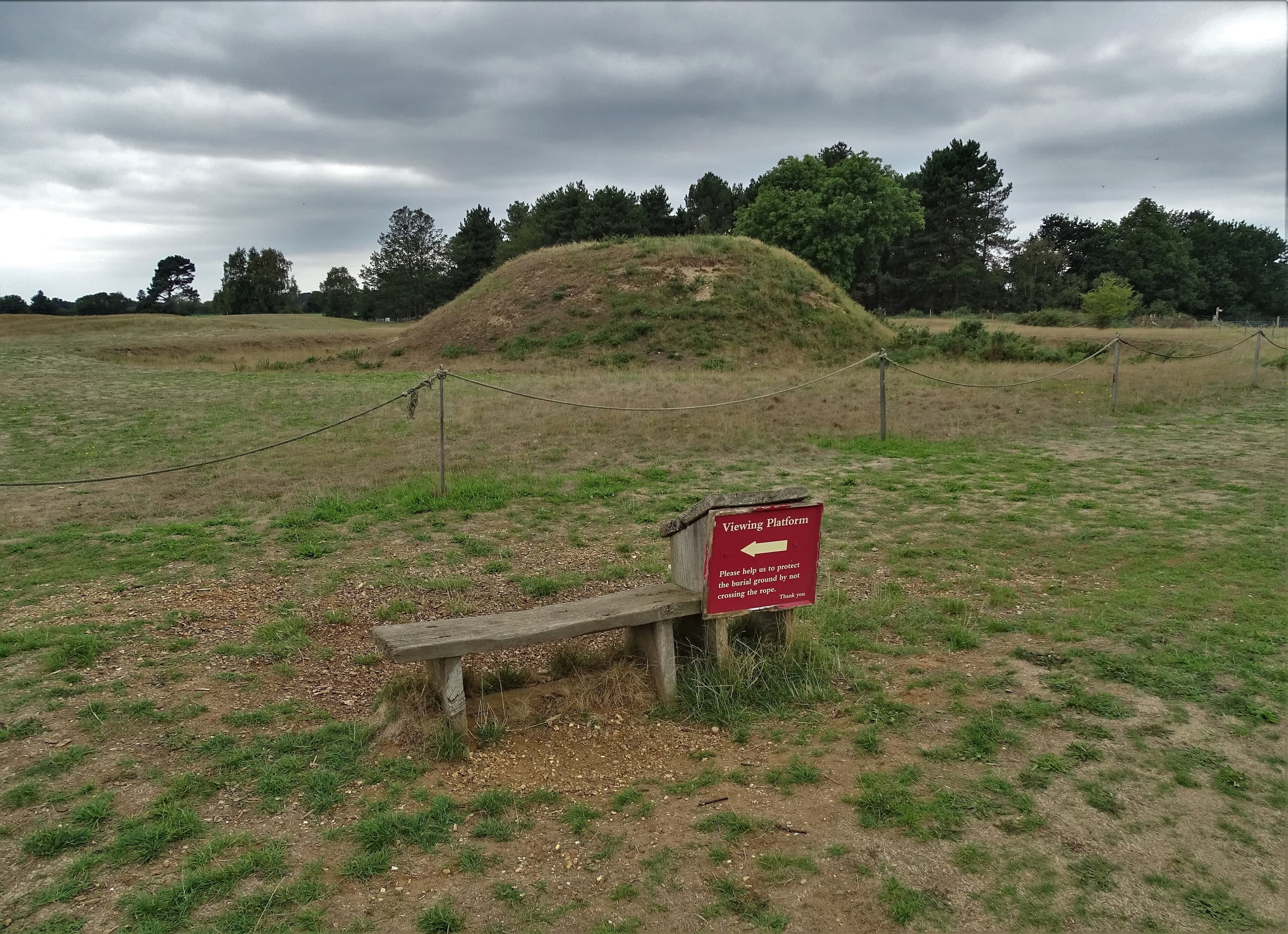
The shoulder-clasps were found in a ship burial at Sutton Hoo, near Woodbridge in Suffolk, in 1938. The site is a cemetery on a low hill overlooking the River Deben estuary. The burial that contained the clasps had been dug into the centre of a ship, which was then covered with earth to form a mound. The ship itself had rotted away, but its impression remained in the soil, along with the iron rivets that had held the planks together.
Inside the burial chamber were the remains of a warrior's equipment: a helmet, a shield, a sword, and a suite of gold fittings including these clasps. There was no body — the soil at Sutton Hoo is too acidic for bone to survive — but the objects suggest this was the grave of a person of considerable status, possibly a king. Scholars have suggested Rædwald, a king of the East Angles, as a candidate, but the identification is not certain.
The clasps themselves are functional objects. They fastened the two halves of a leather cuirass — body armour worn over the shoulders. Each clasp is hinged: one half has a pin that slots into a loop on the other half, allowing the wearer to fasten and unfasten the armour. The hinge mechanism is gold, and it still works.
The red stones are garnet. Garnet deposits exist in Europe, but the chemical composition of the Sutton Hoo garnets suggests they came from India or Sri Lanka. This is not certain — garnet analysis is complex, and not all garnets have been tested — but the evidence points to the Indian subcontinent. If that is correct, the stones travelled thousands of miles before they reached Suffolk, passing through multiple hands and trade networks.
The goldwork itself was almost certainly made locally, or at least within the Anglo-Saxon regions of England. The style of the cloisonné and the imagery — particularly the boar heads — fit within a known Anglo-Saxon tradition. But the garnet was imported, probably as rough stone, and then cut and polished by the goldsmith who made the clasps.
The technique of cloisonné requires control at a very small scale. The goldsmith had to solder the cell walls without melting the backing plate, cut each garnet piece to fit its cell, and set the stones without adhesive — they are held in place by the pressure of the cell walls and, in some cases, by a layer of gold foil beneath the garnet that was folded up around the edges. The foil also reflects light back through the stone, making the red more vivid.
The ship burial was excavated by Basil Brown, a self-taught archaeologist working for the landowner, Edith Pretty. When the significance of the find became clear, national scholars took over the excavation. The objects were declared treasure trove — meaning they legally belonged to the Crown — but Pretty declined compensation and donated them to the British Museum, where they remain.
Why it mattered then
The clasps were made to be seen. They sat on the shoulders, where they would catch light and draw the eye of anyone standing near the wearer. In a society without coinage or widespread literacy, display was a form of communication. The gold announced wealth. The garnet announced access to long-distance trade. The craftsmanship announced control over skilled labour. All three were forms of power. The ship burial itself was a public act. It required the labour of many people: to dig the trench, to drag the ship up from the river, to place the objects inside, to cover it with earth. The mound that resulted would have been visible from the river and from the surrounding land. It was a permanent marker, a statement that this person — and by extension, this family or this group — commanded resources and loyalty. The choice to bury these objects, rather than pass them on, is also significant. In a world where gold and garnet were rare, removing them from circulation was a costly decision. It suggests that the symbolic value of the burial outweighed the practical value of the objects, or that no heir had the standing to claim them.
Why it matters now
The Sutton Hoo ship burial changed what historians thought they knew about seventh-century England. Before 1938, the period was often described as a dark age — a time of cultural collapse. The ship burial showed that the Anglo-Saxons were connected to long-distance trade networks, that they had access to luxury materials, and that they had craftspeople capable of working to very high technical standards. The clasps are evidence of a trade route that linked India or Sri Lanka to Suffolk. The exact path the garnet took is not recorded, but it would have passed through multiple intermediaries: merchants, ports, overland routes. The fact that it reached Suffolk suggests that the Anglo-Saxons were not isolated, and that they had something to trade in return — possibly wool, possibly metalwork, possibly slaves. The technical skill visible in the clasps also matters. The goldsmith who made them had to understand the properties of gold — its melting point, its behaviour under heat, the way it bonds to itself. They had to understand garnet — how it splits along certain planes, how to cut it without shattering it. They had to plan the design in advance, because cloisonné does not allow for errors: once the cells are soldered, the pattern is fixed. This is not the work of a society in decline. It is the work of a society with specialist knowledge and the resources to support specialists.
The surprising detail
The ship burial contained no body. The soil at Sutton Hoo is acidic, and bone does not survive in it. This means the identification of the burial as royal, and the suggestion that it might be Rædwald's grave, rest entirely on the objects. There is no inscription, no name, no direct evidence. The argument is circumstantial: the wealth of the grave goods, the effort required to create the burial, and the historical record, which places Rædwald in the right region at roughly the right time. But it is not certain, and it may never be.
How it got here
The objects were found during excavation of a burial mound on land owned by Edith Pretty. They were declared treasure trove, meaning they legally belonged to the Crown, but Pretty declined the compensation she was entitled to and donated the finds to the British Museum. The objects have remained in the museum's collection since 1939. There is no active repatriation claim associated with the Sutton Hoo material.
Remember this
Gold frames from Suffolk, red stones from India or Sri Lanka, and a hinge that still works after fourteen hundred years.
Test yourself
Why would a goldsmith place gold foil beneath a translucent garnet in a cloisonné cell?
The foil reflects light back through the stone, making the colour more vivid. Garnet is translucent, not opaque, so light passes through it. Without the foil, some of that light would be absorbed by whatever sits beneath the stone — the backing plate, or shadow inside the cell — and the garnet would look darker. The foil turns the cell into a tiny mirror, bouncing light back out through the stone. In some cases the foil was also folded up around the edges of the garnet, helping to hold it in place. This is a practical solution to two problems: securing the stone, and controlling how it looks. It shows that the goldsmith understood both the mechanics of the setting and the optics of the material.
Go deeper
Image: Anglo Saxon burial mound at Sutton Hoo by Neil Theasby. Licence: CC BY-SA 2.0. Source.