III · THE WORK · ART HISTORY
The Cave Paintings of Dunhuang
▶ Listen · narrated
A single site holds a millennium of continuous painting, plus fifty thousand documents that were hidden in the eleventh century and found in 1900.
At a glance
- Site type
- Cave temple complex
- Location
- 25 km southeast of Dunhuang, Gansu, China
- Period of use
- 366 CE to 14th century
- Number of caves
- 500
- Library Cave sealed
- 11th century
Look closer
Flying apsaras with scarves as the only sign of motion
Celestial figures float across the painted ceilings, their bodies horizontal, their robes and scarves streaming behind them. The apsaras — spirits attendant on the Buddha — have no wings. Movement is shown entirely through drapery: long ribbons of cloth that curve and ripple as if the figure were swimming through air. The background is flat, the perspective minimal, so the sense of flight depends on the rhythm of these painted scarves, which loop and spiral across the surface in patterns that took centuries to refine.
Multiple painting styles in one wall
Dunhuang sat at the junction of routes leading west and east along the Silk Road, and the painting styles record that position. Some caves show figures with shading and volume that came along trade routes from India and Persia. Others use the flat, linear brushwork of Chinese scroll painting. In certain chambers both appear on the same wall, painted decades or centuries apart as the site remained in use and tastes shifted. The overlapping styles are a record of which direction the painters and patrons had travelled from.
Oxidised lead white now read as dark grey
Many of the figures that now appear to wear dark robes were originally painted in lead white, a pigment that darkens over time as it reacts with hydrogen sulphide in the air. The chemical change is irreversible, so what a visitor sees today is not the colour scheme the painters intended. Flesh tones have also shifted: red lead has turned brown in some caves, and certain blues have faded. The palette we can reconstruct from written records and from protected fragments does not match the palette on the walls, which means the visual experience of the caves has altered substantially since they were sealed.
The story
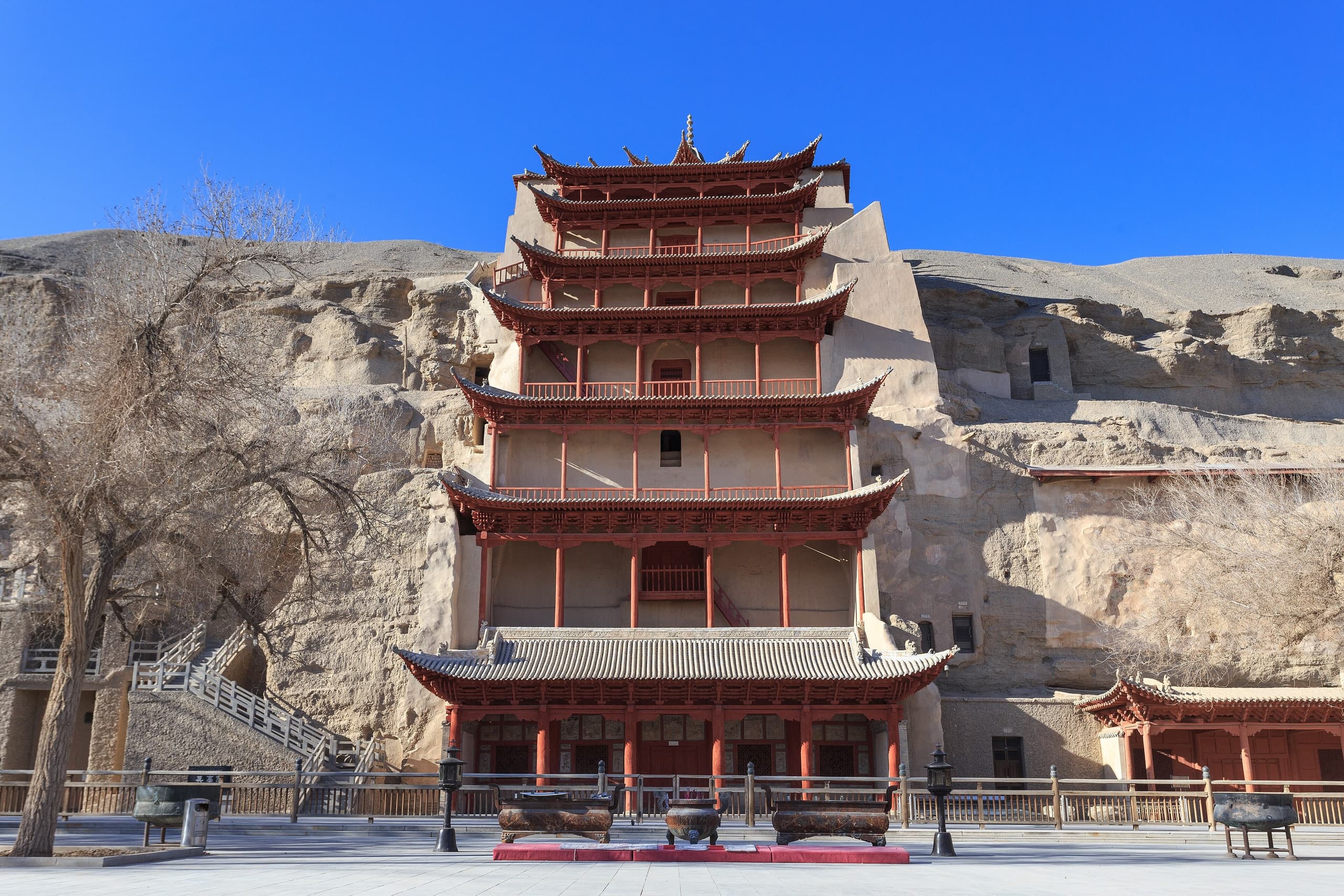
The caves are cut into a cliff face above a river valley in a desert region. Dunhuang itself was an oasis town where the northern and southern branches of the Silk Road rejoined before continuing east, and where traders, pilgrims and officials stopped to rest and resupply. The site is also known as the Mogao Caves, the Thousand Buddha Grottoes, or the Caves of the Thousand Buddhas, though the term Dunhuang Caves sometimes refers collectively to this site and several smaller cave groups in the surrounding area, including the Western Thousand Buddha Caves, Eastern Thousand Buddha Caves, Yulin Caves, and Five Temple Caves.
The record states that caves were dug out in 366 CE as places for Buddhist meditation and worship. Over the next thousand years, more chambers were excavated into the soft conglomerate rock, plastered, and painted. By the time work stopped in the fourteenth century, five hundred caves had been made. The interiors vary in size and layout: some are small meditation cells, others large halls with painted ceilings and rows of sculpted figures. The walls and ceilings are covered with Buddhist imagery — narrative scenes, devotional figures, decorative patterns — executed in mineral pigments on a layer of plaster.
The painting was not the work of a single period or a single tradition. Dunhuang's position meant that people and ideas arrived from multiple directions, and the styles visible in the caves reflect that. Some figures are modelled with shading and suggest three-dimensional form, techniques that travelled east from India and Persia. Others are rendered in the flat, calligraphic brushwork associated with Chinese painting. In certain caves, both approaches appear on the same wall, layered as the site continued to be used and repainted over centuries. The stylistic variety is a record of movement: of which painters worked there, which patrons commissioned the work, and which visual languages were current when.
In 1900, a Daoist caretaker discovered a sealed chamber, now called Cave 17 or the Library Cave, packed with manuscripts, paintings on silk, and other documents. The chamber had been walled up in the eleventh century, and the reason for sealing it is not recorded. The cache contained roughly fifty thousand items, many of them Buddhist texts but also secular documents, letters, and records in Chinese and other languages. After the discovery, portions of the collection were sold or given to foreign explorers and scholars, and the contents were dispersed. The largest groups of manuscripts are now held in Beijing, London, Paris and Berlin. The International Dunhuang Project was established to coordinate research on the scattered material and to make it accessible digitally.
The caves are now a tourist site, though the number of visitors allowed in per day has been limited to reduce the impact on the paintings. The interiors are vulnerable to changes in humidity, temperature and carbon dioxide levels, all of which fluctuate with the presence of people. Some caves are closed to the public entirely, and others are shown only in rotation.
Why it mattered then
Dunhuang mattered because it was a major stop on the Silk Road before the desert crossing, and a secure point on the return journey east. It was a place to rest, to trade, to wait for a caravan, and to pray for safe passage. The caves were made by people who understood the journey as dangerous and the outcome as uncertain, and who wanted to leave something that would last longer than they would. The act of excavating and decorating a cave was itself a form of devotion, a way of accumulating religious merit. Donors are sometimes named in inscriptions, and the range of names suggests that patrons included both wealthy families and groups of merchants or monks pooling resources. The site was not a single monastery but a collection of individual chapels and halls, each commissioned separately, which explains the variety in size, style and subject matter. The caves became a place of pilgrimage, and the act of viewing the paintings and sculptures was understood as spiritually beneficial. The painted narratives taught Buddhist doctrine to those who could not read, and the sheer accumulation of images — hundreds of Buddhas, thousands of attendant figures — created an environment meant to represent the paradise that awaited the faithful.
Why it matters now
The caves are significant now because they preserve a record of continuous artistic and religious practice over a period when much else has been lost. The paintings show how Buddhist imagery adapted as it moved east, and how local and imported styles coexisted and influenced each other. The manuscripts from the Library Cave include some of the oldest surviving printed documents, as well as texts in languages that are otherwise poorly recorded. Together, the visual and textual material offers a detailed picture of life, trade, and belief along the Silk Road during a period for which other evidence is fragmentary. The early twentieth-century removals remain contentious. The manuscripts and paintings that left China are now distributed across institutions in multiple countries, and their dispersal has made comprehensive study difficult. The International Dunhuang Project has worked to reunite the material digitally, creating a shared archive that allows scholars worldwide to access images and transcriptions. The question of where the objects should be held is unresolved, and arguments about repatriation continue. The caves also matter as a case study in conservation. The paintings are deteriorating, and the causes are both natural — salt migration, humidity, microbial growth — and human — damage from touch, changes in airflow, the introduction of electric lighting. The decision to cap visitor numbers reflects a broader tension between making cultural heritage accessible and preserving it for the future. The site is now a testing ground for techniques in environmental monitoring, digital documentation, and the stabilisation of painted surfaces on rock.
The surprising detail
The Library Cave was sealed in the eleventh century, and no contemporary account explains why. The chamber contained manuscripts and paintings stacked from floor to ceiling, many of them damaged or incomplete, which has led to the suggestion that it was a storage room for worn-out sacred texts that could not simply be discarded. Another theory is that the cave was sealed in haste, possibly to protect the contents from an approaching army. A third possibility is that it was a working library that was closed and forgotten when the site declined in importance. The lack of a clear answer is itself unusual: the caves were in continuous use for centuries, and records were kept, yet the sealing of a room full of documents was not written down, or the record has not survived.
What is disputed
The reason for sealing the Library Cave in the eleventh century is not recorded, and the theories proposed — that it was a storage room for damaged texts, a library closed in haste, or a cache hidden from invaders — remain speculative. The date of 366 CE for the beginning of work at the site is given in later sources but is not independently confirmed. The number of caves is reported as five hundred, but this count may include chambers that were never completed or have since collapsed, and different sources define a 'cave' differently.
Remember this
A thousand years of painting in five hundred caves, and a library that was sealed without explanation and opened nine centuries later.
Test yourself
The Library Cave contained roughly fifty thousand items when it was opened in 1900. Given that the cave was sealed in the eleventh century, and that the documents inside included Buddhist texts, secular records, and letters in multiple languages, why is the absence of a recorded reason for sealing the cave so puzzling?
Because the site was in continuous use as a place of pilgrimage and worship, and because the documents themselves show that records were kept. The caves were not abandoned suddenly or destroyed; they continued to be visited and maintained for centuries after the Library Cave was sealed. The act of walling up a chamber full of manuscripts would have been deliberate and effortful, and the contents were valuable enough that portions of them were sold or given away after the discovery. The fact that no inscription, letter, or chronicle mentions the sealing suggests either that the reason was so obvious it did not need to be stated, or that the record was lost, or that the sealing was done quietly for a reason that was not meant to be shared. Each of those possibilities raises further questions, and none has been confirmed. The silence is the puzzle.
Go deeper
Image: Zhangzhugang, CC BY-SA 4.0. Licence: CC BY-SA 4.0. Source.