III · THE WORK · ART HISTORY
The Dome of the Rock
▶ Listen · narrated
The building has stood for thirteen centuries, but the argument written into its walls — in gold mosaic letters running for 240 metres — has never been resolved.
At a glance
- Completed
- 691
- Commissioned by
- Abd al-Malik, Umayyad Caliphate
- Materials
- Marble, wood, copper, aluminium
- Form
- Octagonal shrine with dome
Look closer
The octagonal plan built around the rock
The building is shaped as two octagons, one inside the other, with a circular arcade at the centre. The rock itself — uncut, irregular — sits under the dome. The octagonal form may have been influenced by a Byzantine church built between 451 and 458 on the road between Jerusalem and Bethlehem. The plan creates a walking path: you enter through one of the outer walls, move through the ambulatory between the two octagons, and approach the rock at the centre, which is enclosed but visible.
The inscription band running inside the arcade
A continuous band of mosaic inscription runs around the inner octagon, covering roughly 240 metres. The text is in Arabic, formed in gold letters against a background of coloured glass and stone. These inscriptions proclaim Islam and the prophet Muhammad. They represent the practice of writing religious texts into the fabric of a building, which became common in Islamic architecture afterward. The inscriptions have been called a milestone because of this: they established a pattern.
Ottoman tilework replacing the original mosaic outside
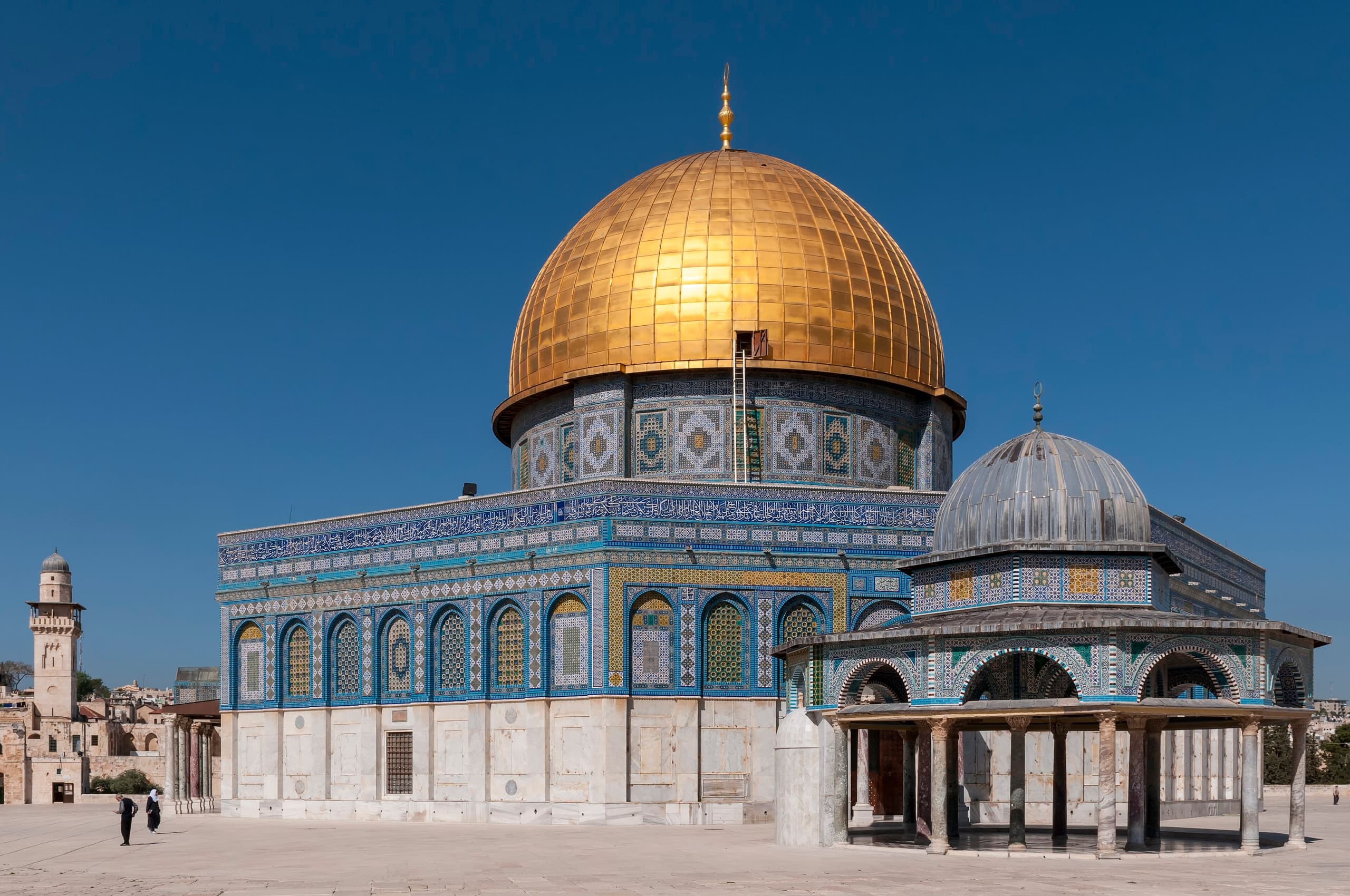
The exterior walls were originally decorated with mosaic, patterned after nearby Byzantine churches and palaces. During the Ottoman period, those mosaics were replaced with tiles in the Iznik style — brightly coloured, mainly blue and white. The dome itself has been rebuilt and recovered more than once. The original dome collapsed in 1015 and was rebuilt in 1022–23. The current gold-plated covering was applied in 1959–64 and again in the 1990s. What you see from outside is therefore largely Ottoman and modern work, not the original surface.
The story
The Dome of the Rock was built in 691 by order of Abd al-Malik, the Umayyad caliph, during a period of internal conflict known as the Second Fitna. It stands on the Temple Mount in Jerusalem, at the centre of what is now the Al-Aqsa mosque compound. The structure is a shrine, not a congregational mosque — it was built to enclose and honour a particular stone, not to hold Friday prayers.
The rock at the centre is called the Foundation Stone, or Noble Rock. For Muslims, the site is significant because of the belief that Muhammad's Night Journey — his miraculous journey to heaven — began from this rock. For Jews and Christians, the rock is believed to be the place where Abraham prepared to sacrifice his son. Jewish tradition also holds that the site is where God created the world and Adam, and that a temple destroyed by the Romans in 70 CE once stood there. The Dome of the Rock was built directly on top of this contested ground.
The building is octagonal. An outer octagonal wall encloses an inner octagon of columns and piers, which in turn surrounds a circular arcade. The rock sits under the dome at the centre, uncut and irregular. The dome has a subtly bulbous shape — not hemispherical, but slightly swollen. The original dome collapsed in 1015 and was rebuilt in 1022–23.
The decoration was elaborate from the beginning. The interior is covered with mosaics made of coloured glass and stone, and the inscriptions are set in gold letters. The plan and the mosaic work were patterned after Byzantine churches and palaces nearby. The octagonal plan itself may have been influenced by a Byzantine church built between 451 and 458, though the connection is not certain.
The exterior has changed more. The original mosaic decoration was replaced during the Ottoman period with tiles in the Iznik style — brightly coloured ceramics, mainly blue and white. The dome was recovered with gold-plated aluminium in 1959–64 and again in the 1990s. The building you see from outside is therefore a composite: the structure and interior decoration date to 691, but the outer surface is largely Ottoman and modern.
The inscriptions inside are themselves an argument. They run continuously around the inner octagon for roughly 240 metres, proclaiming Islam and naming Muhammad. These are the inscriptions that have been described as a milestone: after the Dome of the Rock, such texts became a common feature in Islamic buildings. The practice of writing religious proclamation into architecture — making the building itself a statement of faith — appears here in 691, at least in the surviving record.
Why it mattered then
The Dome of the Rock was built during the Second Fitna, a civil war within the Umayyad Caliphate. Abd al-Malik ordered its construction at a moment when his authority was contested and Jerusalem was under his control. The building made a claim: it placed an Islamic monument on a site sacred to Jews and Christians, and it did so with a level of ambition and expense that announced the permanence and legitimacy of Islamic rule. The inscriptions inside are part of that claim. They proclaim Islam and name Muhammad in gold mosaic letters, running for 240 metres around the inner arcade. The texts are not private or internal — they are architectural, built into the fabric of the shrine, visible to anyone who enters. The Dome of the Rock is the structure that established this practice. Afterward, inscriptions became a standard feature of Islamic buildings, but in 691 it was a new form of religious argument: not a book or a sermon, but a building that speaks.
Why it matters now
The Dome of the Rock has been called Jerusalem's most recognisable landmark, alongside the Western Wall and the Church of the Holy Sepulchre. It remains at the centre of competing religious claims to the same ground. The site is sacred to Muslims, Jews and Christians, and the building itself — because it was constructed on top of the Foundation Stone — is both a declaration and a problem. It cannot be separated from the political arguments that surround it. The building is also a document. It is the surviving work of Islamic architecture from 691, and it contains the inscriptions that established a pattern followed for centuries afterward. Art historian Oleg Grabar described it as a "unique monument of Islamic culture in almost all respects", including as a "work of art and as a cultural and pious document". It is both an object to be studied and a site that cannot be studied neutrally. The Dome of the Rock is a shrine, a landmark, an argument and a record, and it has been all of those things since the year it was completed.
The surprising detail
The dome has been rebuilt and recovered multiple times, but the original structure beneath it — the octagonal walls, the columns, the interior mosaics — has stood since 691. The original dome collapsed in 1015 and was rebuilt in 1022–23. The exterior mosaics were replaced with Ottoman tiles. The current gold-plated covering was applied in 1959–64 and again in the 1990s. What this means is that the building you see is a composite: the bones are from the seventh century, the skin is largely Ottoman, and the dome's surface is modern. The inscriptions inside, however — the 240 metres of gold mosaic letters proclaiming Islam — are original. The argument written into the walls has outlasted the dome that covers them.
What is disputed
The influence of the Byzantine church built between 451 and 458 on the octagonal plan is suggested but not certain. The inscriptions are described as a milestone because they established a pattern, but whether they were the absolute first such inscriptions in Islamic architecture is not stated in the sources — only that they are the inscriptions that proved to be a milestone and that afterward such texts became common.
Remember this
The Dome of the Rock is a building and an argument, constructed on ground sacred to three religions, with its case written in gold letters into the walls.
Test yourself
The Dome of the Rock was built during the Second Fitna, a civil war within the Umayyad Caliphate. How does that context help explain why Abd al-Malik chose to build an expensive, permanent monument in Jerusalem at that particular moment?
A civil war is a crisis of legitimacy: it means your authority is being contested by rivals who believe they have a better claim to rule. Abd al-Malik built the Dome of the Rock at a moment when his control was uncertain and Jerusalem was under his authority. The building was a declaration — it placed a monumental Islamic shrine on a site sacred to Jews and Christians, and it did so with a level of expense and ambition that announced permanence. The inscriptions inside, proclaiming Islam in gold mosaic letters for 240 metres, were not private texts but public statements built into the architecture. The Dome of the Rock was not just a religious act; it was a political one, asserting that Islamic rule was not temporary or provisional but established and enduring. Building something meant to last for centuries is a way of claiming that your authority will last as well.
Go deeper
Image: Ralf Roletschek, GFDL 1.2. Licence: GFDL 1.2. Source.