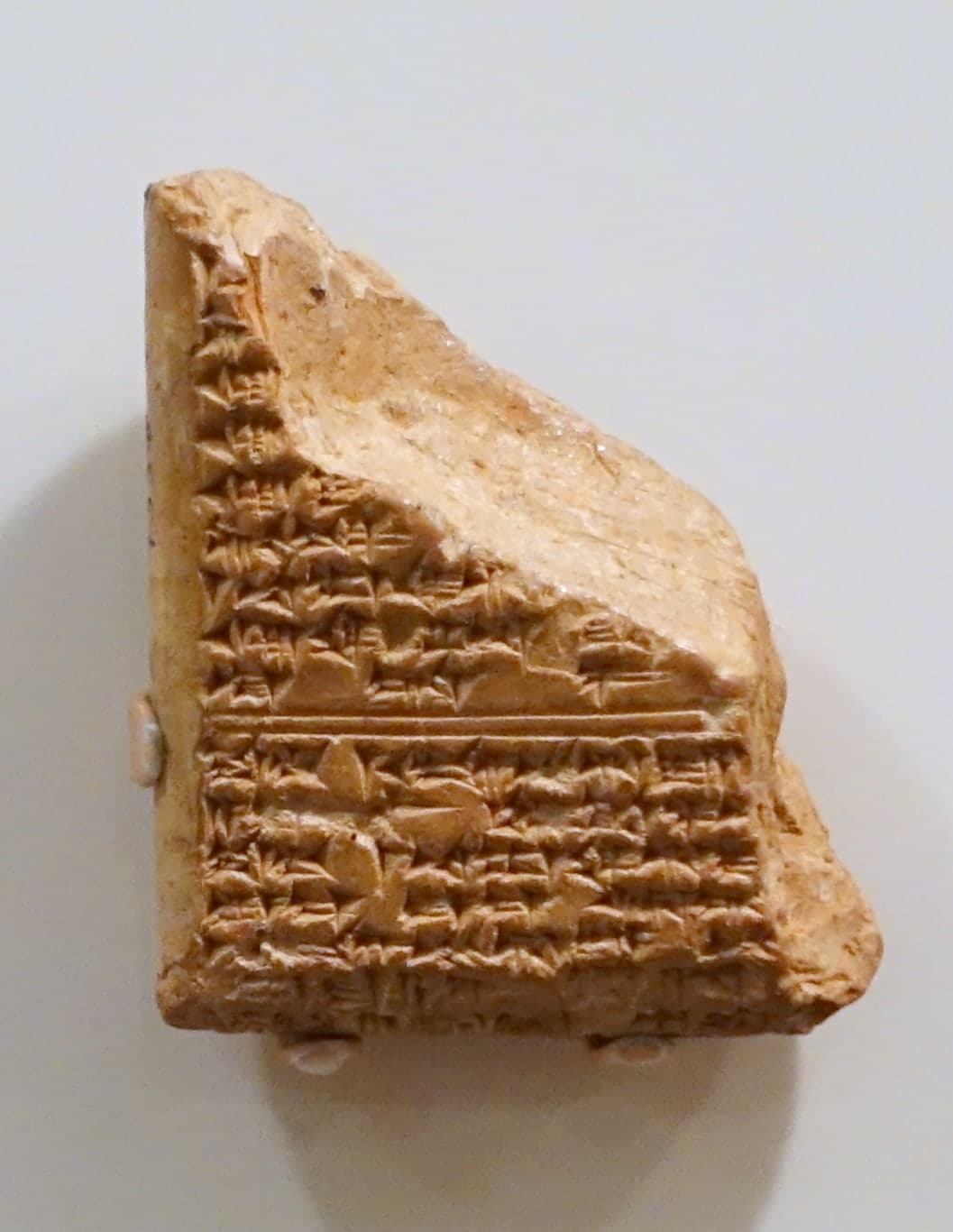
I · THE OBJECT · BRITISH MUSEUM
The Amarna Letters
▶ Listen · narrated
When Egypt negotiated with its neighbours, it did not write in Egyptian. It wrote in Akkadian, on clay, in the script of Mesopotamia — a diplomatic language no pharaoh spoke at home.
At a glance
- Period
- Middle of the 14th century BC, no more than thirty years
- Material
- Clay tablets inscribed in cuneiform
- Language
- Primarily Akkadian; one long letter in Hurrian
- Number of tablets
- 382 tablets and fragments
- Find location
- El-Amarna, Upper Egypt
Look closer
A mixed language on the page
The Akkadian in these letters is not the Akkadian of Mesopotamia. It is coloured throughout by the mother tongue of the scribes who wrote it — probably an early form of the language that would later become Hebrew and Phoenician. Scholars call this mixture Canaanite-Akkadian. The interference is not occasional: it runs through the grammar and vocabulary. These letters record what happens when people write in a lingua franca they speak as a second language, and the substrate shows through.
One letter in a different language entirely
Most of the archive is in Akkadian, but one letter — catalogued as EA 24 — is written in Hurrian, a language unrelated to either Akkadian or Egyptian. It is a long letter, and it is the longest continuous text in Hurrian known to survive. Why this one letter was written in Hurrian, and whether the Egyptian recipient could read it or needed it translated, the archive does not say.
Most were not found in context
Of the 382 tablets and fragments, only 26 were found in their archaeological context — a building designated Q42.21. The rest were dug up before controlled excavation, so the precise location within the site, and the original arrangement of the archive, are not recorded. What is known is that they came from el-Amarna, the short-lived capital founded by Akhenaten.
The story
Egypt in the mid-14th century BC governed an empire that stretched into the Levant. Maintaining that empire required constant communication: with Egyptian representatives stationed in Canaan and Amurru, and with the leaders of neighbouring kingdoms. The medium for that communication was not Egyptian hieroglyphs or hieratic script. It was cuneiform, pressed into clay, writing Akkadian — the language of Mesopotamia.
Akkadian had become the diplomatic language of the region. It was nobody's first language in Egypt or Canaan, but it was the language everyone's scribes were trained to write when corresponding across borders. The choice was practical: Akkadian was already established as the language of international statecraft, and cuneiform on clay was durable and portable. Egyptian scribes learned it; Canaanite scribes learned it; and the result is this archive, written in a language foreign to both sender and recipient.
The tablets were found at el-Amarna, in Upper Egypt. That is the modern name for Akhetaten, the city Akhenaten founded as his new capital and which was abandoned shortly after his death. The city itself did not last long — it was occupied for around fifteen years — but during that time it served as the administrative centre of the Egyptian state, and the archive reflects that. The span of the correspondence is no more than thirty years in the middle of the 14th century BC.
The archive contains 382 tablets and fragments. Most are letters; the rest are literary texts and school texts — the kind of material you would expect in a scribal training environment. Of the letters, 350 survive in some form. They record requests, complaints, reports, and the routine back-and-forth of administering territory and managing relationships with neighbouring powers. The tone varies: some are deferential, some are blunt, some are anxious.
The Akkadian in the letters is not standard. It is shaped by the native language of the scribes who wrote it. Scholars describe it as Canaanite-Akkadian, a mixed language where the grammar and vocabulary are pulled toward the scribes' first language — probably an early form of what would later become Hebrew and Phoenician. This is not occasional interference: it is pervasive. The letters are evidence of what happens when a lingua franca is used by people who do not speak it natively, and the substrate language leaves its mark throughout.
One letter stands apart. It is catalogued as EA 24, and it is written not in Akkadian but in Hurrian, a language unrelated to either Akkadian or Egyptian. It is a long letter, and it is the longest continuous Hurrian text known to survive. Why it was written in Hurrian is not recorded. Whether the Egyptian court could read it, or whether it was translated on arrival, the archive does not say.
The tablets were published in two volumes by Jørgen Alexander Knudtzon, in 1907 and 1915. That edition, Die El-Amarna-Tafeln, remains the standard reference. It includes 358 of the tablets. The remaining 24, excavated after Knudtzon's work, have since been published separately.
Why it mattered then
The choice to write in Akkadian rather than Egyptian was a practical one, but it also marked Egypt's participation in a system of international relations that operated according to shared conventions. Using Akkadian signalled that Egypt recognised the same diplomatic norms as the other major powers of the region. It was a language of parity, not imposition: Egypt wrote to its neighbours in the same language those neighbours used when writing to each other. The content of the letters reflects the concerns of an empire managing distant territory. Egyptian representatives in Canaan and Amurru reported on local conditions, requested resources, and complained when support did not arrive. Neighbouring rulers wrote to the pharaoh with requests, grievances, and assurances of loyalty. The correspondence is not ceremonial: it records the work of maintaining control and managing alliances in a region where Egypt's authority was contested and required constant reinforcement. The archive also reflects the infrastructure required to sustain this system. Scribes had to be trained in a foreign script and a foreign language. Clay tablets had to be prepared, inscribed, dried, and transported. Messages had to be carried across hundreds of miles, and replies had to be drafted and sent back. The existence of the archive is evidence that Egypt invested in that infrastructure, and that it considered the investment worthwhile.
Why it matters now
The Amarna letters are evidence for how a lingua franca works when it is used by people who do not speak it natively. The Canaanite-Akkadian in the letters is not a failed attempt at correct Akkadian: it is a functioning written language shaped by the grammatical and lexical habits of the scribes' first language. Linguists use the letters to trace features of early Canaanite, the ancestor of Hebrew and Phoenician, several centuries before those languages are directly attested. The interference is not noise: it is data. The letters also complicate the picture of Egyptian statecraft. Egypt is often studied through its monumental inscriptions, which present a highly controlled image of royal power. The Amarna letters record a different register: the administrative correspondence of an empire dealing with logistical problems, uncooperative neighbours, and representatives who did not always do what they were told. The gap between the monumental and the administrative record is instructive. The archive has also been significant for biblical studies. The letters describe the political landscape of Canaan in the 14th century BC, and they name places and groups that appear in later biblical texts. The relationship between the two sets of sources is debated, but the letters provide a contemporary account of the region in a period that biblical texts describe from a much later perspective.
The surprising detail
The city where the tablets were found, Akhetaten, was occupied for only around fifteen years. It was founded by Akhenaten as a new capital, and it was abandoned shortly after his death. The archive spans thirty years of correspondence, which means it covers a period longer than the city's entire occupation. Some of the tablets must record events that took place before the city was founded, or they were brought to Akhetaten from an earlier administrative centre. The archive is not a record of the city's own diplomatic activity: it is a transferred record, brought to a new capital that did not last long enough to generate thirty years of correspondence on its own.
What is disputed
The precise context of the archive within el-Amarna is not well recorded. Only 26 of the 382 tablets and fragments were found in their archaeological context, in a building designated Q42.21. The rest were excavated before controlled archaeological methods were standard, so their original arrangement and the full extent of the archive room are not known. The span of the correspondence — no more than thirty years in the middle of the 14th century BC — is also longer than the city's occupation, which suggests some of the tablets were brought from an earlier administrative centre, but which centre and when the transfer happened are not recorded.
Remember this
Egypt's foreign office wrote in a language that was not Egyptian, on clay, in cuneiform — a borrowed script for borrowed words, and the interference from the scribes' first language is visible throughout.
Test yourself
The Amarna letters are written in Akkadian, but the Akkadian is heavily influenced by the scribes' native language — probably an early form of Canaanite. Why is that linguistic interference valuable to scholars, rather than just a distortion of correct Akkadian?
Because the interference is systematic, not random, and it reveals features of the scribes' first language — early Canaanite — at a stage several centuries before that language is directly attested in its own right. The 'mistakes' are not noise: they are evidence. When a scribe writes Akkadian grammar but uses Canaanite word order, or borrows a Canaanite term, that tells linguists something about how Canaanite worked in the 14th century BC. The letters are a window onto a language that left almost no other written record from this period, precisely because the scribes were writing in a lingua franca and their native language kept showing through.