III · THE WORK · ART HISTORY
The Murals of the Ajanta Caves
▶ Listen · narrated
A figure painted fifteen hundred years ago on a monastery wall still holds your attention with nothing but the tilt of a head and the fall of light across a cheek.
At a glance
- Location
- River gorge, Deccan Plateau
- Date
- Built in two phases: 2nd century BCE and 5th century CE
- Type
- 30 rock-cut Buddhist cave monuments
- Function
- Monasteries (viharas) and worship halls (chaityas)
- Paintings
- Tempera on prepared rock, surviving in Caves 1, 2, 16, 17
Look closer
Padmapani's lowered gaze and tilted head
The Bodhisattva Padmapani stands in a gentle contrapposto, weight on one leg, head inclined downward and to the side. The eyes do not meet yours. They are cast down and away, toward something outside the picture plane, and the effect is neither withdrawn nor confrontational but contemplative. The painter has used the direction of the gaze and the angle of the neck to convey an inner state without gesture or narrative context. It is a study in restraint: the face does almost nothing, and carries the entire emotional weight of the composition.
Lotus held loosely in the right hand
The right hand holds a blue lotus by its stem, the grip relaxed, the flower drooping slightly under its own weight. The hand is not offering the lotus to anyone, nor holding it upright as an attribute. It simply holds it, as a person holds something while thinking of something else. The naturalism is in the physics: the stem bends, the petals have mass, the fingers close just enough to keep the thing from falling. It is painted observation of how a hand actually works, applied to a divine figure in a devotional context.
Dark contour lines redrawn over modelled flesh
The figure is built in layers. First, the painter modelled the flesh with gradations of tone, using lighter pigment where light would strike the form and darker where it would recede. Then, over the top of that modelled surface, a dark contour line was drawn to define the edge of the body. You can see both systems at once: the shading that describes three-dimensional form, and the line that bounds it. The technique is a hybrid, using both the sculptural language of light and shadow and the graphic language of drawn outline. It is not tentative. It is deliberate.
The story
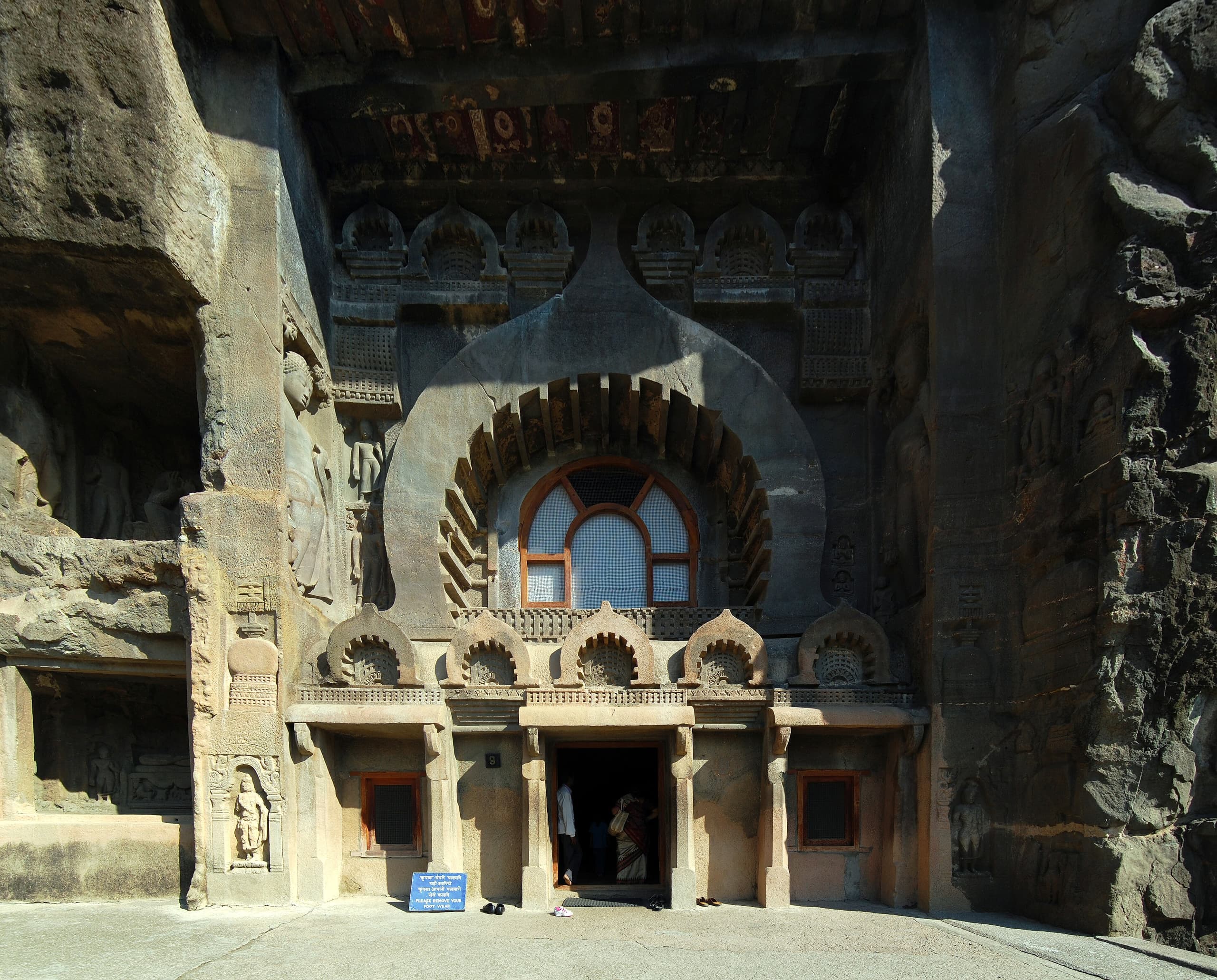
The Ajanta Caves are thirty chambers cut into the rock face of a horseshoe-shaped gorge in the Deccan Plateau, where waterfalls sound when the river is high. The chambers are monasteries and worship halls, carved and painted by Buddhist communities over a span of roughly seven hundred years, in two distinct phases. The earlier phase began around the second century BCE. The later phase is less securely dated: older accounts placed it between 400 and 650 CE, while later scholarship has argued for a much shorter window, between 460 and 480 CE. The disagreement is not trivial, but the chambers themselves are silent on the matter.
The caves served as monsoon retreats for monks, and as resting places for merchants and pilgrims travelling through the region. Textual records mention them, and medieval Chinese Buddhist travellers wrote about visiting them. Then the jungle grew over the entrance to the gorge, and the caves were lost to contemporary knowledge until 1819, when a British officer named John Smith, hunting tiger, stumbled on the rock face and the doorways cut into it.
What makes Ajanta notable is not the caves themselves but what is painted on their walls. Historical records make it clear that mural painting was widespread in ancient India, but almost none of it survives. The murals in Caves 1, 2, 16 and 17 at Ajanta form the largest corpus of surviving ancient Indian wall painting. They depict scenes from the Jataka tales, which recount the Buddha's past lives and rebirths, and scenes from other Buddhist narratives. They also depict figures of Bodhisattvas and deities, painted not as flat icons but as modelled forms.
The technique is tempera on prepared rock. The stone surface was chiselled smooth, then covered with layers of mud, cow dung, chopped rice husk and lime plaster to create a ground that would take paint. The pigments were mineral and organic: ochres, lamp black, lapis lazuli for blue. The painters worked in layers, beginning with an underdrawing, then blocking in areas of local colour, then modelling the forms with lighter and darker tones to describe how light would fall on a three-dimensional body. Over the top of that modelled surface, they redrew the contours in dark line. The result is a hybrid: the figures have volume, described by shading, and they have edges, described by drawn boundaries. Both systems are visible at once.
The technique is not unique to Ajanta, but the survival is. What remains shows a command of foreshortening, of overlapping forms to suggest depth, and of modelling to suggest mass. The painters understood how to make a flat surface read as a body in space. They also understood how to use a face. The Bodhisattva Padmapani, painted on the wall of Cave 1, does almost nothing. He stands, weight on one leg, head tilted, eyes downcast. He holds a lotus loosely in one hand. The gaze does not meet the viewer's. It is directed downward and away, and the tilt of the head and the fall of light across the cheek convey an interior state without gesture or drama. It is painting that knows how much can be carried by restraint.
Why it mattered then
The caves were working monasteries, and the paintings were not decoration but teaching. The Jataka tales painted on the walls recount the Buddha's previous lives, stories in which the future Buddha appears as a king, a merchant, an animal, always acting with compassion or wisdom or self-sacrifice. The narratives were familiar to the monks and pilgrims who used the caves, and the paintings served as visual retellings, aids to contemplation and instruction. The figures of Bodhisattvas and deities were objects of devotion, but they were also demonstrations of an ideal: beings who had attained enlightenment but chose to remain in the cycle of rebirth to help others. The caves were also stopping points on trade and pilgrimage routes. Merchants funded the excavation and decoration of some of the chambers, and inscriptions record their donations. The monsoon rains made travel difficult for part of the year, and the caves provided shelter. The paintings would have been seen by a mixed audience: monks in residence, lay donors, pilgrims passing through, traders waiting out the weather. The images were public, not cloistered, and they were made to be read by people with varying degrees of familiarity with the texts and traditions they illustrated. The technique itself mattered. The decision to model the figures with light and shadow, to give them volume and weight, was a choice about how to represent the sacred. The painters were not working in a flat, symbolic mode. They were describing bodies that occupied space, faces that had structure, hands that held objects with the physics of actual hands. That naturalism was not incidental. It was a way of making the sacred legible, of translating the teachings into forms that felt present and immediate.
Why it matters now
The murals at Ajanta are evidence of a painting tradition that has otherwise vanished. Historical texts describe mural painting as common in ancient India, but the material record is almost empty. What survives at Ajanta — the techniques, the range of subject matter, the level of skill, the understanding of how to describe form and space on a flat surface — would be lost if these four caves had not preserved it. The Bodhisattva Padmapani is taught in art history because it is a clear example of a particular kind of problem solved: how to paint a face that conveys an inner state without relying on narrative action or symbolic gesture. The solution is in the direction of the gaze, the tilt of the head, the modelling of the cheek and brow. It is a lesson in economy, and it is still studied because the problem it addresses — how to paint a presence, not just a likeness — is still a problem. The caves are a UNESCO World Heritage Site, and they are visited, but they are also fragile. The paintings are on rock that breathes moisture, in a climate that is humid for half the year. The pigments are stable, but the plaster ground is not. The survival so far has been partly luck and partly the fact that the caves were hidden for a thousand years. Now that they are known and accessible, their preservation is a managed process, not a given.
The surprising detail
The caves were lost for roughly a millennium. Chinese Buddhist pilgrims visited and wrote about them in the medieval period, but at some point after that the jungle grew over the entrance to the gorge and the site was forgotten. It was not a gradual decline in knowledge; the caves simply dropped out of the record. In 1819, a British officer named John Smith was hunting tiger in the area and happened upon the rock face. The rediscovery was not the result of scholarship or a search for a rumoured site. It was an accident. If Smith had hunted elsewhere that day, the caves might have remained hidden longer, or been found in worse condition, or not been documented when they were. The survival of the paintings depended on a chain of chances, and one of them was a man chasing an animal through a gorge.
What is disputed
The dating of the later phase of construction and painting is genuinely disputed. Older scholarship placed it between 400 and 650 CE, a span of two and a half centuries. Later scholars have argued for a much narrower window, between 460 and 480 CE, a period of only twenty years. Both accounts have been defended with evidence, and neither has displaced the other. The difference matters for how we understand the speed and organisation of the work, but the paintings themselves do not settle it.
Remember this
The Ajanta murals form the largest corpus of surviving ancient Indian wall painting, and they show a command of modelling and foreshortening that has otherwise left no record.
Test yourself
The painters at Ajanta used both modelling with light and shadow and dark contour lines to define the figures. Why would they use both techniques in the same image, rather than choosing one or the other?
Because the two techniques solve different problems, and the painters wanted both solutions visible. Modelling with light and shadow describes three-dimensional form: it shows how a body occupies space, where the surfaces turn toward or away from a light source, and how mass is distributed. A contour line defines the edge: it separates the figure from the ground and gives it a clear, readable boundary. In a devotional context, where the image needs to function both as a convincing presence and as a legible icon, both are useful. The modelling makes the figure feel solid and immediate. The contour makes it graphically clear, so it reads well from a distance or in dim light. The hybrid technique is not a compromise or a failure to choose. It is a deliberate layering of two kinds of visual information, each doing work the other cannot.
Go deeper
Image: Marcin Białek, CC BY-SA 4.0. Licence: CC BY-SA 4.0. Source.