III · THE WORK · ART HISTORY
Dürer's Self-Portrait at Twenty-Eight
▶ Listen · narrated
In 1500, an artist in Nuremberg painted his own face using the visual grammar that belonged, by convention, to images of Christ alone.
At a glance
- Artist
- Albrecht Dürer
- Date
- 1500
- Material
- Oil paint on lime panel
- Dimensions
- 67.1 × 48.9 cm
- Collection
- Alte Pinakothek, Munich
Look closer
Strict frontal symmetry, reserved for holy images
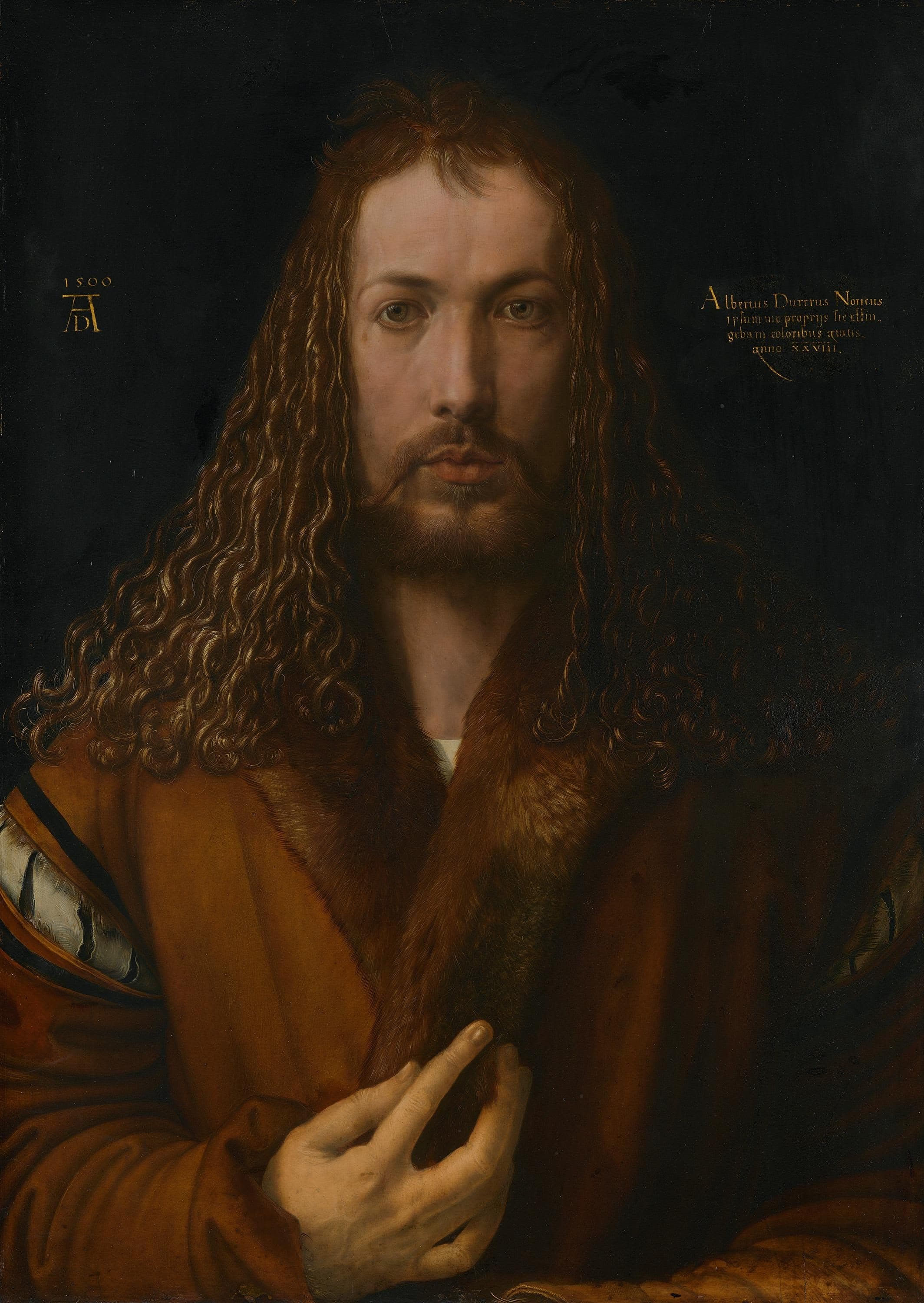
The face is centred, looking directly out. The body does not turn. The composition divides down a vertical axis through the nose, the parted hair, the hand. This is not how portraits were painted in 1500. Sitters turned at an angle, looked to one side, stood in three-quarter view. The frontal pose — perfectly symmetrical, meeting the viewer's gaze — was the convention for devotional images of Christ. Dürer has adopted it without alteration.
The hand raised in a gesture between blessing and display
The right hand is lifted, fingers arranged in a way that recalls the gesture of benediction in religious painting. It does not quite bless, and it does not quite rest. The pose is ambiguous, suspended between sacred gesture and the act of presenting oneself. The hand draws attention without declaring what it means, and that suspension is deliberate.
Individually painted hairs catching light
The hair and the fur trim are rendered strand by strand, each filament catching or losing light according to its curve. This is not generalised texture. It is specific, patient description of how hair behaves — how it separates, how it reflects, how it falls. The technical command is made visible by being applied to something as ordinary and difficult as fur.
The story
Dürer completed this panel early in 1500, just before his twenty-ninth birthday. It is painted in oil on lime wood, and it measures 67.1 by 48.9 centimetres. It hangs now in the Alte Pinakothek in Munich, part of the Bavarian State Painting Collections.
The composition is frontal and symmetrical. Dürer faces forward, his gaze level and direct. His right hand is raised near the centre of the panel, fingers arranged in a gesture that hovers between blessing and presentation. His hair falls in long, dark curls over a fur-trimmed robe. The background is plain and dark. There is no landscape, no window, no attribute to place him in a profession or a moment. The painting is about the face and the pose.
That pose is the issue. In 1500, the frontal, symmetrical arrangement — subject centred, looking out, hand raised — belonged to devotional images of Christ. Portraits of living people were painted differently: turned, angled, engaged with something outside the frame. The strict frontal view was reserved for holy figures, particularly for depictions of Christ in which the face is shown full-on, the hand raised in blessing, the gaze meeting the viewer's directly. Dürer has used that template without modification.
The painting is signed and dated in Latin. The inscription reads, in translation, that Albrecht Dürer of Nuremberg painted himself with indelible colours at the age of twenty-eight. The phrasing is formal, the language not German but Latin, the tone closer to a legal document than a signature. The claim is not hidden.
What the painting means is less settled. It has been read as arrogance, as blasphemy, as a theological statement about the artist as made in the image of God, as a humanist assertion of the dignity of intellectual labour. The visual fact is that Dürer has taken the pictorial form reserved for Christ and applied it to his own face. Whether that is a claim about his own person or about the nature of artistic creation — whether it is personal or professional — is a question the painting does not resolve. It presents the resemblance and declines to explain it.
Why it mattered then
In 1500, the status of painting as an intellectual rather than a manual craft was contested. Painters were members of guilds, classed with artisans. The liberal arts — grammar, logic, rhetoric, arithmetic, geometry, music, astronomy — did not include painting. Dürer was working in a moment when that classification was beginning to be argued against, particularly in Italy, where painters and theorists were asserting that painting required knowledge of geometry, anatomy, perspective and proportion, and therefore belonged among the learned disciplines. The self-portrait in the pose of Christ is a claim in that argument. It does not assert that Dürer is Christ-like in person. It asserts that the act of making images is an act of creation, and that the artist, in making a likeness, participates in the divine act of forming the human in God's image. The theological idea that man is made imago Dei — in the image of God — was not controversial. What was new was applying it to the specific act of painting, and doing so in a self-portrait that made the claim visible rather than written. The painting was made in Nuremberg, a city with a strong tradition of craft excellence and a growing humanist intellectual culture. Dürer had travelled twice to Italy by this date, and the influence of Italian ideas about the status of the artist is visible in the work. The Latin inscription, the formal tone, the learned reference — all of these are moves in a cultural argument about what an artist is.
Why it matters now
The painting remains unresolved because the question it raises has not closed. What is the relationship between making an image and making a claim about yourself? When does self-presentation become self-assertion, and when does self-assertion become arrogance? The painting does not answer. It shows the resemblance and leaves the interpretation open. That openness is why the work is still argued over. It is not a puzzle with a solution. It is a picture that makes a visual statement — this face, this pose — and then offers no commentary. The viewer is left to decide whether the resemblance is devotional, professional, personal, or something else. The painting is confident, but it is not explicit, and that gap between what is shown and what is claimed is where the work continues to generate interpretation. It is also a reminder that the question of what an artist is — whether the work is intellectual or manual, whether it is craft or creation, whether it is skilled labour or something more — was not settled in the Renaissance and is not settled now. The terms have changed, but the argument about the status of making things, and the relationship between technical skill and intellectual authority, is still active. Dürer's painting is an early, clear statement in that argument, and it remains legible because the argument remains open.
The surprising detail
The painting was completed early in 1500, just before Dürer's twenty-ninth birthday, but the inscription states his age as twenty-eight. The discrepancy is small but deliberate: Dürer was counting his age by the number of years completed, not the year he was in, which was the usual German practice at the time. The choice to state the age in that form, in Latin, in a formal inscription, suggests that the painting was conceived not as a private record but as a public document — something to be read, not just looked at.
Remember this
Dürer painted his own face in the pose reserved for Christ, making a claim about the nature of artistic creation without stating what the claim was.
Test yourself
Why does the frontal, symmetrical pose matter more than the quality of the painting itself?
Because the pose is a borrowed form, and borrowing it is the statement. A beautifully painted portrait in three-quarter view would demonstrate Dürer's skill, but it would not make a claim about the status of painting as an intellectual act. The frontal pose was the visual grammar of devotional images of Christ — it carried a specific meaning in 1500, and that meaning was not available to portraits of living people. By adopting it without modification, Dürer is not just painting himself well; he is asserting that the act of making a likeness is an act of creation that participates in the divine. The form is the argument. The skill is what makes the argument visible, but the pose is what makes the argument possible.
Go deeper
Image: Albrecht Dürer, Public domain. Licence: Public domain. Source.