I · THE OBJECT · BRITISH MUSEUM
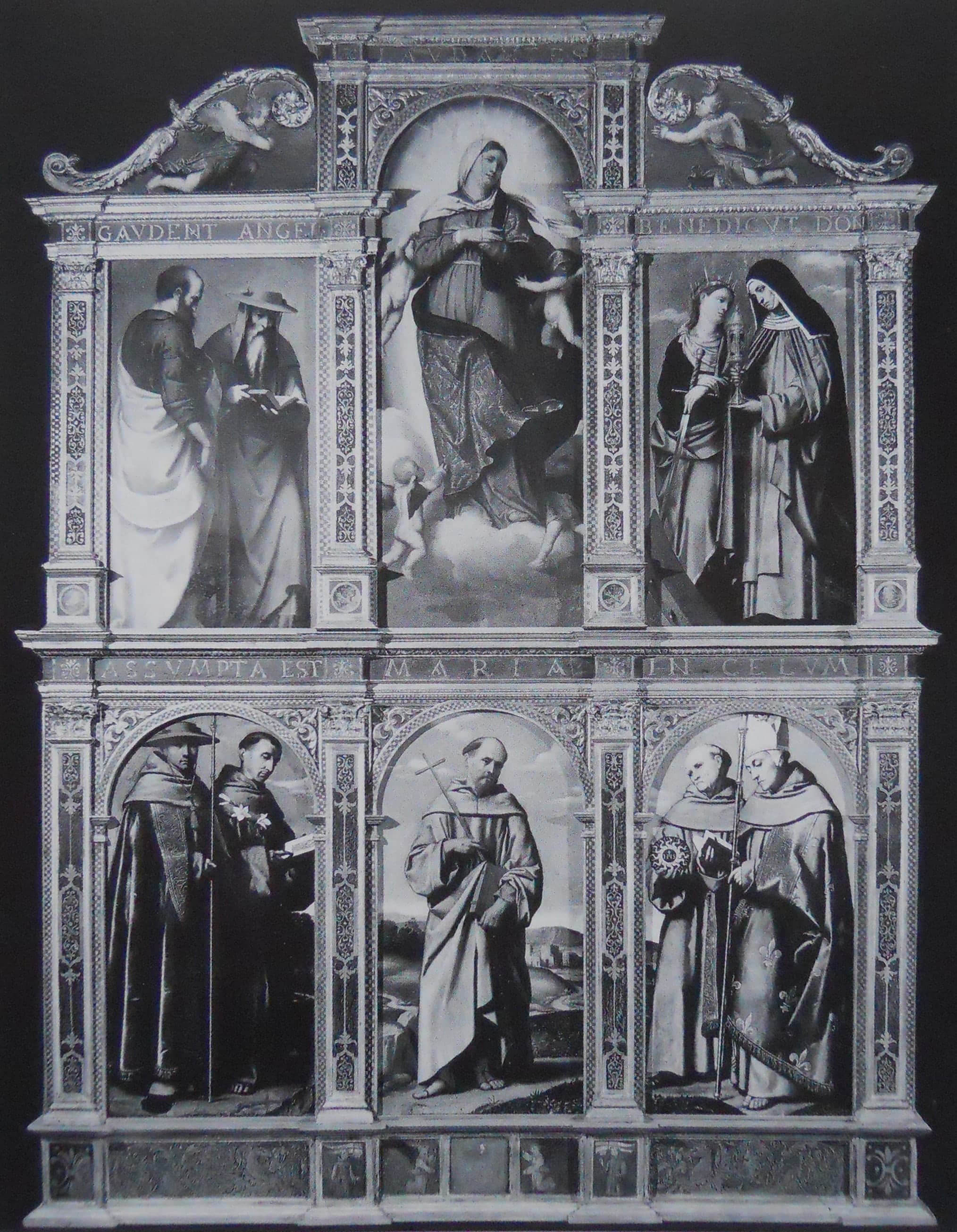
Polyptych of Assumption
▶ Listen · narrated
A complete altarpiece stood in one church for nearly three hundred years. Then it was taken apart, and some panels went to one city while others travelled to another.
At a glance
- Date
- 1529
- Artist
- Moretto da Brescia
- Material
- Oil paint on canvas
- Current location
- Pinacoteca di Brera (Milan), Louvre Museum (Paris), private collection
- Inventory numbers
- Louvre 135, 145, 143
Look closer
A polyptych is a structure, not just a group of paintings
The word polyptych describes an altarpiece made of multiple panels, hinged or fixed into a single architectural frame. This work was conceived as one object: panels arranged in tiers, each saint positioned in relation to the others, the whole designed to be read upward from the viewer toward the Virgin. When it was split, the structure was lost. What remains are individual canvases that once formed parts of a larger composition.
The Virgin panel and four saints
The central panel, now in Milan, shows the Virgin. The Louvre holds two pairs of saints: St Jerome and St Mark in one panel, St Catherine and St Clare in another. The records indicate other panels existed — the altarpiece was larger than what survives in these two collections. Some panels are noted as being in a private collection, but their current state is not detailed in the available material.
Oil on canvas, not panel
The material is recorded as oil paint on canvas. Many Renaissance altarpieces were painted on wooden panels, which were rigid and durable but heavy. Canvas was lighter and could be rolled for transport, though it required different preparation and offered a different surface. The choice of canvas for an altarpiece of this scale suggests either practical considerations or regional workshop practice.
The story
Moretto da Brescia painted this polyptych in 1529. A polyptych is an altarpiece made of multiple panels, arranged in a frame so that figures occupy separate compartments but form a unified composition. This one was made for a specific location: it stood in a church, and the arrangement of saints would have reflected the dedications or devotions of that place.
The work shows the Virgin, flanked by saints. The Louvre now holds panels depicting St Jerome and St Mark together, and St Catherine and St Clare together. The central panel, showing the Virgin, is in the Pinacoteca di Brera in Milan. Other panels are recorded as being in a private collection, though the details are not given.
In 1805, the altarpiece was removed from its original location and moved to Milan. All the panels were kept together there, in the Pinacoteca di Brera, for seven years. Then, in 1812, some of the panels were sent to Paris. The transfer was part of an exchange: the Brera gave the Louvre several paintings, including two panels from this altarpiece, and received five paintings in return. The exchange involved works by other artists, but the names and titles of those paintings are not recorded in the material available here.
The separation was permanent. The altarpiece, designed as a single structure, became a set of fragments distributed across institutions. The central panel remained in Milan. Two pairs of saints went to the Louvre. The rest of the original work is either in private hands or unaccounted for in the records supplied.
Moretto da Brescia worked in Brescia, a city in northern Italy. The material does not give dates for his life or details of his training, but the work is identified as religious art from the Renaissance. The medium is oil paint on canvas, which is noted in the records but not explained further. The inventory numbers assigned by the Louvre — 135, 145, and 143 — identify the three canvases it holds, each catalogued separately.
The original setting is not described in the material. The work is listed as having been in a basilica, but the name of that church and the reasons for its removal are not given. The dismantling in 1805 and the transfer to Milan are recorded as facts, but the circumstances are not detailed. The exchange in 1812 is described as a transaction between two institutions, but the criteria for valuing the works involved are not explained.
Why it mattered then
An altarpiece in 1529 was not simply a painting hung on a wall. It was a commissioned structure, made for a specific altar in a specific church, and its imagery reflected the dedications and devotions of that place. The choice of saints was not arbitrary: each figure carried associations that would have been legible to the congregation. St Jerome, a translator of scripture, and St Mark, an evangelist, were paired in one panel. St Catherine and St Clare, both associated with learning and religious life, occupied another. The Virgin, at the centre, was the focal point of the composition and the object of the devotion the altarpiece was made to support. The polyptych format allowed for this kind of structured imagery. Each saint occupied a separate compartment, but the arrangement created a hierarchy: lower tiers of standing saints, upper tiers moving toward the divine. The viewer's gaze was directed upward, from the altar toward the image of the Virgin. The frame itself was part of the meaning, organising the figures and reinforcing the theology the altarpiece was made to express. The work was made in a period when religious art served both devotional and civic functions. An altarpiece of this scale announced the wealth and piety of its patrons, whether a religious order, a confraternity, or a prominent family. It marked the importance of the altar it adorned and the church that housed it. The commission of such a work was an act of devotion, but it was also a visible claim to status and a contribution to the shared religious life of the community.
Why it matters now
The separation of this altarpiece raises questions about how we encounter Renaissance art. The panels in Milan and Paris are catalogued and displayed as individual paintings, each with its own inventory number and wall label. A visitor to the Louvre sees two pairs of saints, framed and lit as standalone works. A visitor to the Brera sees the Virgin, similarly isolated. Neither sees the altarpiece as it was made to be seen: as a single structure, with all its parts in relation to one another. This is not unusual. Many polyptychs were dismantled, and their panels are now scattered across museums and private collections. The separation often happened during periods of upheaval — wars, suppressions of religious orders, sales of church property — and the panels entered the art market as portable, valuable objects. Museums acquired them as examples of Renaissance painting, not as fragments of larger wholes. The result is that much Renaissance religious art is now encountered in a way that erases the original context and structure. The exchange that sent panels from Milan to Paris in 1812 is a reminder that museum collections are shaped by transactions, not just by preservation. The Louvre received paintings from the Brera and gave paintings in return. The terms of the exchange are not recorded here, but the fact of it is: art moves between institutions, and the movements are determined by the priorities and negotiations of the institutions involved. The altarpiece, as a complete work, was not the unit of value. The individual panels were. What remains now is a set of objects that can be studied, conserved, and displayed, but not reassembled. The polyptych as it was made no longer exists. What exists are the surviving parts, and the record that they once formed a whole.
The surprising detail
The panels were moved from their original location in 1805 and kept together in Milan until 1812. Then some were sent to Paris as part of an exchange. The Brera gave the Louvre several paintings and received five in return. The material does not name the five paintings the Brera received, but it records that the transaction was considered balanced: several works, including two panels from this altarpiece, valued against five others. The calculus that determined the equivalence is not explained, but the exchange itself is documented as a negotiated settlement between two institutions, each acquiring works the other was willing to part with.
What is disputed
The original location of the altarpiece is described in the reference material as a basilica, but the name of that church is not given in the verified facts supplied here. The circumstances of the removal in 1805 and the reasons for the exchange in 1812 are not detailed in the available material. The reference text mentions specific saints depicted in panels that went to the Louvre, but those names do not appear in the verified facts, so they are not stated in this lesson. Some panels are noted as being in a private collection, but no further information about them is provided.
How it got here
The altarpiece was removed from its original location in 1805 and moved to the Pinacoteca di Brera in Milan. In 1812, some panels were transferred from the Brera to the Louvre as part of an exchange between the two institutions. The Brera gave several paintings, including panels from this altarpiece, and received five paintings in return. The exchange is recorded as a negotiated transaction, but the criteria for determining equivalence are not detailed in the available material. The separation was permanent, and the panels have remained in their respective collections since that time.
Remember this
A single altarpiece, made as one structure, now exists as separate paintings in separate cities.
Test yourself
Why does the separation of a polyptych matter more than, say, the separation of paintings that were always meant to hang individually?
Because a polyptych was designed as a single object with an internal structure. The placement of each panel, the arrangement of figures, and the visual relationships between them were all determined by the artist and the patron as part of a unified composition. The frame itself organised the imagery and directed the viewer's gaze. When the panels are separated and displayed individually, that structure is lost. Each panel becomes a standalone painting, but the meaning that came from the arrangement — the hierarchy, the visual movement, the theological programme — is no longer visible. The work as it was made to be experienced no longer exists, even though the individual parts survive. This is different from a set of paintings that were always intended to be independent: those can be moved and regrouped without losing their original form. A dismantled polyptych cannot be reassembled without the frame, the original site, and the knowledge of how the parts were meant to relate to one another.
Go deeper
Image: Moretto da Brescia, Public domain. Licence: Public domain. Source.