I · THE OBJECT · BRITISH MUSEUM
Anjou Legendarium
▶ Listen · narrated
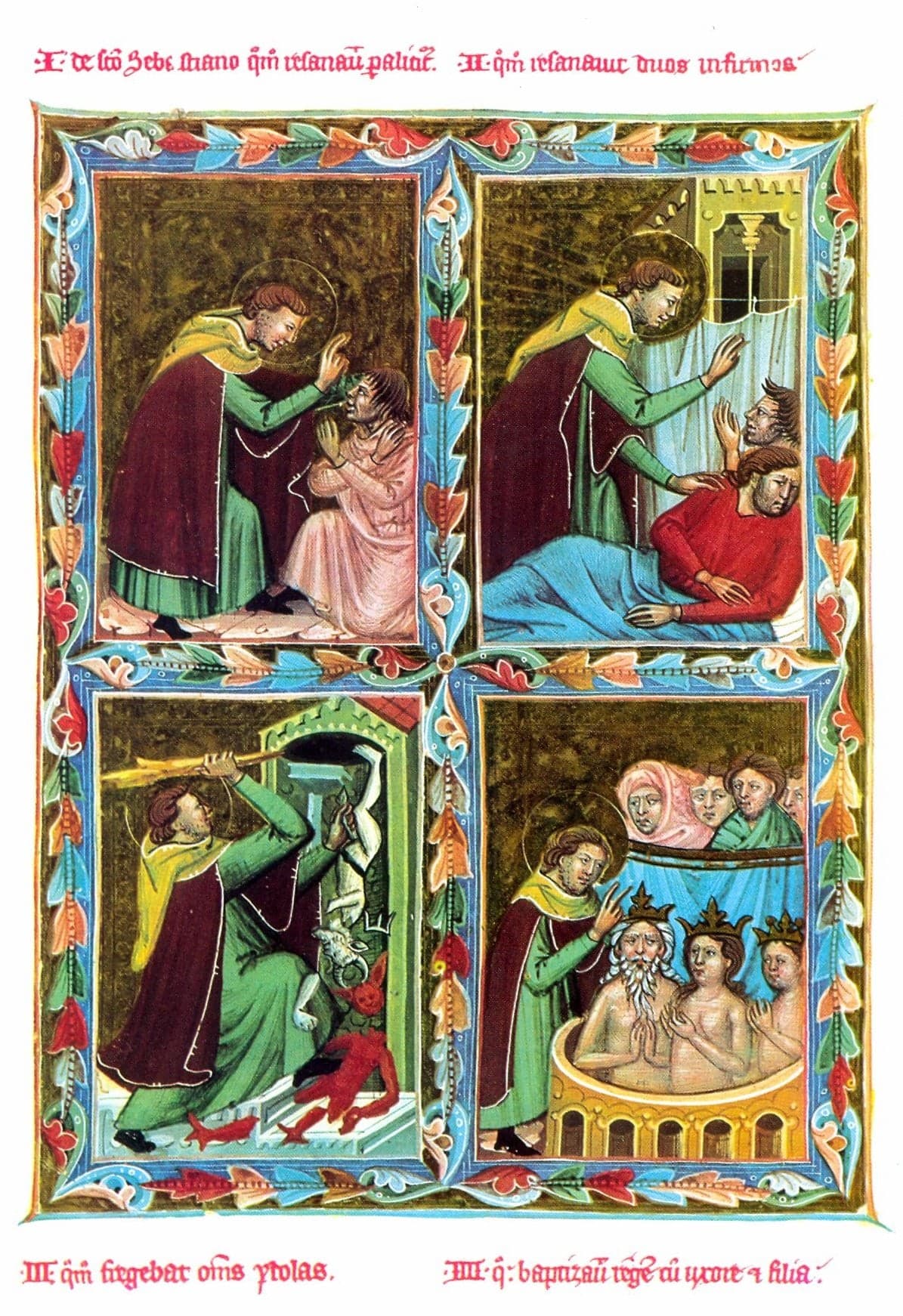
A legendarium was a picture book: images first, text second, made so a child could follow the stories. This one was painted for royalty, then dismembered.
At a glance
- Date
- 15th century
- Material
- Parchment
- Type
- Illuminated manuscript, legendarium
- Current locations
- Vatican Library, Morgan Library, Hermitage Museum, Louvre Museum
Look closer
A picture book, not a prayer book
A legendarium is a specific type of manuscript: a collection of saints' lives arranged as pictures with brief accompanying text. The images come first. The format was designed for readers who were learning — often children — so that the narrative could be followed visually even if the Latin was difficult. The Anjou Legendarium contains images and scenes from the lives of Jesus Christ, Hungarian saints including Gerard Sagredo, Emeric and Ladislaus I, the Polish bishop Stanislaus of Szczepanów, Francis of Assisi, Martin, George, and other figures from Christian tradition.
Painted in Bologna, made for Hungary
The painters came from Bologna and worked in the style of the trecento — the Italian fourteenth-century manner, though this manuscript was made in the fifteenth century. The choice of saints ties the book to the House of Anjou of Hungary: Gerard Sagredo was a Hungarian bishop, Emeric a Hungarian prince, Ladislaus I a Hungarian king. The manuscript was a royal commission, but the precise patron is uncertain.
Scattered across four collections
The manuscript no longer exists as a single object. Portions are held in the Vatican Library, the Morgan Library and Museum, the Hermitage Museum, and the Louvre Museum. Inventory numbers assigned by each institution — Vat. Lat. 8541, RF 29940, M.360, E 16930-16934 — trace the fragments. The original codex contained more than 140 pages. How and when it was divided is not recorded in the material available.
The story
The Anjou Legendarium is an illuminated manuscript made in the fifteenth century: a picture book of saints' lives, painted on parchment by artists from Bologna working in the trecento style. A legendarium is a particular kind of book, not a general term. It collects stories of saints, but arranges them as images with short texts rather than as continuous prose. The format was designed for readers who were still learning, often children, so that the narrative could be followed through pictures even where the Latin was hard going.
The saints chosen for this manuscript connect it to the House of Anjou of Hungary. The book includes scenes from the life of Jesus Christ, but also Hungarian figures: Gerard Sagredo, a bishop; Emeric, a prince; and Ladislaus I, a king. Stanislaus of Szczepanów, a Polish bishop, appears as well, along with Francis of Assisi, Martin, George, and other figures from Christian tradition. The choice of subjects suggests a royal patron, and the origins of the codex point in several directions. It may have been made for Charles I of Hungary and his son Prince Andrew. Another possibility is James of Piacenza. Csanád Telegdi, archbishop of Esztergom, is also a candidate. The evidence does not settle the question.
The painters came from Bologna. The style is that of the trecento, the Italian fourteenth century, though the manuscript itself was made in the fifteenth. Trecento painting is characterised by a particular approach to space, colour and the depiction of figures, and the artists working on this legendarium brought that manner north to a Hungarian commission. The book was made as a single codex of more than 140 pages.
It no longer exists as one object. Portions of the manuscript are now held in four institutions: the Vatican Library, the Morgan Library and Museum, the Hermitage Museum, and the Louvre Museum. Each institution has assigned its own inventory numbers to the pages it holds. The Vatican's fragment is catalogued as Vat. Lat. 8541, the Morgan's as M.360, the Louvre's as RF 29940, and the Hermitage's as E 16930-16934. How the manuscript was divided, when, and by whom is not recorded in the available material. What survives is a picture book made for a royal child, painted in one city for use in another, and now separated across four collections on three continents.
Why it mattered then
A legendarium was a teaching tool, and this one was made for a child who would inherit power. The House of Anjou ruled Hungary, and the education of a prince required more than literacy: it required models. Saints' lives provided those models — examples of courage, devotion, sacrifice and right action, presented in a form a young reader could follow. The choice of saints was not neutral. Gerard Sagredo, Emeric and Ladislaus I were Hungarian, and their inclusion taught the child that sanctity and kingship were not foreign ideas but part of his own inheritance. Stanislaus of Szczepanów connected Hungary to Poland; Francis of Assisi and the other figures placed the Hungarian court within the wider community of Christendom. The book was a map of belonging. The commission of painters from Bologna to work in the trecento style also mattered. It demonstrated that the Hungarian court could afford to bring painters from a recognised centre of manuscript production, and that it valued the manner they worked in. Trecento painting was admired across Europe in the fifteenth century, and bringing that style north was a statement of taste and connection. The manuscript was a tool for teaching a child, but it was also a tool for teaching anyone who saw it what kind of court this was.
Why it matters now
The Anjou Legendarium survives as evidence of how education worked for the powerful in the fifteenth century, and as a record of what was considered worth teaching. The manuscript shows that pictures were not decoration but pedagogy — a child learned through looking. It also shows that learning was never neutral: the choice of saints, the style of painting, the language of the text were all decisions about what kind of person the reader should become. The scattering of the manuscript across four collections raises questions that the available material does not answer. How did a single codex made for a royal child become fragments held in the Vatican Library, the Morgan Library and Museum, the Hermitage Museum and the Louvre Museum? When did the division happen, and under what circumstances? The inventory numbers trace the fragments, but not the route they took. The fact that the manuscript is now divided means that no single visitor can see it whole, and no single institution can present the full sequence of images as they were intended to be read. What was designed as a continuous narrative is now a set of interrupted excerpts. The manuscript also matters as an example of collaboration across borders: Bolognese painters working for a Hungarian patron, creating a book that taught a child about Hungarian, Polish and Italian saints, in a style developed in one place and exported to another. The trecento manner was portable, and this legendarium is one record of that portability.
The surprising detail
The manuscript was made as a picture book for a child, but the identity of that child is uncertain. The evidence points in several directions — Charles I of Hungary and his son Prince Andrew, James of Piacenza, or Csanád Telegdi, archbishop of Esztergom — but does not settle on one. A royal commission of this scale would usually be recorded, but here the records either did not survive or were never made in a form that has reached us. The result is that we can describe the book's purpose and style with confidence, but not name the reader it was made for.
What is disputed
The origins of the manuscript are unclear. It may have been made for Charles I of Hungary and his son Prince Andrew, for James of Piacenza, or for Csanád Telegdi, archbishop of Esztergom. The evidence does not settle the question. How and when the manuscript was divided among its current four locations is also not recorded in the available material.
Remember this
A legendarium was a picture book, not a prayer book: images first, text second, designed so a child could follow the saints' lives by looking.
Test yourself
Why would a royal court in Hungary commission painters from Bologna to work in a style from the previous century, rather than employ local artists or seek out a more recent manner?
The trecento style was admired across Europe in the fifteenth century, and bringing Bolognese painters north demonstrated both the court's taste and its resources. Commissioning artists from a recognised centre of painting showed that the Hungarian court understood what was valued elsewhere and could afford to import it. The choice of an earlier style was not a matter of being behind the times but of choosing a manner that carried prestige. The lesson generalises: style is never just aesthetic preference — it is also a statement about who you are and where you belong.
Go deeper
Image: Szántó Tibor from N. Pataki-Timko's book, CC BY-SA 3.0. Licence: CC BY-SA 3.0. Source.