III · THE WORK · ART HISTORY
The Clothed Maja
▶ Listen · narrated
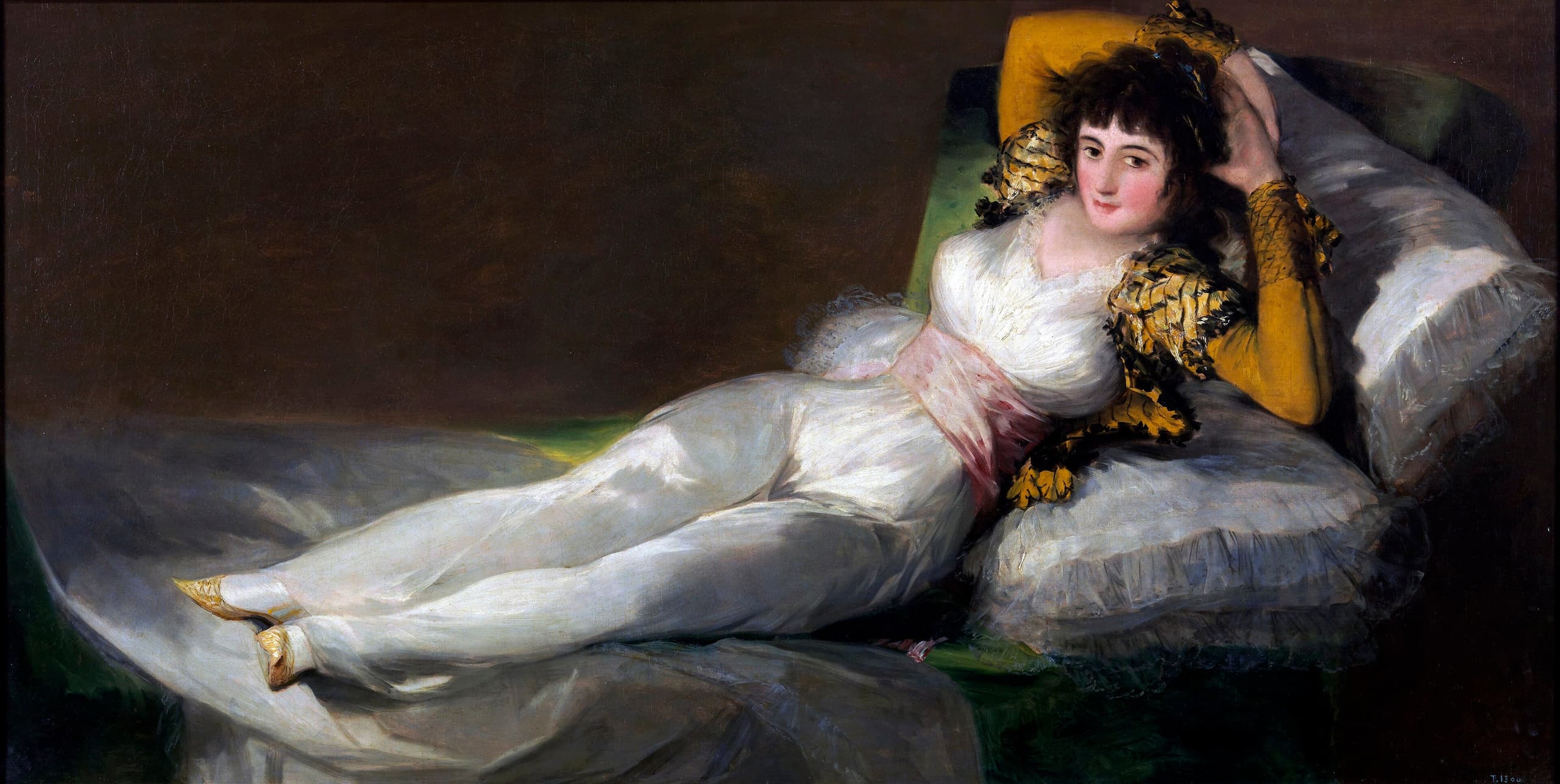
A woman reclines on green cushions, clothed in white and gold. The painting exists because another version, showing her naked, existed first.
At a glance
- Artist
- Francisco Goya
- Date
- 1800
- Medium
- Oil on canvas
- Dimensions
- 95 × 190 cm
- Location
- Museo del Prado, Madrid
Look closer
The pose is identical
The woman lies on her left side, head propped on two stacked pillows, right arm behind her head, left hand at her waist. Her body occupies the same position on the canvas as it does in the earlier nude version. Goya has painted the same arrangement twice, changing only what covers it. The repetition is exact enough that the two paintings can be overlaid, which suggests they were made to be seen in sequence or alternation, though no record confirms how they were displayed.
The jacket is open
She wears a white jacket trimmed with gold braid, fastened with a single ribbon at the chest but otherwise open from neck to hem. Beneath it, a long white skirt. The jacket does not conceal the body so much as frame it: the deep V of the opening follows the line of her torso, and the gold trim draws the eye downward. The effect is of clothing that acknowledges, rather than contradicts, the nude version it covers.
The face is the same
Her expression in both paintings is identical: eyes meeting the viewer directly, mouth closed, no smile. The face does not change between clothed and nude. What changes is everything around it — fabric instead of skin, white and gold instead of shadow and light — but the gaze remains steady. Whoever she is, Goya has painted her looking at the viewer with the same directness in both states.
The story
Goya painted a woman lying on cushions, dressed in white and gold, in the year 1800. The painting is 95 centimetres high and 190 centimetres wide, which makes it almost twice as wide as it is tall — a shape that fits the horizontal body it contains. The woman reclines on her left side, head resting on pillows, right arm bent behind her head, left hand at her waist. She wears a white jacket with gold braid and a white skirt. Her shoes are pale yellow, trimmed with pink ribbon. The cushions beneath her are green. She looks directly out at the viewer.
This painting exists because another one existed before it. Goya had already painted the same woman, in the same pose, on the same size canvas, without clothes. That earlier painting is called La maja desnuda — the nude maja. This one, made to match it, is La maja vestida — the clothed maja. A maja was a young woman of the lower classes in Madrid, though whether the term describes the sitter or simply the style of the painting is not recorded. The two works share the same composition, the same arrangement of body and pillows, the same direct gaze. What differs is the surface: skin in one, fabric in the other.
Who the woman was is not confirmed. Art historians have suggested two names: María Cayetana de Silva, or Pepita Tudó. Both paintings were listed in an inventory in 1808, when certain assets were seized. But the inventory does not name the sitter, and the historical record does not settle the question. Nor is it known who commissioned the paintings, or whether they were made as a pair — to be displayed together, or perhaps one in front of the other, to be revealed in turn. The paintings were not exhibited publicly during Goya's lifetime, so how they were meant to be seen is a matter of inference, not record.
What is documented is their later history. Both paintings were twice held by the Royal Academy of Fine Arts of San Fernando in Madrid. Between 1814 and 1836, they were sequestered — removed from circulation and held elsewhere. They were returned, and since 1901 they have been displayed together at the Museo del Prado.
The clothed version was painted after the nude, which means it was made in response to something that already existed. Whether it was meant to cover, to complement, or to create a reveal — a mechanism where one painting could be lifted or slid aside to show the other — is not known. What is clear is that Goya painted the same scene twice, changing only the clothing, and that both versions survived.
Why it mattered then
The paintings were made in Spain at a moment when the display of a nude woman was not simply unconventional but could lead to official action. That the clothed version exists at all suggests an awareness of that risk: it provided a version that could be shown, or that could be placed in front of the other, making the nude revealable rather than permanently visible. Whether this was the intent, or simply a later use, is not recorded, but the clothed painting gave the pair a form that could be defended or concealed depending on who was looking. The fact that both were sequestered between 1814 and 1836 suggests they were known to be controversial, and that their existence together was part of their meaning.
Why it matters now
The clothed maja is now exhibited alongside the nude at the Prado, where they have been displayed together since 1901. The pairing has become the standard way of seeing them, though it is not certain this was how they were originally shown. What makes the clothed version significant is not that it is modest — it is not, particularly — but that it is a response. It is a painting made because another painting existed, and it carries that relationship in its composition. The two works together raise a question that a single portrait does not: what does it mean to paint the same person twice, in the same pose, with only the surface changed? The clothed maja is not a correction of the nude, nor is it simply a companion. It is a second version, and the fact that both survive means we are still looking at the question Goya built into them.
The surprising detail
The paintings were sequestered between 1814 and 1836 — removed from circulation and held for twenty-two years. What was done with them during that time is not recorded: whether they were examined, stored, or simply kept out of view. They were returned in 1836, but no document explains the decision or the delay. The sequestration is documented; the reasoning is not.
What is disputed
The identity of the sitter is not confirmed. Art historians have suggested María Cayetana de Silva or Pepita Tudó, but no contemporary document names her. Similarly, it is not known whether the two paintings were made as a pair, or how they were displayed during Goya's lifetime. The inventory that first lists them, made in 1808, does not describe their arrangement or purpose.
Remember this
Goya painted the same woman twice, in the same pose, clothed and nude. Who she was, and who asked for the paintings, remains unconfirmed.
Test yourself
Why does the existence of the clothed version tell us something about how the nude was understood, even if we do not know who commissioned either painting?
Because the clothed version was made after the nude, in direct response to it. That sequence means the nude existed first, and someone — whether Goya, the patron, or both — decided a second version was necessary. The clothed maja is not a preparatory study or an alternative composition; it is the same pose, the same canvas size, the same gaze, with clothing added. That makes it a form of answer or accommodation. Whether it was meant to make the pair displayable, to provide a cover that could be removed, or simply to create a contrast, the fact that it was painted at all shows that the nude was understood to need something else alongside it. The clothed version is evidence that the nude was seen as incomplete or risky on its own, even if no document says so directly.
Go deeper
Image: Francisco Goya, Public domain. Licence: Public domain. Source.