I · THE OBJECT · BRITISH MUSEUM
The Minoan Bull-Leaper
▶ Listen · narrated
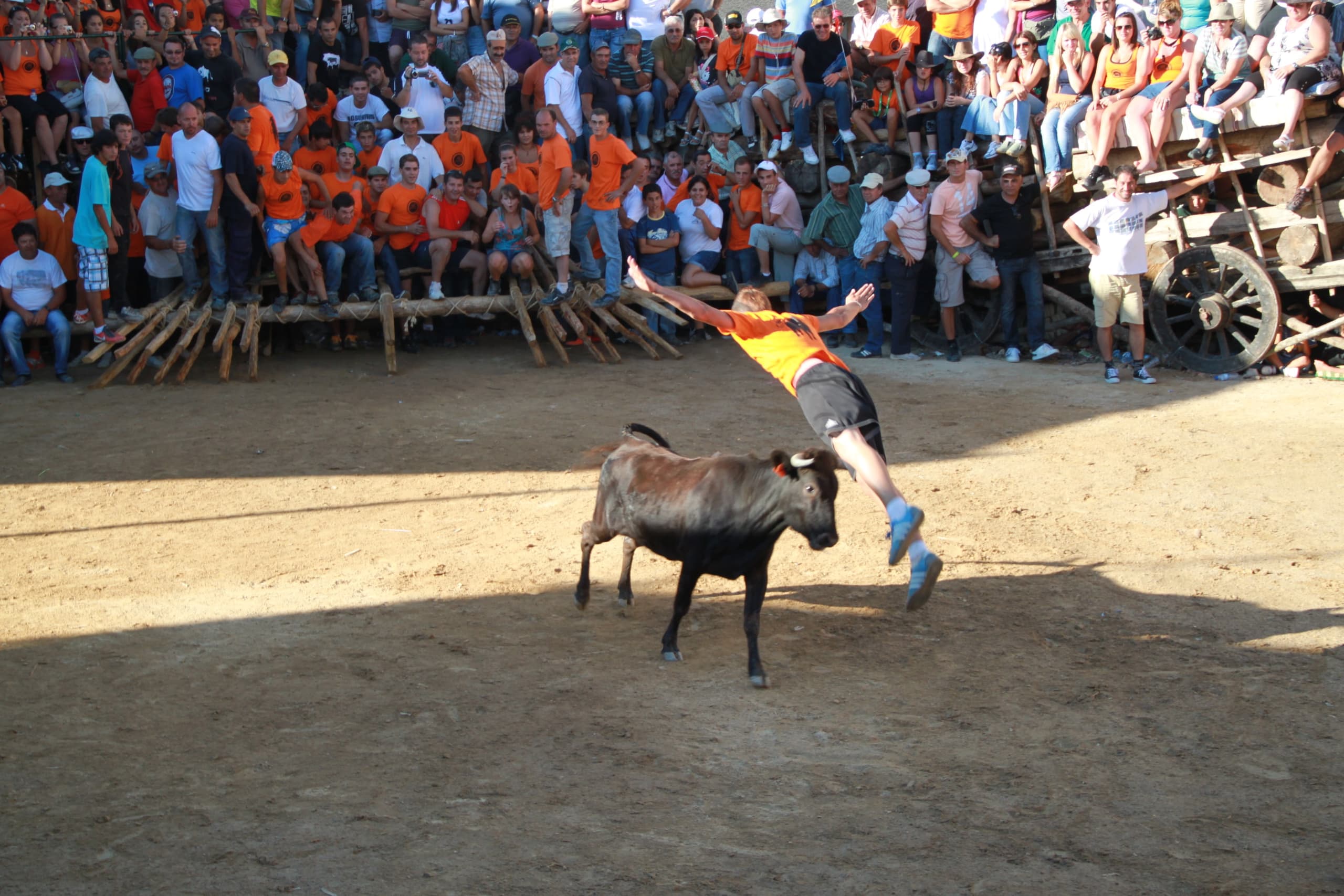
The figure is frozen in mid-air, back arched, hands on the bull's horns. Scholars still argue over whether the stunt was physically possible at all.
At a glance
- Culture
- Minoan
- Period
- Middle Bronze Age
- Subject
- Bull-leaping
- Medium
- Bronze figurine
Look closer
The moment captured
The acrobat's body forms an arch, hands gripping the bull's horns, legs extended behind. It is the instant between contact and landing — or the instant before being thrown. The pose appears in other Minoan images: frescoes, seals, figurines. The repetition suggests either a real manoeuvre or a ritual convention so established that artists reproduced it regardless of feasibility.
The bull's posture
The bull is shown in a gallop, all four legs off the ground in some depictions. A charging bull does not move this way — it runs with at least one hoof always planted. The stylised gait may be artistic convention, or it may indicate that the artists were depicting an idealised action rather than documenting a real event. Either way, the mismatch between image and animal behaviour is one reason the debate over historicity persists.
Where else the motif appears
Bull-leaping images turn up across the Middle Bronze Age Mediterranean and beyond: in Minoan art, in objects found in Mycenaean Greece, and in Hittite Anatolia, the Levant, Bactria, and the Indus Valley. The geographic spread suggests either wide cultural contact or independent invention of a similar ritual idea. The Minoan examples are the most numerous and the most detailed, which is why the practice is most strongly associated with that civilization.
The story
The bronze shows an acrobat in the air above a bull, body curved, arms extended toward or gripping the horns. It is a snapshot of a manoeuvre that appears repeatedly in Minoan art: on frescoes, carved seals, and other figurines. The Greek term for it, taurokathapsia, comes from later sources, but the images themselves are Middle Bronze Age.
The standard interpretation is that this depicts a real ritual or sport in which an acrobat approached a charging bull, grasped its horns, and used the animal's upward toss to somersault over its back. Some reconstructions suggest the leaper pushed off the horns; others propose the bull's head movement supplied the necessary force. A third possibility is that the leaper vaulted from the side, using the bull's back as a platform rather than engaging the horns at all.
The difficulty is that no ancient text describes the mechanics. The images exist, but their relationship to lived practice is uncertain. Modern attempts to recreate the stunt — using both trained acrobats and live bulls — have produced mixed results. Some succeed with cooperative animals and careful choreography; others conclude the manoeuvre as depicted would be lethal. Bulls do not behave predictably, and a toss from a horned head can generate enough force to break bones. Whether Minoan athletes performed this regularly, occasionally, or not at all remains unresolved.
The repetition of the motif across Minoan art suggests it held significance, whether as documentation or as myth. The figures are often shown in ritual contexts: frescoes in palatial settings, seals that may have marked religious or administrative authority. The bull itself had symbolic weight in Minoan culture, appearing in architectural decoration and in other ritual scenes. The leap may have been a real test of skill and courage, a stylised representation of dominance over a powerful animal, or both.
What survives is the image, not the event. The bronze captures a moment that may never have happened in quite this way, or that happened often enough to become a visual convention. The gap between the two possibilities is where the scholarly dispute lives.
Why it mattered then
The bull had symbolic weight in Minoan culture. It appears in architectural ornament, in frescoes, on seals, and in ritual objects. The animal represented strength, fertility, or divine presence — the exact meaning is not recorded in writing, because Minoan script has not been fully deciphered. Linear A, the writing system used in the Minoan civilization, remains largely unreadable. If the leap was a real practice, it would have been a demonstration of human skill against animal power, performed in front of an audience and possibly in a sacred setting. Frescoes showing the leap appear in palatial complexes, which suggests the activity, real or symbolic, was associated with elite or religious authority. If it was purely symbolic, it still communicated something about the relationship between humans and bulls, and about the qualities valued in those who faced them. The geographic spread of the motif — it appears beyond the Minoan civilization, in places with trade or cultural contact with it — suggests the image carried meaning that translated across cultures. Whether that meaning was 'this is a thing we do' or 'this is a thing we imagine' is unclear, but the image itself was powerful enough to travel.
Why it matters now
The figure is a test case for how we interpret ancient images. When a motif appears repeatedly in art, does that confirm it happened, or does it confirm it mattered symbolically? The question applies to many aspects of ancient life that were depicted but not described in writing. The scholarly dispute over feasibility also raises a methodological question: how much weight should physical plausibility carry when assessing ancient practices? Some historians argue that if modern athletes cannot reliably perform a stunt, the ancient depictions are probably idealised or mythological. Others counter that ancient training, lost techniques, or different breeds of cattle might have made the leap possible. The absence of a definitive answer is itself instructive. It is a reminder that images are not photographs, and that the relationship between art and reality in any culture is complex. The motif also survives in modified forms. In parts of Spain, southern France, and Tamil Nadu, modern sports involve acrobats dodging or leaping near bulls, though the manoeuvres differ from the Minoan depictions. Whether these represent continuous tradition or independent reinvention is debated, but the fact that humans still test themselves against bulls suggests the appeal of the contest — real or symbolic — has persisted.
The surprising detail
The debate over whether the leap was possible is not a minor footnote. It cuts to the centre of how we read ancient art. Some scholars treat the repeated depiction as evidence the leap was performed; others argue the repetition proves only that the image was conventional, not that the action was real. A third group suggests the truth lies in between: that some form of bull-leaping occurred, but the artistic depictions exaggerate or stylise it in ways that make reconstruction impossible. The fact that modern attempts have produced contradictory results — some succeeding, some failing — has not resolved the question. It has only confirmed that the answer depends on variables we cannot recover: the temperament of the animals, the training of the acrobats, and the exact technique used.
What is disputed
Whether the leap depicted in Minoan art was ever performed as shown is genuinely disputed. Modern reconstructions have produced contradictory results: some acrobats and trained animals have managed versions of the stunt, while other attempts have concluded it would be impractical or fatal with an uncooperative bull. The repetition of the motif in Minoan art is agreed upon; its relationship to lived practice is not. Some scholars interpret the images as documentation of a real ritual or sport; others read them as stylised or symbolic representations that exaggerate or idealise a more modest manoeuvre; still others suggest the leap was mythological from the start. The absence of descriptive texts and the partial decipherment of Minoan script mean the question remains open.
Remember this
A repeated image is not proof of a repeated action. The bronze shows either a real stunt or a powerful idea — and scholars still disagree on which.
Test yourself
Why does the geographic spread of the bull-leaping motif — appearing in Minoan art, Mycenaean Greece, Hittite Anatolia, the Levant, Bactria, and the Indus Valley — complicate the question of whether the leap was a real practice?
Because wide geographic distribution can support two opposite conclusions. If the leap was a real technique, the spread might indicate that the practice traveled through trade or cultural contact, or that multiple societies independently developed a similar stunt. But if the leap was symbolic or mythological, the spread might mean the image resonated as a powerful metaphor — humans overcoming animal strength — regardless of whether anyone performed it. The Minoan examples are the most detailed, which is why that civilization is most associated with the practice, but the presence of the motif elsewhere does not settle whether it documents an event or an idea. The distribution proves the image mattered across cultures; it does not prove what the image represented.
Go deeper
Image: Paulo Fernandes from Lisboa, Portugal, CC BY-SA 2.0. Licence: CC BY-SA 2.0. Source.