I · THE OBJECT · BRITISH MUSEUM
Demeter of Knidos
▶ Listen · narrated
This seated figure was made to last forever, then someone laid her face-down in a trench and covered her with earth. The burial preserved her.
At a glance
- Date
- 350 BC
- Material
- Marble
- Height
- 150 centimetres
- Findspot
- Near Knidos, south-west Asia Minor
Look closer
The scale is human, not monumental
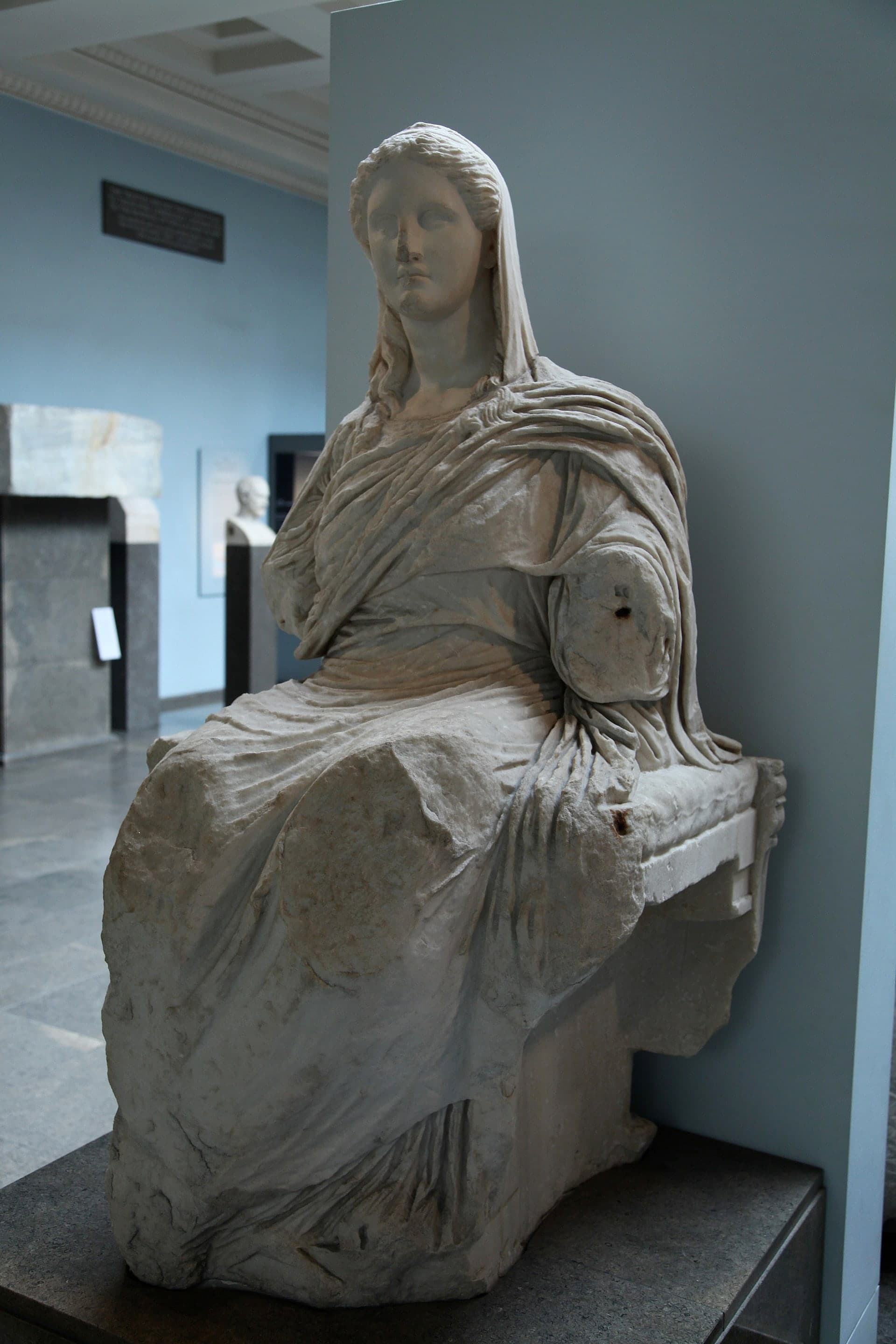
At 150 centimetres, the seated figure is close to life-size — the height of an adult woman sitting. That scale matters. Temple sculpture could be colossal, designed to dominate a space or be seen from a distance. This statue was made to be encountered at eye level, in a sanctuary where a visitor would stand near it. The proportions are those of presence, not spectacle.
The posture is formal, not narrative
She sits upright, both feet on the ground, one hand perhaps holding an attribute now lost. The pose is static and frontal — a cult image, not a figure caught mid-action. Greek sculpture of this period could show violent motion or intimate gesture, but sanctuary statues often held still. The stillness was the point: a permanent presence, receiving offerings, witnessing rituals.
The carving survives because it was buried
Marble weathers. Sculpture left exposed for two millennia loses detail to rain, wind, and frost. This statue spent those centuries underground, laid face-down in a trench. The burial was deliberate — not destruction, but deposition. Why remains unclear, but the result is legible: the surface that would have eroded in open air stayed intact in the earth.
The story
The statue was found near Knidos, a Greek city on the coast of what is now south-western Turkey. Knidos sat on a peninsula jutting into the Aegean, a port with two harbours and a reputation for sculpture. The city had sanctuaries, and this figure came from one of them.
The identification as Demeter — goddess of grain, of harvest, of the cycle that keeps cities fed — rests on the type: a seated woman of divine scale, holding attributes now lost. Demeter was shown this way often enough that the pose became a template. But the attributes that would confirm it are missing, so the name is an educated assignment, not a certainty recorded in an inscription.
The carving dates to around 350 BC, a period when Greek sculptors were working in marble with confidence. The stone itself is pale and fine-grained, capable of holding crisp edges and smooth planes. At 150 centimetres tall as she sits, the figure would have been slightly over life-size if standing — a presence, but not an overwhelming one.
She was not found in the sanctuary where she was erected. At some point, the statue was taken down, carried to a trench, and laid face-down in the earth. The burial was careful: no smashing, no defacement. Whether this was done to protect her during a crisis, to retire her when the sanctuary changed, or for some other reason, the sources do not say. What the burial did, unintentionally or not, was preserve the surface. Marble left in the open loses detail. Marble underground does not.
The statue reached the British Museum in 1859, acquired as part of a collection that included other material from the region. How it left the ground and entered that collection is not detailed in the records that survive. The museum's acquisition number is 1859,1226.26.
What remains now is the seated figure: head, torso, lap, feet. The arms are incomplete. The face is calm, the drapery falls in folds that follow the body beneath. It is the kind of sculpture that was made in quantity across the Greek world in the fourth century BC, but survival is not democratic. Most are fragments. This one is not.
Why it mattered then
A sanctuary needed images. They were the focus of ritual, the recipients of offerings, the visible presence of the divine in a place set aside for it. A city like Knidos, prosperous from trade and known for its sculptors, would have commissioned figures like this as a matter of course. Demeter, if the identification holds, mattered because grain mattered. Greek cities lived on wheat and barley. A harvest that failed meant hunger; a good one meant security. The goddess who governed that cycle was owed attention. Her sanctuaries were places to give thanks, to ask for favour, to mark the seasons. A statue like this stood at the centre of that attention, a permanent witness to prayers and processions. The care taken in the carving — the folds of cloth, the posture, the scale — was not ornament. It was theology made visible. The gods were imagined in human form, and sculpture was the medium that made that imagination solid. A well-made statue was not decoration; it was the deity's address in the world.
Why it matters now
It survives. That is the blunt reason it still matters. Greek sculpture from the fourth century BC is known largely from Roman copies and from fragments. Complete or near-complete figures in the original marble are not common. This one offers a direct line to the period: the carving, the stone, the scale, the style. It also holds a question that has no answer. Why was it buried? The trench, the careful placement, the long preservation underground — none of that was accidental, but the motive is lost. The statue is evidence of a decision whose reasoning we cannot recover. That gap is as instructive as the object itself. The material record is full of such gaps. We have the things; we do not always have the reasons. And it stands as a reminder that survival is contingent. The sculpture that weathers into illegibility, the sanctuary that gets quarried for building stone, the statue that gets broken and reused — those are the usual outcomes. This figure stayed whole because someone put it in the ground and it stayed there. Chance and care, in equal measure.
The surprising detail
The statue was buried face-down. That orientation is recorded, and it is not the position you would expect for something simply discarded or hidden in haste. Laying a figure face-down takes effort and suggests intention. Was it a gesture of respect, retiring a cult image that could not be left exposed but could not be destroyed? Was it protection during a conflict or a transition? The sources do not say. What the burial did, whether it was meant to or not, was preserve the face and the front of the figure — the parts most vulnerable to damage — by pressing them into the earth.
What is disputed
The identification as Demeter rests on the type — a seated female figure of divine scale — but no inscription survives to confirm it. The attributes she once held, which would have made the identification certain, are lost. The name is an assignment based on comparisons with other sculptures, not on evidence from the statue itself.
How it got here
The statue was acquired by the British Museum in 1859 as part of a collection that included material from the Knidos region. The details of how it was excavated and how it left Turkey are not recorded in the surviving documentation. It remains in the museum's collection, catalogued as 1859,1226.26.
Remember this
A seated goddess, carved in marble, buried face-down for two thousand years. The trench saved what the open air would have worn away.
Test yourself
Why would a sanctuary bury a cult statue rather than simply leave it in place or move it elsewhere?
The sources do not answer this directly for the Demeter of Knidos, but the practice is known from other sites. A cult image was not ordinary property. It had been consecrated, ritually activated as the dwelling-place or representation of a deity. You could not discard it like broken pottery. If a sanctuary was closing, or if a statue was being replaced, or if there was a threat that required temporary removal, burial was a solution that showed respect. The earth became a kind of storage, a way to retire the image without desecration. Whether that reasoning applies here is uncertain, but the care taken in the burial — face-down, intact, preserved — suggests something more deliberate than disposal.