III · THE WORK · ART HISTORY
Michelangelo's Sistine Chapel Ceiling
▶ Listen · narrated
Between 1508 and 1512, Michelangelo covered the Vatican chapel's vault with frescoes that redefined what painted architecture could hold and how the human body could be shown.
At a glance
- Artist
- Michelangelo
- Date
- 1508–1512
- Medium
- Fresco painting
- Dimensions
- 40.9 metres by 13.4 metres
- Collection
- Vatican Museums
Look closer
The gap between the two hands
In The Creation of Adam, God's right arm extends towards Adam's left. Their index fingers do not touch. The gap between them is small — a few centimetres at the scale of the fresco — but it is deliberate and complete. The near-contact has been read as the moment before life, the transfer of divine will, the unbridgeable distance between creator and created. What is certain is that Michelangelo painted a space, not a touch, and that space is now the detail most people remember from the ceiling.
The brain-shaped cloak
God's billowing red cloak in The Creation of Adam, which surrounds him and a group of attendant figures, has an outline that some observers have compared to a anatomical cross-section of the human brain. Whether this resemblance is intentional is not documented. Michelangelo dissected cadavers and knew human anatomy in detail, so the knowledge was present. The interpretation has been argued, but the cloak's shape is not explained in any surviving record from Michelangelo or his contemporaries. What is visible is a form that suggests both enclosure and motion, wrapping the divine figures in a billowing structure.
Fictive architecture dividing the vault
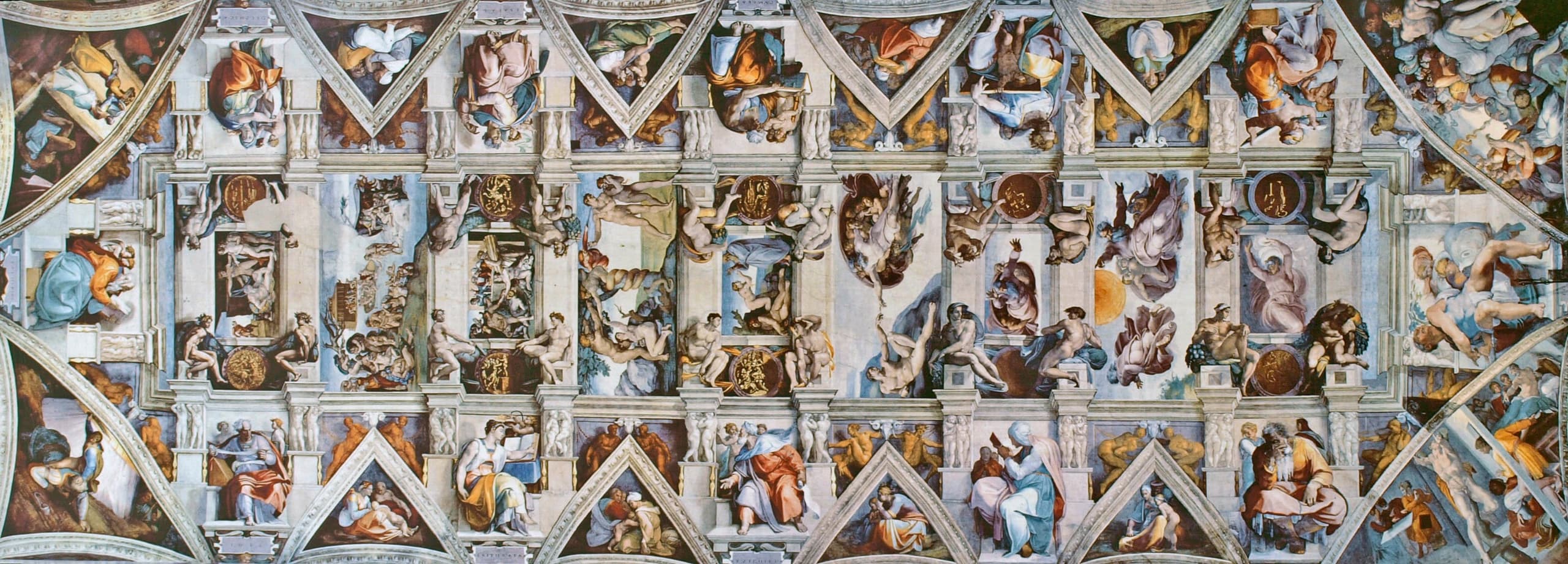
The ceiling is not a continuous picture. Michelangelo painted an illusionistic architectural framework — columns, cornices, ribs — directly onto the curved surface, dividing it into distinct panels. The nine Genesis scenes sit within this painted structure as though they were separate paintings mounted in a real frame. Between them are figures of prophets and sibyls seated in painted niches, and nude figures — ignudi — seated on painted plinths at the corners of the Genesis panels. The architecture is entirely fictive, but it organises the whole scheme and makes the ceiling read as a coherent structure rather than a single sprawling image.
The story
The Sistine Chapel was built between 1477 and 1480 for Pope Sixtus IV. By 1508, its walls had been painted by several artists including Sandro Botticelli, Domenico Ghirlandaio and Pietro Perugino, but the ceiling remained a simpler scheme. Pope Julius II commissioned Michelangelo to paint it. The project took four years, from 1508 to 1512.
Michelangelo worked in fresco, which means painting onto wet plaster so that the pigment binds chemically as the plaster dries. The method requires speed and certainty: once the plaster is dry, corrections are difficult. The ceiling is large — over forty metres long and more than thirteen metres wide — and curved. Michelangelo designed a scaffold to support the work. Contrary to persistent anecdote, he painted standing up, not lying on his back. The scaffold allowed him to stand close to the surface.
The design is a cycle of frescoes organised by a painted architectural framework. Nine scenes from the Book of Genesis run down the centre of the vault. They include the separation of light from darkness, the creation of the sun and moon, the creation of Adam, the creation of Eve, the temptation and expulsion from Eden, the sacrifice of Noah, the flood, and the drunkenness of Noah. Around these central panels, Michelangelo painted prophets and sibyls — figures from Jewish scripture and classical tradition who were understood to have foretold the coming of Christ — seated in painted architectural niches. At the corners of the Genesis panels, he placed nude figures, called ignudi, who sit on painted plinths and hold garlands and bronze-coloured medallions.
The Creation of Adam is the fourth of the Genesis scenes. Adam reclines on a barren slope, his left arm extended. God, wrapped in a red cloak and surrounded by attendant figures, reaches towards him. Their hands do not meet. The gap is small and deliberate. The composition is simpler than many of the other panels — two main figures, a clear gesture, a single moment — and it has become the most reproduced detail of the ceiling.
The ceiling was well-received immediately. Other artists studied and imitated it. The poses Michelangelo invented for the human figures — twisting, foreshortened, seen from below — became a reference for painters and sculptors across Europe. The chapel continued to serve as the setting for papal conclaves and other ceremonies. Michelangelo later returned to paint The Last Judgment on the altar wall. Raphael had earlier designed tapestries for the lower walls, made between 1515 and 1516.
The ceiling has been restored several times. The most recent restoration ran from 1980 to 1994. It removed centuries of accumulated grime, candle soot and earlier restoration layers, revealing brighter colours than had been visible for generations. The restoration was debated: some scholars argued that the cleaning removed not just dirt but also subtle tonal layers Michelangelo had applied himself. Others maintained that the brighter palette was closer to the original intention. The cleaned ceiling is what visitors see now.
Why it mattered then
The commission came from Pope Julius II, who wanted the chapel's decoration to reflect the theological programme already begun on the walls. The ceiling was part of a larger scheme illustrating Catholic doctrine, from Genesis through the life of Christ to the Last Judgment. The chapel served as the site of papal conclaves — the gatherings of cardinals that elect a new pope — and other important liturgical functions, so its decoration was not private or decorative in a domestic sense. It was a statement of the Church's understanding of history, prophecy and salvation, made visible in a space where the Church's leadership assembled. Michelangelo was already known as a sculptor, but he was not primarily a painter. The scale and complexity of the ceiling established him as capable of both. The figures he painted — twisting, muscular, seen from sharp angles — demonstrated a command of anatomy and foreshortening that other artists studied. The painted architecture, which made a curved vault read as a structured framework of panels and niches, showed how illusion could organise a large surface without flattening it. The ceiling became a teaching work: other painters came to see how Michelangelo had solved the problems of scale, structure and the human figure in difficult poses.
Why it matters now
The Sistine Chapel ceiling remains in place, in the chapel for which it was made. It is seen by millions of visitors, and the Creation of Adam — specifically the two hands — has been reproduced so widely that the detail is recognisable in contexts far removed from its original religious function. The near-touch has been used in advertisements, parodies, science fiction, and secular commentary. It has become a shorthand for creation, connection, and the relationship between human and divine, or human and other. The ceiling is also a reference point for arguments about restoration. The cleaning completed in 1994 is still debated. Some scholars believe the brighter colours are closer to what Michelangelo painted; others argue that the restorers removed tonal layers he applied intentionally after the fresco dried. The debate is not settled, and it raises a broader question: when a work has been altered by time, dirt, earlier restorations and the artist's own later touches, what does it mean to restore it? The ceiling is both the thing Michelangelo made and the thing centuries have made of it, and those two identities do not align perfectly.
The surprising detail
Michelangelo did not paint lying on his back. The image of the artist flat on a scaffold, paint dripping onto his face, is persistent but wrong. He designed a scaffold that allowed him to stand upright, close to the ceiling surface. He did work with his head tilted back, and he described the physical strain in a poem written during the project: his beard pointing skyward, his chest like a harpy's, his spine curved, his face spattered. But he was standing, not supine. The confusion may come from later retellings and dramatisations. The myth is more recent than the ceiling itself.
What is disputed
The brain-shaped cloak interpretation is not documented in any record from Michelangelo's lifetime or the following centuries. Whether the resemblance is intentional or coincidental is unresolved. The restoration completed in 1994 is also debated: some scholars believe the cleaning revealed Michelangelo's original colours, while others argue it removed tonal layers he applied after the fresco dried. Neither position has displaced the other.
Remember this
Michelangelo painted standing up, on a scaffold he designed, covering a chapel vault with nine Genesis scenes held together by fictive architecture.
Test yourself
Why did Michelangelo paint an architectural framework onto the ceiling rather than treating the vault as a single continuous surface?
Because the ceiling is large and curved, and a single sprawling image would have been difficult to read from below. The painted architecture — columns, ribs, cornices, niches — divides the surface into distinct panels and creates a structure that the eye can follow. It organises the nine Genesis scenes, the prophets, the sibyls and the ignudi into a coherent scheme rather than a chaotic spread. The framework also creates the illusion that the ceiling is not a vault but a complex of real architectural elements with paintings mounted within them. This makes the flat or curved plaster read as three-dimensional space. The fictive architecture is not decoration; it is the organising logic of the whole ceiling, and it allows the viewer to understand where one scene ends and another begins.
Go deeper
Image: Michelangelo, CC BY-SA 3.0. Licence: CC BY-SA 3.0. Source.