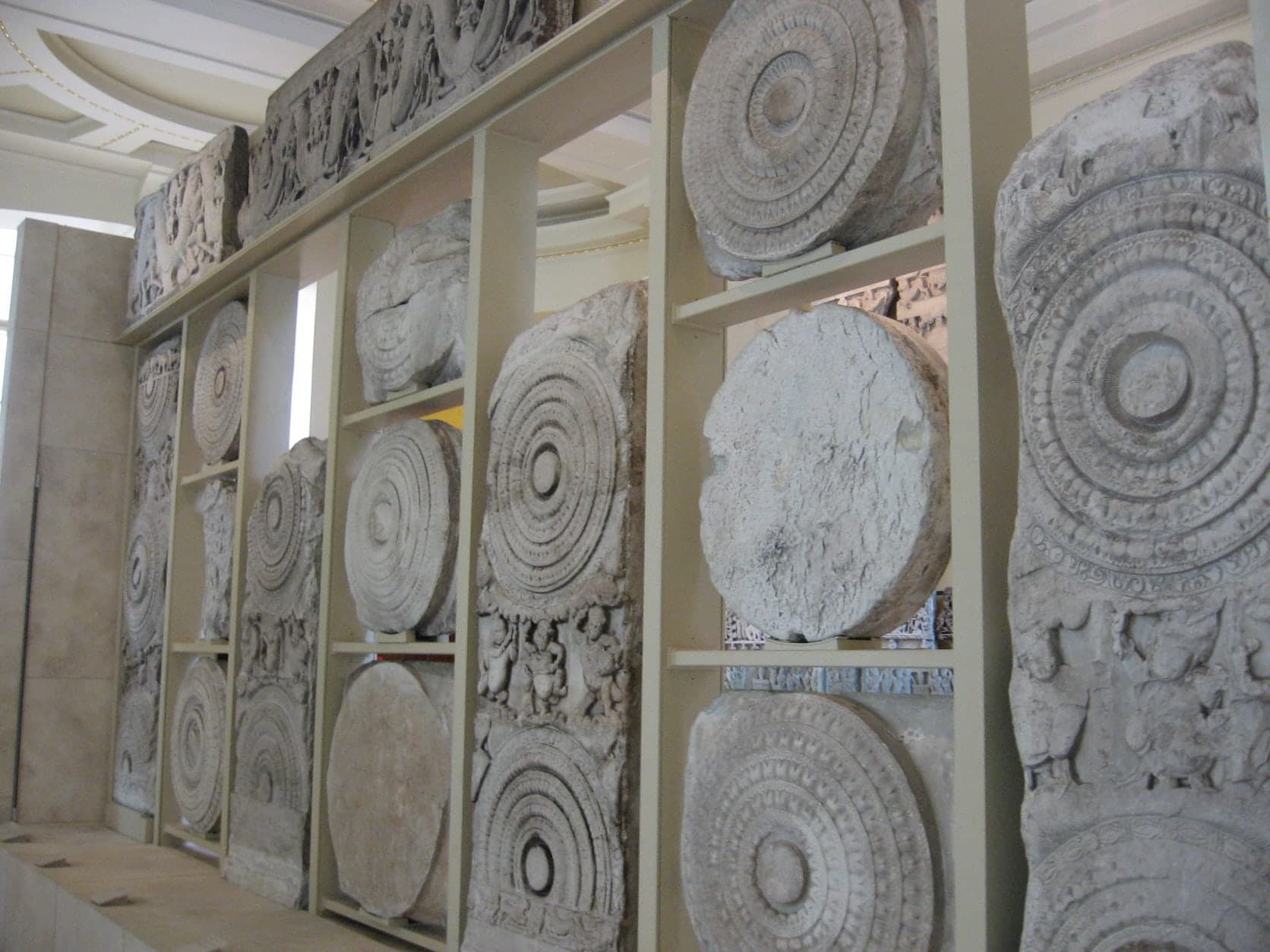
I · THE OBJECT · BRITISH MUSEUM
Amaravati sculptures in the British Museum
▶ Listen · narrated
These reliefs once wrapped a monument in southern India. Now they sit in a museum thousands of miles away, the result of decisions made in the eighteen-forties.
At a glance
- Number of pieces
- 120 sculptures and inscriptions
- Original site
- Amaravati Stupa, Guntur, Andhra Pradesh
- Date range
- 1st century BCE to 8th century CE
- Entered collection
- 1880s
Look closer
Multiple phases of building
The sculptures come from different periods of construction and rebuilding at the stupa, spanning roughly nine centuries. This was not a monument built once and left alone. It was expanded, repaired, and recarved over generations. The result is that the British Museum's collection includes work from several distinct phases, though the museum display does not always make clear which panel belongs to which period.
A pilgrimage site in the south
Amaravati was a grand pilgrimage stupa — a dome-shaped monument housing relics or marking a sacred site — in what is now Andhra Pradesh. It stood in the southern reaches of the Buddhist world as it existed in India during the early centuries CE. The stupa itself no longer survives intact, but the scale of the sculpture suggests a structure of considerable size and importance.
The Elliot Marbles
The sculptures were sometimes called the Elliot Marbles in the nineteenth century, after Sir Walter Elliot, who had them removed from the site to Madras in the eighteen-forties. The name echoes the Elgin Marbles and other groupings of Greco-Roman sculpture, and was applied to the whole group taken to Madras. Most of that group remains in Chennai. Nearly all of the smaller group now in London came from Elliot's removal.
The story
The Amaravati Stupa stood in what is now the Indian state of Andhra Pradesh, a Buddhist pilgrimage site built and rebuilt over many centuries. The stupa — a dome-shaped monument that might house relics or mark a sacred event — was decorated with carved limestone panels showing scenes from the life of the Buddha, earlier lives recounted in Buddhist texts, and the activities of donors and worshippers. The earliest work dates to the 1st century BCE; the latest to the 8th century CE. This was not a single construction campaign but a structure that grew and changed as the site remained active.
The British Museum holds a hundred and twenty of these sculptures and inscriptions. They entered the collection in the eighteen-eighties, but their removal from the site began earlier. In the eighteen-forties, Sir Walter Elliot arranged for a large group of sculptures to be taken from Amaravati to Madras, the colonial administrative centre. Most of that group stayed in Madras, now Chennai, where it forms the core of the collection in the Chennai Government Museum. A smaller portion was later sent to London.
The term Elliot Marbles was used in the nineteenth century for the whole group removed to Madras, in conscious imitation of the Elgin Marbles and other named collections of classical sculpture. It was essentially a Victorian coinage and applied to material that is now divided among several institutions. The site museum at Amaravati also holds sculptures, some found after the main removals, and smaller groups exist in museums elsewhere.
The carvings themselves show a distinctive style. Figures are densely packed, often in narrative sequences that unfold across a single panel. The Buddha is sometimes represented by symbols — a wheel, a tree, an empty throne — rather than in human form, following an earlier convention in Buddhist art. Other panels show him as a figure among many. Inscriptions record the names of donors, their villages, and occasionally their trades. These were not anonymous gifts but acts of merit tied to specific people and communities.
The stone is limestone, a material that allowed fine detail but has not always weathered well. Some panels are crisp; others are worn to the point where figures are barely legible. The condition varies because the panels were exposed to different conditions over time, and because some were reused or buried while others remained standing.
Why it mattered then
The stupa at Amaravati was a working religious site for centuries, and the sculptures were part of that function. Pilgrims came to walk around the monument, a ritual act called circumambulation, and the carved panels would have been visible during that walk. The inscriptions make clear that many of the sculptures were commissioned by individuals or groups as acts of religious merit. Donating a panel or a section of railing was a way to gain spiritual benefit and to record one's name and community for posterity. The scenes depicted were not decorative in a purely aesthetic sense. They were teaching tools and devotional images. A visitor who could not read would still have been able to follow the stories carved in stone, recognising episodes from the Buddha's life or from the Jatakas, the tales of his previous births. The stupa was a site of instruction as well as worship. The scale of the monument and the quality of the carving suggest substantial patronage. The donors named in inscriptions include monks, laypeople, and members of guilds. The stupa was not the project of a single ruler or institution but a collective enterprise sustained over generations. That it was rebuilt and expanded multiple times indicates that it remained significant, drawing resources and attention long after its initial construction.
Why it matters now
The sculptures are now divided among several collections, with the largest groups in Chennai and London. This division is the result of decisions made in the nineteenth century, when British officials and scholars removed material from the site and sent it to museums in India and Britain. The removal was not covert, but it was conducted under colonial authority and without the consent of any body that might be said to represent the local population or the Buddhist community. The question of where these objects belong is not settled. The site they came from is damaged and incomplete, and the stupa itself no longer exists as a functioning monument. The sculptures in Chennai are closer to their origin, but even they are not at the site. The British Museum's position is that the collection was acquired legally under the laws of the time and that it serves an educational purpose in London. Others argue that material of such cultural significance should be returned to India, where it can be seen in a context closer to its making. The sculptures also matter as evidence. They are among the records we have of early Buddhist art and practice in southern India, and the inscriptions provide names, places, and social details that are otherwise scarce for this region and period. But they are fragments of a larger whole, and their removal has made it harder to understand the monument they once adorned. The site at Amaravati was extensively quarried and disturbed before any systematic archaeology took place, and much information was lost.
The surprising detail
The term Elliot Marbles was a deliberate echo of the Elgin Marbles, an attempt to frame the Amaravati sculptures as a comparable treasure and to associate them with the prestige of classical antiquity. The parallel was not accidental. Victorian collectors and administrators frequently described non-European material in terms borrowed from Greece and Rome, a habit that shaped how these objects were valued and displayed. The name has largely fallen out of use, but it lingers in some older scholarship.
What is disputed
The exact circumstances of the removal in the eighteen-forties are not fully documented. The role of Sir Walter Elliot is clear, but the decisions about which pieces to take and the condition of the site at the time are less well recorded. The stupa had already been damaged and quarried for building stone before Elliot's involvement, so some of the sculptures may have been loose or displaced when they were collected.
How it got here
The sculptures were removed from the Amaravati Stupa site in the eighteen-forties by Sir Walter Elliot, who sent them to Madras. Most remained there and are now in the Chennai Government Museum. A smaller group was later transferred to the British Museum and entered the collection in the eighteen-eighties. The removal took place under colonial authority, and the sculptures were acquired under the legal framework of that period. There is ongoing debate about whether material of this cultural significance should be returned to India. The British Museum maintains that the collection was legally acquired and serves an educational purpose in London, while others argue that the sculptures should be reunited with the larger collection in India or returned to the region of their origin.
Remember this
A hundred and twenty pieces in London, most of a much larger group removed in the eighteen-forties and now divided among museums in India and Britain.
Test yourself
The sculptures span nine centuries of work at the same site. Why does that long timespan make it harder to interpret the collection as a whole?
Because the stupa was not a single project but a structure that was built, expanded, and rebuilt over many generations. Panels from different centuries may reflect different artistic styles, different religious emphases, and different patron communities. Without knowing which phase each sculpture belongs to, it is difficult to say what the monument looked like at any given moment or how its meaning changed over time. The British Museum display does not always distinguish between phases, so a visitor sees the collection as a group rather than as layers of history. The removal of the sculptures from the site also means we have lost the spatial relationships — which panels were adjacent, which were at eye level, which were high up — that would have shaped how they were seen and understood when the stupa was intact.
Go deeper
Image: CC BY-SA 3.0. Licence: CC BY-SA 3.0. Source.