I · THE OBJECT · BRITISH MUSEUM
Oxyrhynchus Papyri
▶ Listen · narrated
A century of work has transcribed five thousand documents from this rubbish heap. That is thought to represent about two per cent of what remains.
At a glance
- Material
- Papyrus, parchment, paper
- Discovery location
- Oxyrhynchus, Minya Governorate, Egypt
- Date range
- Ptolemaic period (3rd century BC) to Muslim conquest (640 AD)
- Current locations
- Bodleian Library, Ashmolean Museum, Cambridge University Library, University of Manchester Library, and institutions worldwide
- Published volumes
- 88 volumes (as of May 2025)
Look closer
Most of it is paperwork, not literature
An estimated ten per cent of the papyri are literary — poetry, plays, philosophical texts. The rest is administrative and private material: tax assessments, census returns, court records, wills, accounts, horoscopes, private letters. That ratio tells you what survives when a town throws things away for centuries. Literary works were copied and recopied, so they had other routes to survival. The ephemera — a lease, a petition, a bill — existed in a single copy, and when it was discarded it was gone. Oxyrhynchus preserved the paperwork that everywhere else disappeared.
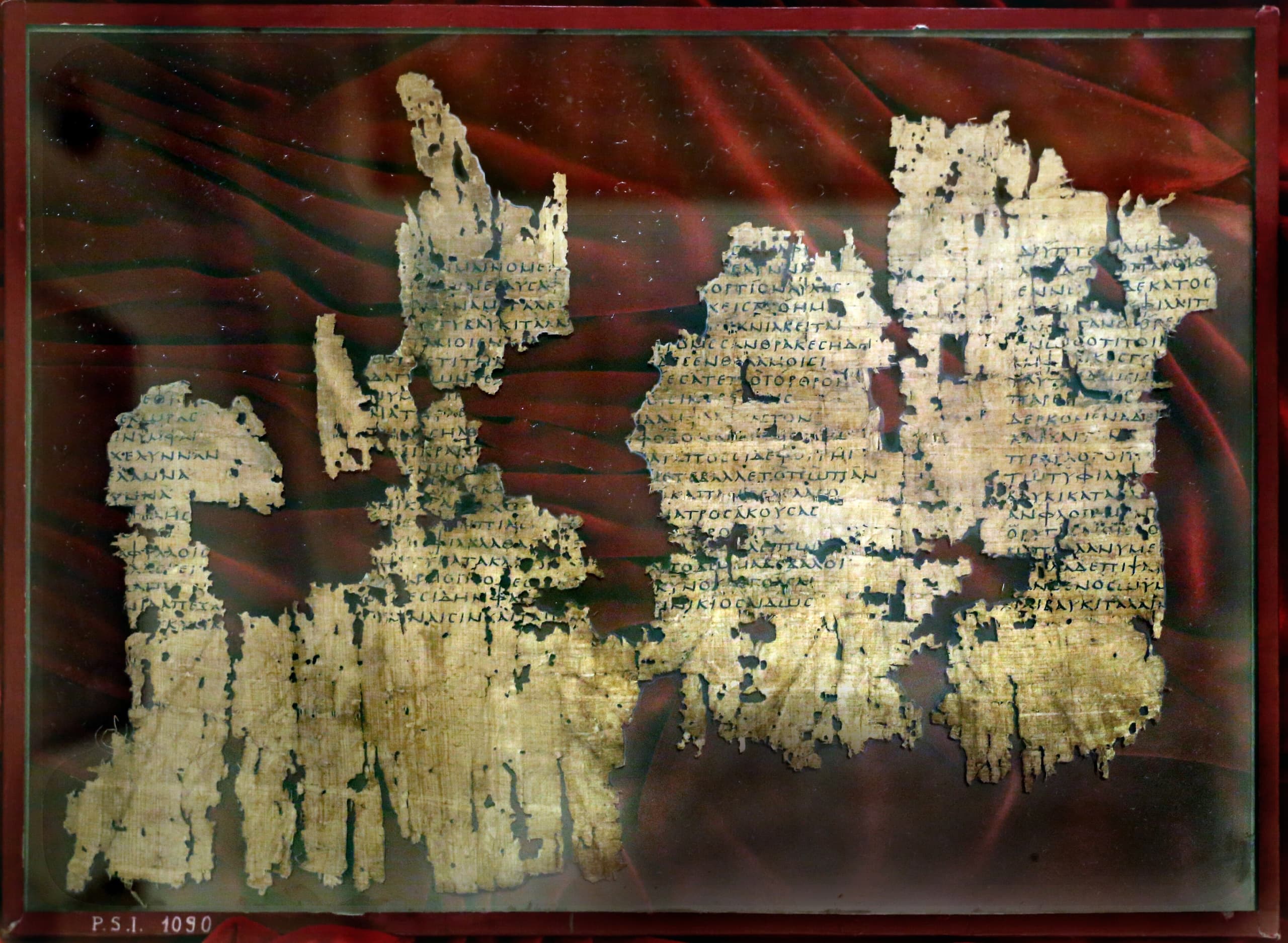
The fragments are the size of large cornflakes
The papyri were not found as scrolls or intact sheets. They arrived in hundreds of boxes as fragments, many no larger than a cornflake. Transcribing them means identifying the script, the language, the genre, and then attempting to reconstruct text from pieces that may or may not belong to the same document. Since the late nineteenth century, scholars have collated and transcribed over five thousand documents. That work continues: the most recent published volume appeared in May 2025.
Greek dominates, but seven other languages appear
Most of the papyri are in Greek, the administrative language of Ptolemaic Egypt and the Roman period that followed. But the dump also contained texts in Egyptian scripts — hieroglyphics, Hieratic, Demotic, and Coptic — as well as Latin and Arabic. Hebrew, Aramaic, Syriac and Pahlavi have been identified in smaller numbers. The linguistic mix reflects the town's position across a long span of Egyptian history, from the Ptolemaic period in the third century BC through to the Muslim conquest in 640 AD.
The story
Oxyrhynchus was a town in Egypt, about 160 kilometres south-west of Cairo, on a canal off the Nile. Its modern name is el-Bahnasa. In the late nineteenth and early twentieth centuries, papyrologists Bernard Pyne Grenfell and Arthur Surridge Hunt excavated an ancient rubbish dump there and found papyrus.
Not a library or an archive — a dump. For centuries, the inhabitants of Oxyrhynchus had discarded written material: letters, receipts, tax records, wills, horoscopes, court documents, census returns, private accounts. Also poems, plays, philosophical works, and other literary texts. All of it ended up in the same refuse heaps, and the dry climate of Egypt preserved it. Papyrus rots in damp conditions, but in the desert it can survive for millennia as long as it stays buried.
What Grenfell and Hunt brought back were not scrolls. They were fragments — hundreds of boxes of them, many pieces no larger than a cornflake. Since 1898, scholars have been sorting, conserving, transcribing and publishing them. Over five thousand documents have been collated and published so far. That is thought to represent between one and two per cent of the total material recovered. At least half a million papyri are estimated to remain, awaiting conservation, transcription, decipherment and cataloguing.
The papyri span roughly a millennium, from the Ptolemaic period — beginning in the third century BC — through the Roman period of Egyptian history, which started in 32 BC, and up to the Muslim conquest in 640 AD. Most are written in Greek, the administrative language of those periods. But the collection also includes texts in Egyptian scripts: hieroglyphics, Hieratic, Demotic, and Coptic, the late form of Egyptian written in a modified Greek alphabet. Latin and Arabic appear as well. Smaller numbers of texts in Hebrew, Aramaic, Syriac and Pahlavi have been identified.
The literary material — an estimated ten per cent of the total — has drawn significant scholarly attention. But the bulk of the collection is bureaucratic and private paperwork. Tax assessments. Petitions. Leases. Bills. Horoscopes. Census returns. Official correspondence. Registers. Codes. Edicts. Sales. Wills. Accounts. Inventories. Private letters. Court records.
That ratio reflects what a town actually wrote, and what it threw away. Literary works were copied, so they had multiple paths to survival. A tax receipt or a private letter existed in one copy. When it was discarded, it was gone — unless the dump where it landed stayed dry and undisturbed for two thousand years.
The papyri are now dispersed across institutions worldwide. Substantial collections are held at the Bodleian Library in Oxford, the Ashmolean Museum, Cambridge University Library, and the University of Manchester Library. There is an online table of contents listing the type of material in each papyrus or fragment. The most recent published volume — the eighty-eighth — was released in May 2025.
Why it mattered then
Oxyrhynchus was not a capital or a major cult centre. It was a provincial town, and the rubbish dump reflects that ordinariness. The papyri record the texture of daily administration and private life across a long stretch of Egyptian history, under Ptolemaic and then Roman rule, and into the early Islamic period. Tax assessments show how revenue was calculated and collected. Census returns list household members. Court records preserve disputes over property, debt, and family matters. Private letters capture the tone of personal correspondence — requests, complaints, affection, business. The literary fragments are significant, but the administrative documents are arguably more so for historians. Literature was copied and circulated; it had institutional support. Bureaucratic paperwork and private letters were ephemeral by design. They were written to be read once, filed briefly if at all, and then discarded. Oxyrhynchus preserved them in volume, and that volume makes it possible to reconstruct how a provincial town actually functioned: who paid what, who owned what, who wrote to whom, and what the language of those transactions looked like.
Why it matters now
The Oxyrhynchus Papyri remain an active field of scholarship. A century after the excavations began, the majority of the material has not been published. Transcription is slow: fragments must be conserved, the script identified, the language determined, the text deciphered and contextualised. Many pieces are damaged, incomplete, or written in cursive hands that require specialist knowledge to read. Digitisation has accelerated the work. High-resolution imaging allows scholars to examine fragments without handling them, and images can be shared internationally. Collaborative transcription projects have brought more readers to the material. But the scale remains daunting: five thousand documents published from an estimated half a million recovered. The collection continues to yield surprises. Fragments of lost literary works appear — poems, plays, philosophical treatises known only from references in other texts. But the documentary papyri also matter. They provide evidence for economic history, legal practice, linguistic change, and social structure in a way that monumental inscriptions and literary sources do not. A private letter or a tax receipt was never meant to be read two thousand years later, and that is precisely what makes it valuable. It was not written for posterity. It was written because someone needed to record a transaction, settle a dispute, or send a message. The rubbish dump at Oxyrhynchus preserved the routine, and the routine is what most of history discards.
The surprising detail
The papyri were not discovered in a single dramatic find. Grenfell and Hunt excavated the site over multiple seasons, and the material arrived back in England in hundreds of boxes, unsorted. The work of cataloguing and transcribing began immediately, but the sheer volume meant that much of it sat untouched for decades. Some boxes were only opened and examined in the late twentieth century, more than seventy years after they were packed. The most recent published volume appeared in May 2025, more than a century after the excavations ended. Scholars are still working through material that was dug out of the ground in the 1890s.
What is disputed
The estimate that the published material represents one to two per cent of the total recovered is based on scholarly assessment, not a complete inventory. The figure of at least half a million papyri remaining is also an estimate. The exact volume of unpublished material, and its condition, is not fully catalogued.
Remember this
Half a million papyrus fragments from a town dump, and a century of work has read about one in fifty.
Test yourself
Why does the fact that most of the Oxyrhynchus material is bureaucratic paperwork, rather than literary texts, make it more valuable for historians in some respects?
Because bureaucratic and private documents were ephemeral by design — written to be read once and then discarded — so they had no institutional mechanism for preservation. Literary works were copied and recopied, which gave them multiple routes to survival. A tax receipt, a census return, or a private letter existed in a single copy, and when it was thrown away it was gone. Oxyrhynchus preserved those single copies in volume, which means it captures the texture of daily life and administration in a way that literature and monumental inscriptions do not. The routine paperwork was never meant to be read two thousand years later, and that is precisely what makes it historically valuable: it records what people actually did, not what they wanted posterity to remember.