III · THE WORK · ART HISTORY
Leonardo's Mona Lisa
▶ Listen · narrated
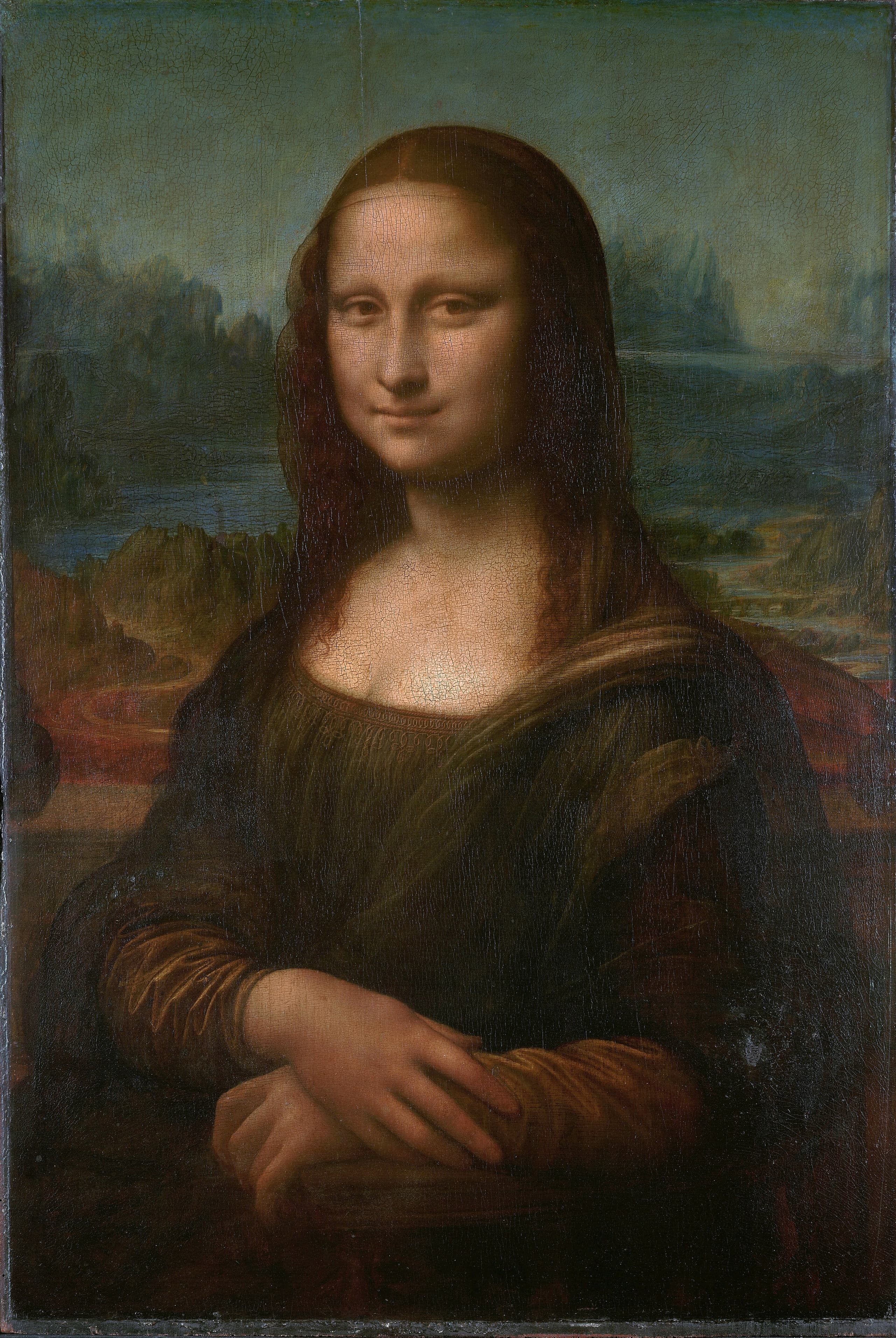
The face was built from glazes thin enough that no tool mark remains visible. The landscape's two sides sit at different heights, and nobody has settled why.
At a glance
- Artist
- Leonardo da Vinci
- Date
- Begun 1503, possibly worked on until 1517
- Material
- Oil paint on poplar panel
- Dimensions
- 79.4 × 53.4 centimetres
- Collection
- Louvre Museum, Paris
Look closer
Sfumato dissolving the corners of the mouth
The technique Leonardo used here is called sfumato — from the Italian for smoke or haze. He applied oil paint in glazes so thin that light passes through multiple layers before bouncing back. The effect is that edges blur without a visible transition. Look at the corners of the mouth: there is no line where lip ends and skin begins, no brushstroke you can point to. The shadow grades so gradually that the expression refuses to settle. This is not blending. It is transparency built up in films thin enough that dozens might sit in the thickness of a human hair.
Mismatched horizon lines left and right
The landscape behind the figure does not align. On the left, a road curves down toward a bridge and the land beyond sits lower. On the right, the horizon is higher — the distant plain is elevated relative to the left side. If you were to extend the two landscapes toward each other behind the figure's head, they would not meet at the same level. Scholars have proposed that Leonardo painted the two sides at different times, or that the imbalance is deliberate, a way of making the figure seem monumental by setting her against an unstable world. The painting does not explain itself.
The transparent veil over the hair
A fine dark veil lies over the hair, barely visible except where it crosses the lighter tones of the face and chest. It is painted thinly enough that the hair beneath shows through. The veil was a common element in portraits of married women in this period, a piece of decorum that identified social position without requiring ornament. Here it is so understated that many viewers do not register it at first glance, but it is one of the details that situates the sitter in a specific context — a woman of standing, dressed with restraint rather than display.
The story
Leonardo began this portrait in 1503, working in oil on a panel of white poplar wood. The painting is traditionally understood to show Lisa del Giocondo, the wife of a merchant, though Leonardo never delivered it to the family. He may have continued working on it for more than a decade; some accounts suggest he was still refining it as late as 1517.
The technique that defines the surface is sfumato, a method Leonardo developed of applying oil paint in glazes so thin that no individual brushstroke remains visible. Each glaze is transparent or nearly so. Light enters the paint, bounces off the white ground beneath, and returns through the layers, picking up colour and losing definition on the way. The result is that edges dissolve. There is no drawn line around the eyes or mouth, no border where shadow becomes skin. The transitions happen gradually enough that the eye cannot fix them, and the expression shifts depending on where you stand and how the light falls.
The landscape behind the figure is unresolved in a different way. The horizon on the left side of the panel sits lower than the horizon on the right. A road winds down toward a bridge on the left, and the land beyond is lower; on the right, the distant plain is elevated by comparison. If the two halves were joined behind the sitter's head, they would not meet. Scholars have proposed that Leonardo painted the background in stages and did not reconcile the levels, or that the imbalance is deliberate, a way of making the figure seem stable and monumental against a world that does not cohere. The painting offers no explanation, and Leonardo left no notes on this work that survive.
The panel passed into the collection of the French crown after Leonardo's death in 1519. It became the property of the state during the Revolution and has been held by the Louvre since 1797, with brief interruptions. It hung in various rooms of the palace before being installed in the Salle des États, where it remains.
The event that changed the painting's position in public attention happened in 1911. On a Monday in August, an employee of the Louvre named Vincenzo Peruggia removed the panel from the wall, hid it under his coat, and walked out of the building. The theft was not discovered until the following day. The painting was missing for more than two years. Peruggia kept it in his lodgings in Paris, then took it to Italy, where he attempted to sell it. He was arrested, and the panel was recovered and returned to the Louvre in 1914.
Peruggia stated that he had taken the painting because he believed it belonged in Italy, that it had been stolen by France and should be returned. This was not accurate — Leonardo had brought the painting to France himself — but the story fed a narrative of national grievance that gave the theft a layer of meaning beyond ordinary crime. The recovery generated coverage in newspapers across Europe and beyond. The painting had been well regarded before 1911, but the theft converted it into an object of mass attention. References began appearing in popular songs, films, and novels within a few years. The 1915 opera Mona Lisa took the theft as part of its plot; two films in the early 1930s dramatised versions of the story; a song recorded by Nat King Cole in 1950 became widely known.
The painting now hangs behind protective glass in a climate-controlled case in a room built to accommodate the crowds that come to see it. In 1962, it was insured for a valuation of 100 million dollars for a tour — a figure noted at the time as equivalent to roughly 1 billion dollars in 2023 currency. The Louvre does not lend it out. It remains in the Salle des États, seen by millions of visitors each year, most of whom spend less than a minute in front of it.
Why it mattered then
When Leonardo began this portrait in 1503, oil painting on panel was an established medium in Italy, but the techniques he applied here were not standard practice. Sfumato — the use of glazes thin enough to blur edges without visible brushstrokes — required patience, time, and a willingness to work in layers so fine that progress would have been almost imperceptible from one session to the next. Most portraits of the period were finished within weeks or months. Leonardo kept this one for years, possibly more than a decade, refining it in ways that would not have been legible to a patron waiting for delivery. The painting was made during a period when Leonardo was working on multiple projects and finishing few of them. He was employed intermittently by patrons in Florence and Milan, and his notebooks record studies of water, anatomy, flight, and fortifications alongside sketches for paintings. The portrait of Lisa del Giocondo was never delivered to her family. Instead, Leonardo kept it with him when he moved to France, and it remained in his possession until his death. The decision to retain the painting suggests it mattered to him as an ongoing experiment rather than as a completed commission. The sfumato technique, the unresolved landscape, the attention to gradations of light and shadow — these were concerns that occupied Leonardo across his work, and this panel became a site where he could pursue them without the pressure of a deadline or a patron's expectations.
Why it matters now
The painting's position now is shaped less by what Leonardo made than by what happened to it in 1911. The theft and recovery converted it from a respected work in a major collection into an object of global attention. The coverage generated by the theft reached audiences who had never heard of Leonardo, and the story — a painting stolen, hidden, and recovered — was simple enough to travel across languages and media. The painting became shorthand for art itself, a reference point that required no explanation. That fame has consequences. The painting now hangs in a room designed to manage crowds, behind glass, in a case that controls temperature and humidity. Most visitors spend less than a minute in front of it, often at a distance, often with a phone raised. The conditions under which it is seen are not the conditions under which it was made. The sfumato that Leonardo spent years refining is difficult to perceive from several metres back, through glass, in a crowded room. What remains legible is the fact of its fame. The painting is reproduced, referenced, and parodied constantly, and that ubiquity is itself a historical fact worth noting. It is not the work Leonardo spent the longest on, and it is not the portrait from the Italian Renaissance that repays close looking most richly — but it is the one that a theft made into a story, and stories travel further than technique.
The surprising detail
The painting left the Louvre in 1962, when it travelled for a tour that was insured at a valuation of 100 million dollars — equivalent to roughly 1 billion dollars in 2023 currency. The Louvre has not lent it since. It remains in the Salle des États, where it is seen by millions of visitors each year but cannot be studied anywhere else. The painting that became globally famous because it was stolen is now held in conditions that make theft nearly impossible, and also make sustained looking difficult.
What is disputed
The identification of the sitter as Lisa del Giocondo is traditional and widely accepted, but Leonardo left no written confirmation. The dates are likewise approximate: the painting is understood to have been begun in 1503, but the endpoint is uncertain, with some accounts suggesting Leonardo continued working on it until 1517. The reason for the mismatched horizon lines in the landscape has not been settled; proposals include that Leonardo painted the background in stages and never reconciled the levels, or that the imbalance is deliberate.
Remember this
Leonardo layered oil glazes so thin that edges dissolved, and a theft in 1911 made the painting famous everywhere.
Test yourself
Why does the mismatched horizon in the background matter to how we see the figure, even if we do not consciously notice the mismatch?
Because the instability in the landscape makes the figure seem more solid and monumental by contrast. If the horizon were level and the background coherent, the sitter would sit within a unified space. As it is, the two sides of the landscape do not agree — one sits higher than the other, and they would not meet if extended behind her head. That incoherence pushes the figure forward. She becomes the stable element in a composition where the world behind her does not hold together. Whether Leonardo intended this effect or simply never reconciled the two halves is not settled, but the result is the same: the figure dominates not because she is large or brightly lit, but because everything around her refuses to cohere. The eye has nowhere else to rest.
Go deeper
Image: Leonardo da Vinci, Public domain. Licence: Public domain. Source.