I · THE OBJECT · BRITISH MUSEUM
Oscott Psalter
▶ Listen · narrated
Some medieval manuscripts arrive with clear records of who commissioned them and why. This psalter, made around 1200, does not — and that silence is itself part of what it tells us.
At a glance
- Date
- Around 1200
- Type
- Illuminated manuscript
- Inventory number
- 50000
- Current location
- British Library
Look closer
What a psalter is
A psalter is a manuscript containing the psalms, the hundred and fifty poems and prayers from the Hebrew Bible that formed the core of Christian monastic worship. Monks and nuns recited portions of the psalms daily, in a cycle that repeated weekly, so a psalter was a working book, not a display object. Illuminated psalters — copies decorated with painted initials, borders and miniature scenes — were made for wealthy patrons who could afford both the parchment and the painter's time.
Illumination
An illuminated manuscript is one decorated with painted images and ornament, often using gold or silver that catches the light — hence 'illuminated'. The term covers everything from a single decorated initial letter to full-page paintings. The work was done by specialist painters, sometimes in the same workshop as the scribe who copied the text, sometimes separately. The pigments were ground minerals and plant extracts bound with egg white or gum, applied with fine brushes to prepared parchment.
The name
The Oscott Psalter is named after the place it was kept in the nineteenth century: St Mary's College, Oscott, a Catholic seminary near Birmingham. How it came to be there is not recorded in the available sources. It was later acquired by the British Museum, and when the British Library separated from the Museum, manuscript collections transferred to the new institution. It is now held by the British Library.
The story
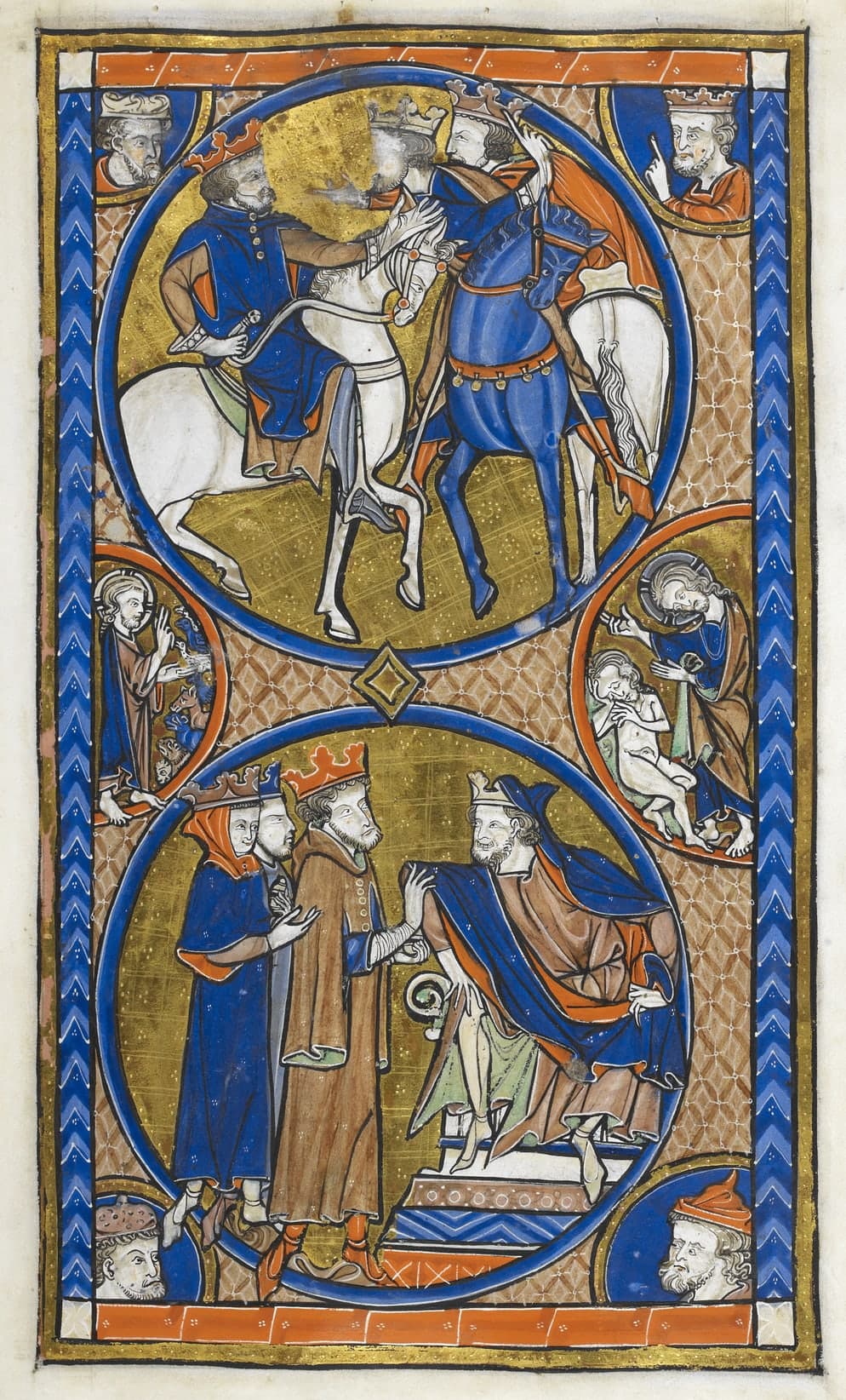
The Oscott Psalter is an illuminated manuscript made around the year 1200. It contains the psalms, the collection of hundred and fifty poems and prayers that formed the backbone of Christian monastic worship. The psalms were recited daily, in a fixed cycle, so a psalter was a practical book, meant to be opened and read repeatedly. That this one was illuminated — decorated with painted images and ornament — indicates it was made for someone with resources, but the manuscript itself does not record who that person was.
The term 'illuminated' refers to decoration that includes gold or silver, materials that catch and reflect light. The pigments used in such work were ground from minerals and plant materials and bound with egg white or gum, then applied to parchment with fine brushes. The labour was skilled and time-consuming, and the cost of an illuminated manuscript reflected both the materials and the hours required to produce it. A psalter of this kind would have been a significant commission.
The manuscript takes its name from St Mary's College, Oscott, a Catholic seminary near Birmingham where it was kept during the nineteenth century. How it arrived there is not documented in the sources that survive. It was later acquired by the British Museum. When the British Library was established as a separate institution, manuscripts held by the Museum transferred to the new library, and the Oscott Psalter moved with them. It remains in the British Library's collections.
The dating of the manuscript to around 1200 is based on the style of the script and decoration, methods that rely on comparing features of the manuscript — letterforms, ornamental motifs, the way figures are drawn — with dated examples. This is standard practice for manuscripts that lack internal evidence of when they were made, but it produces approximate dates, not precise ones. The available sources do not specify a narrower range than 'around 1200', and they do not record where the manuscript was made, though such work was typically done in monastic scriptoria or in urban workshops where scribes and illuminators worked for hire.
What survives is the object itself: a psalter made around 1200, illuminated, later kept at Oscott, now in the British Library. The gaps in its history — who commissioned it, where it was made, how it reached Oscott — are characteristic of medieval manuscripts, many of which moved through private hands for centuries before entering institutional collections. The absence of a documented provenance does not diminish what the manuscript is, but it does limit what can be said with certainty about its origins.
Why it mattered then
A psalter made around 1200 was a book for prayer, but also a marker of resources and piety. The psalms were recited daily by monks and nuns, and increasingly by laypeople who could afford a manuscript and had learned to read. An illuminated psalter signalled both devotion and the means to commission skilled work. The decoration served a purpose beyond display: painted initials and borders helped a reader navigate the text, marking divisions and significant passages. The images themselves — scenes from scripture, ornamental patterns, sometimes portraits of the patron — were aids to contemplation, visual prompts in a culture where most religious teaching was oral and most people could not read. To own such a book was to participate in a practice that connected the domestic or private sphere to the liturgical life of the Church.
Why it matters now
The Oscott Psalter is now studied as evidence of manuscript production around 1200, a period when illuminated books were made in increasing numbers for patrons outside monastic communities. The style of its decoration, the quality of its parchment, and the layout of its text all contribute to a picture of how such books were made and for whom. The manuscript also illustrates a common pattern in the survival of medieval objects: centuries of private ownership, during which records were not kept or have been lost, followed by acquisition by an institution that catalogues and preserves it. What we know about the manuscript today is shaped by that history — both the object itself and the gaps in the account of where it has been.
The surprising detail
The manuscript was kept at St Mary's College, Oscott, a Catholic seminary, during the nineteenth century, a period when Catholic institutions in England were rebuilding after centuries of legal restriction. How the psalter came to be there is not recorded, but its presence at Oscott places it in that moment of institutional recovery, when old manuscripts were being gathered and preserved by communities reconnecting with an interrupted past.
What is disputed
The date of around 1200 is based on stylistic comparison, not on internal evidence within the manuscript. The sources do not specify where it was made or who commissioned it, and they do not explain how it came to be at St Mary's College, Oscott, in the nineteenth century. These gaps are not unusual for medieval manuscripts, but they do mean that much of the psalter's early history remains unknown.
Remember this
An illuminated psalter from around 1200, named for the seminary where it was kept in the nineteenth century, now in the British Library — and much of its early history is not recorded.
Test yourself
Why does the absence of a documented early provenance not prevent scholars from dating and studying a manuscript like the Oscott Psalter?
Because the manuscript itself contains datable evidence in its script, decoration, and materials. Letterforms, ornamental styles, and the way figures are drawn change over time in ways that can be tracked by comparing manuscripts with known dates. Parchment preparation, pigment recipes, and binding techniques also vary by period and region. These features allow scholars to place an undated manuscript within an approximate time and sometimes a region, even when no written record of its commission or early ownership survives. The method produces ranges rather than exact dates, and it depends on a large body of comparative material, but it works because manuscripts are made objects, and the choices makers faced were shaped by the practices and materials available to them at a particular time.