I · THE OBJECT · BRITISH MUSEUM
Carthage Tariff
▶ Listen · narrated
Most ancient inscriptions are monuments or tombs. This one is a tariff: the fees for ritual sacrifice, itemised in Punic script on a temple wall.
At a glance
- Material
- Limestone
- Date
- Third century BCE
- Discovery
- 1856, archaeological site of Carthage
- Museum number
- BM 125303
- Inscription catalogue
- KAI 74, CIS I 167
Look closer
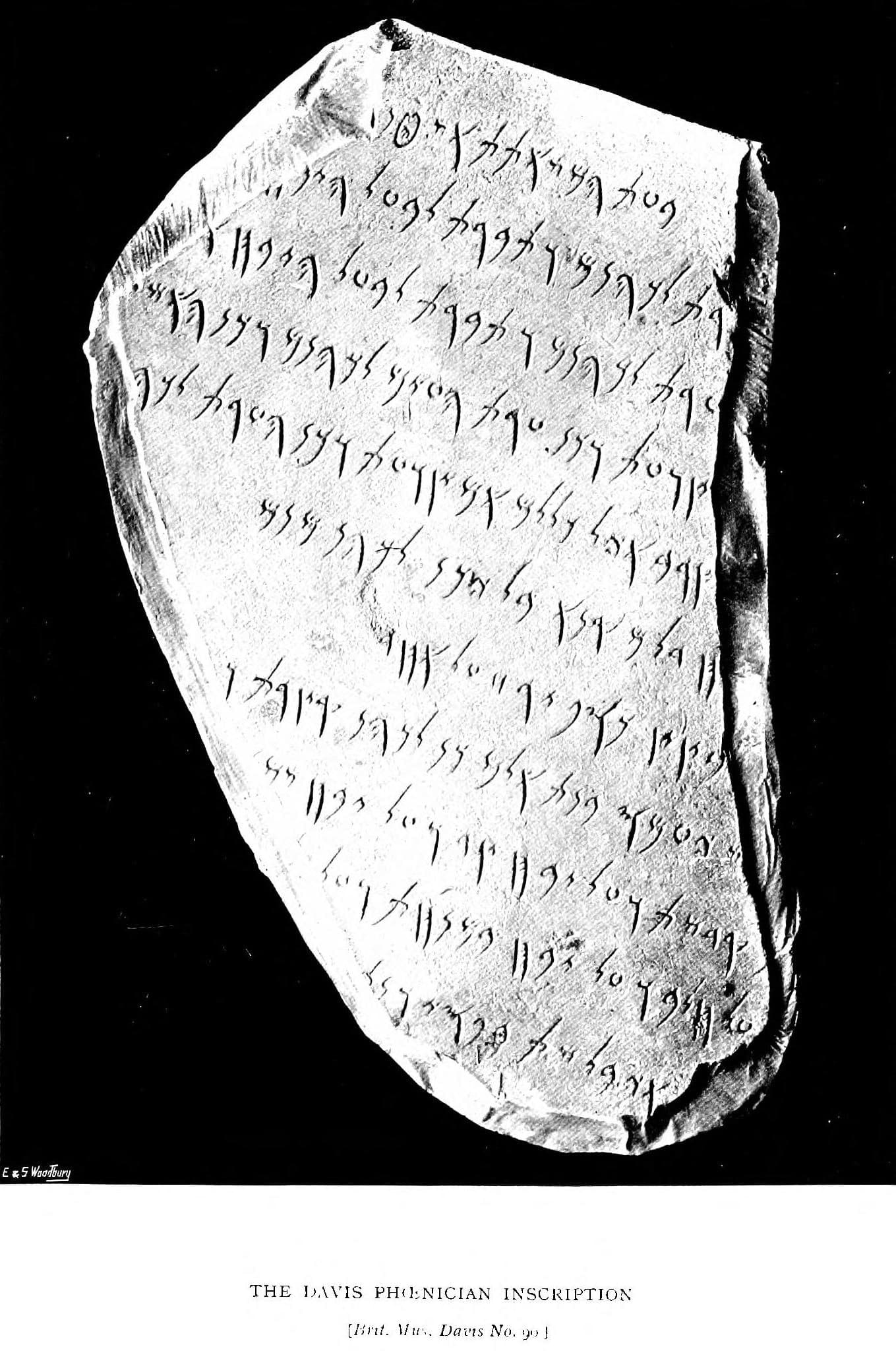
Fragments of a stela
The inscription survives on fragments of what was once a limestone stela — an upright slab. It was found broken, and the pieces that remain carry eleven lines of Punic text. A stela of this kind would have been set into a temple wall, visible to anyone approaching with an offering. The material is local limestone, carved with the angular script the Carthaginians adapted from Phoenician.
What the priests kept
The text lists payments for ritual sacrifices and specifies which portions of the animal go to the priests and which to the person making the offering. This division mattered: temple sacrifice was not symbolic consumption but real butchery, and the meat had value. A tariff made the split explicit, so neither party could claim ignorance. The inscription is, in effect, a public contract between worshipper and temple.
Published by Nathan Davis
Nathan Davis published the inscription after its discovery. The text was later catalogued as KAI 74 in the Kanaanäische und Aramäische Inschriften and as CIS I 167 in the Corpus Inscriptionum Semiticarum. Davis found it among other Carthaginian material, most of which consisted of tombstones. This tariff was one of just three inscriptions he recovered that were not funerary.
The story
The Carthage Tariff is a limestone inscription in the Punic language, dating to the third century BCE. It was discovered in 1856 at the archaeological site of Carthage, in what is now Tunisia. The text survives on fragments of a stela and runs to eleven lines.
What makes this inscription unusual is its content. It is not a dedication, not a tomb marker, not a record of military victory. It is a price list. The text sets out the fees for ritual sacrifices at a temple, and it specifies how the sacrificed animal is to be divided: which portions go to the priests, and which the worshipper takes away.
Punic is the language the Carthaginians spoke and wrote, a development of Phoenician brought west across the Mediterranean by settlers from the Levantine coast. The script is consonantal and reads right to left. By the third century BCE, Carthage controlled a maritime empire that stretched from Tunisia to southern Spain, and Punic was the administrative and religious language of that network. The tariff would have been legible to anyone in Carthage who could read, and it would have been posted where worshippers could see it before approaching the altar.
The discovery took place at the archaeological site of Carthage, the ruins of the city destroyed by Rome in 146 BCE and later rebuilt as a Roman colony. Nathan Davis, who published the inscription, recovered it along with other material, most of which consisted of traditional tombstones. The tariff was one of only three non-funerary inscriptions he found.
The text itself is practical. It does not explain why sacrifices are necessary, or which gods receive them, or what spiritual benefit the worshipper might expect. It assumes all of that is understood. What it does is regulate the transaction: how much the worshipper pays, what the priests are entitled to keep, and what the worshipper receives in return. Temple sacrifice involved the killing and butchering of animals, and the meat had real economic value. A public tariff removed ambiguity and prevented disputes.
The inscription is now held in the British Museum, catalogued as BM 125303. It also appears in two major epigraphic collections: the Kanaanäische und Aramäische Inschriften, where it is listed as KAI 74, and the Corpus Inscriptionum Semiticarum, where it is CIS I 167. Both catalogues are scholarly reference works that gather and publish ancient Semitic inscriptions for comparative study.
Another tariff inscription, thought to be related, was found earlier at Marseille — a city that was never Carthaginian but had strong trade links with the Punic world. The Marseille text is similar in structure and content, and it raises the possibility that such tariffs were a standard feature of Punic temple practice, not a local peculiarity of Carthage. Whether the two inscriptions reflect a shared template or independent solutions to the same administrative problem is not recorded in the surviving evidence.
Why it mattered then
In third-century BCE Carthage, this inscription served a specific administrative need. Temple sacrifice was a central religious practice, and it was also an economic transaction. An animal brought to the temple had value: its meat could be eaten, its hide used, its fat rendered. The tariff made explicit what had always been implicit: the division of that value between the temple and the worshipper. Without a public schedule, disputes were likely. A worshipper might believe the priests were taking more than custom allowed. A priest might suspect a worshipper of trying to reclaim portions that belonged to the temple. A tariff in stone, posted where anyone could read it, removed the room for disagreement. It was a legal text as much as a religious one. The existence of such a tariff also suggests something about Carthaginian society. It implies a literate public, or at least a public that accepted written rules as binding. It implies temples that operated with enough regularity and enough traffic to make a fixed fee schedule worthwhile. And it implies a religious economy in which sacrifice was routine, not exceptional — common enough that standardising the terms made sense.
Why it matters now
The Carthage Tariff matters now because so little Punic writing survives. Carthage was destroyed in 146 BCE, and the Romans who rebuilt the site had no interest in preserving Carthaginian records. What remains is fragmentary: inscriptions on stone, a handful of longer texts, and references in Greek and Roman authors who were often hostile. This tariff is valuable precisely because it is not literature. It was not written to impress or persuade. It was written to regulate a transaction, and that makes it evidence of how an ordinary temple functioned. It records the economic structure of worship, the division of responsibilities between priests and laypeople, and the assumption that such things needed to be spelled out in public. It also contributes to the study of Punic as a language. Every inscribed text adds to the corpus available for linguistic analysis, and a tariff, with its formulaic structure and specialised vocabulary, helps scholars understand how Punic handled legal and administrative language. The relationship to the Marseille tariff is particularly useful: two texts with similar content, found in different locations, allow for comparison and help clarify terms that might otherwise remain ambiguous. Finally, the tariff is a reminder that ancient religion was not purely symbolic. Sacrifice involved animals, meat, money, and the division of resources. A text that regulates those divisions is as much a part of religious history as a hymn or a myth.
The surprising detail
Nathan Davis found this tariff among a much larger collection of Carthaginian tombstones. Of all the inscriptions he recovered, only three were not funerary. The overwhelming majority of Punic inscriptions that survive are tomb markers, which means the evidence for how Carthaginian temples, law courts, or markets functioned is thin. The Carthage Tariff is unusual simply because it records something other than a burial.
How it got here
The inscription was discovered in 1856 at the archaeological site of Carthage, in present-day Tunisia, and was brought to Britain in the nineteenth century. It is now held in the British Museum as BM 125303. The removal of archaeological material from Carthage during the colonial period is part of a broader history of extraction from sites in Tunisia. Tunisia has not, to public knowledge, requested the return of this inscription, but the broader question of repatriation of Carthaginian material remains a matter of ongoing discussion in museum and heritage circles.
Remember this
A temple fee schedule in stone, specifying what the priests keep and what the worshipper takes home — practical religion, made explicit.
Test yourself
The tariff specifies how a sacrificed animal is divided between priests and worshipper. Why would a temple bother to carve that division into stone, rather than leaving it to custom or oral agreement?
Because sacrifice was an economic transaction as well as a religious one, and the meat had real value. Without a public written schedule, disputes were likely: a worshipper might believe the priests were taking more than was proper, or a priest might suspect a worshipper of trying to reclaim portions that belonged to the temple. A tariff carved in stone and posted where it could be read removed ambiguity and made the terms binding. It turned a potential argument into a matter of record. The lesson generalises: when a transaction involves something of value, writing it down protects both parties.
Go deeper
Image: C J Ball, Public domain. Licence: Public domain. Source.