I · THE OBJECT · BRITISH MUSEUM
Rhyd-y-gors Shield
▶ Listen · narrated
This shield is the width of your arm span and thinner than a credit card. It was never meant for battle, but it was worth making anyway.
At a glance
- Date
- 12th to 10th century BC
- Material
- Copper alloy
- Dimensions
- 667 mm diameter, 0.7 mm thick
- Weight
- 1929 grams
- Find location
- Rhyd-y-gors, near Blaenplwyf, Wales
- Museum number
- 1873,0210.2
Look closer
Thinner than the metal in a drinks can
The shield is 0.7 millimetres thick — about the thickness of three sheets of printer paper stacked together, and thinner than the aluminium in a modern beverage can. At 667 millimetres across, that makes it a broad disc of hammered metal with almost no structural rigidity. A sword blow would crumple it, not glance off. The thinness is not wear or corrosion eating away at an originally thicker object: this is how it was made.
Completely flat, with raised decoration
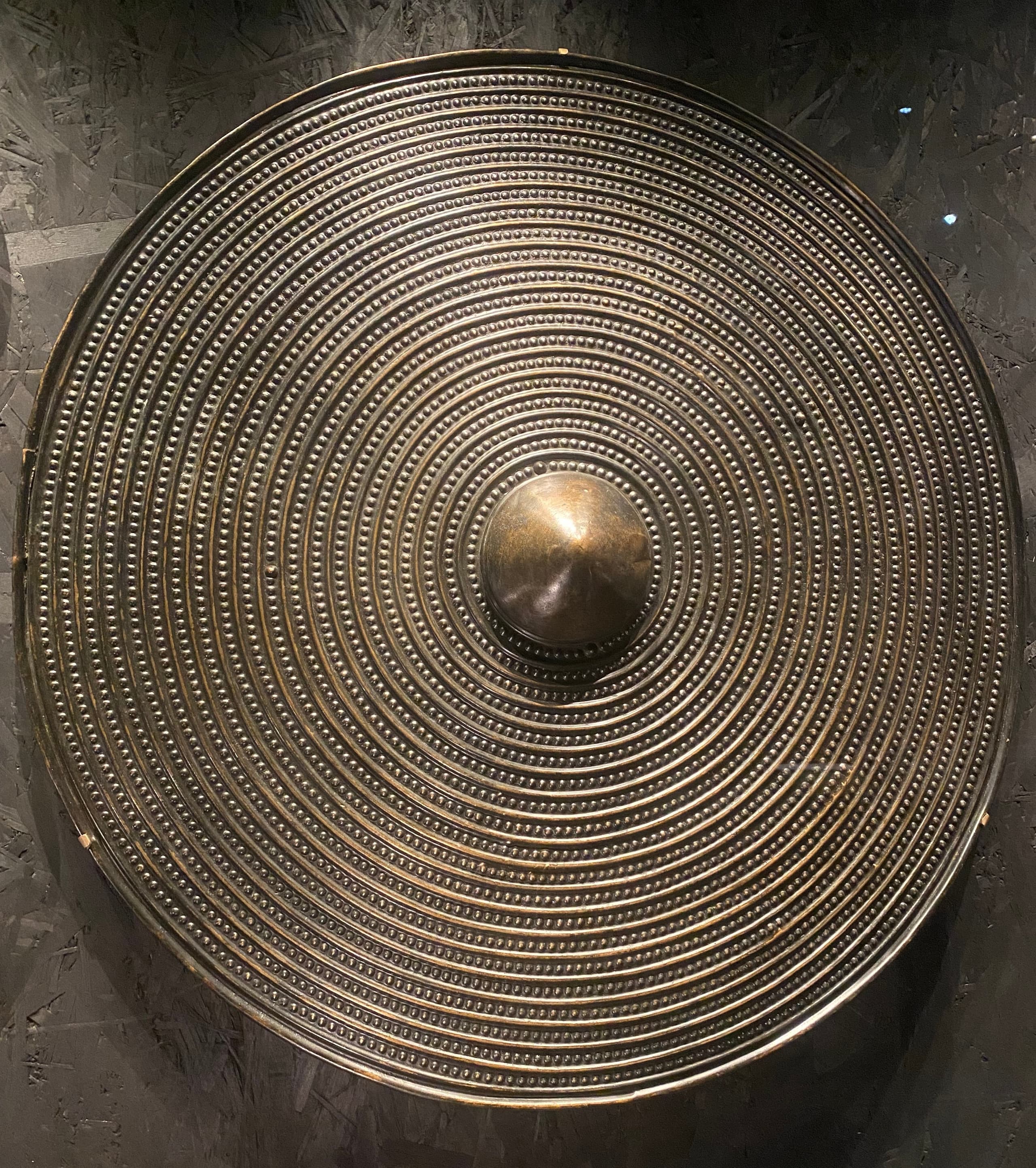
The surface is entirely flat — no domed profile, no central boss to deflect a blow, none of the structural curves that would stiffen the metal or protect the hand behind it. The decoration consists of concentric ridges hammered up from the surface, creating a pattern of raised rings. These were made by working the copper alloy from behind, a technique called repoussé, which thins the metal further at the points where it is raised.
A Yetholm-type shield
The Rhyd-y-gors Shield belongs to a type named after finds at Yetholm in the Scottish Borders. Yetholm-type shields share certain features: they are large, flat, circular, made of thin copper alloy, and decorated with concentric patterns. The type is a classification based on form and technique, not a claim about where they were made or by whom. What unites them is that they are all too fragile to have been defensive weapons in the ordinary sense.
The story
The Rhyd-y-gors Shield was found at Rhyd-y-gors, near Blaenplwyf in Wales, and entered the British Museum's collection in 1873. It is a large circular disc of copper alloy, 667 millimetres across and 0.7 millimetres thick, weighing just under two kilograms. The surface is flat and decorated with concentric ridges raised from the metal. It dates to the period between the twelfth and tenth centuries BC.
The shield is classified as a Yetholm-type, a form named after similar objects found at Yetholm in Scotland. What defines the type is not where the shields were made, but what they have in common: they are large, flat, circular, and made from very thin sheets of copper alloy, decorated with patterns of raised concentric rings or ribs. The Rhyd-y-gors example is completely flat, with no domed profile and no central boss — features that would normally stiffen a shield and help it deflect blows.
The thinness is the central puzzle. At less than a millimetre, the metal is too fragile to have withstood combat. A sword strike would buckle it, and the lack of any structural curve means it would offer almost no protection to the person holding it. The decoration, made by hammering the metal from behind to raise ridges on the front, thins it further at those points. This is not a design that prioritises durability.
That raises the question of what it was for. The effort required to produce it was considerable: copper alloy had to be smelted, cast, and then hammered into a thin, even sheet without cracking. The concentric decoration required skill and time. Someone made this, and someone valued it enough that it survived to be deposited in the ground. But it was not made to stop weapons.
The most widely held interpretation is that shields like this were ceremonial or symbolic objects — made to be seen, not used in battle. They may have been carried in processions, displayed at gatherings, or deposited as offerings. The fragility, far from being a flaw, may have been part of the point: an object that could only exist in a context where it would not be tested, a display of wealth and metalworking skill that announced its owner's status precisely because it was impractical.
The find location, Rhyd-y-gors, is near Blaenplwyf in Wales. Many Bronze Age metal objects have been found in wet or marshy ground, and it is possible this shield was deliberately placed there, though the circumstances of its discovery are not recorded in detail. Deposition in bogs and rivers is a recurring pattern for objects from this period, and objects placed in such locations were often valuable and intact, suggesting they were offerings rather than accidental losses.
Why it mattered then
In the Bronze Age, metalworking was a specialised and costly craft. Copper and tin, the components of bronze, had to be mined, smelted, and alloyed, and the resulting metal was valuable. To take that metal and hammer it into a sheet less than a millimetre thick, over a diameter of more than half a metre, required both skill and a willingness to invest labour in an object that could not be used for the most obvious purpose a shield might serve. That investment suggests the shield mattered for reasons other than defence. In a society where metal objects were relatively rare and metalworking knowledge was held by a small number of people, an object like this would have been a visible statement of access to resources and craft skill. Its fragility may have been deliberate: it could only exist in contexts where it would not be struck, and that restriction would have been legible to anyone who saw it. It was a shield that announced it did not need to function as one. If it was used in ceremonies or deposited as an offering, it would have played a role in the social and ritual life of the community that made it. Bronze Age depositions in wet ground are common enough to suggest a pattern, though the specific beliefs behind them are not recorded. What is clear is that people were willing to place valuable objects in locations where they could not be retrieved, and that this was considered worthwhile.
Why it matters now
The Rhyd-y-gors Shield is evidence that function and purpose are not the same thing. It is tempting to assume that an object shaped like a shield must have been made to protect someone in combat, but the physical properties of this one rule that out. Its existence forces a more complicated question: what else might a shield be for? That question applies beyond Bronze Age metalwork. Objects that look like tools or weapons but were made too fragile, too ornate, or too impractical to be used in the obvious way appear in many periods and places. They suggest that display, ceremony, and symbolism were not secondary concerns, added on to functional objects, but could be the primary reason something was made. The Rhyd-y-gors Shield is a reminder that we cannot assume we know what an object was for simply by recognising its shape. It also sits within a wider pattern of Bronze Age deposition. The practice of placing valuable metal objects in rivers, bogs, and other wet locations is well attested, and the Rhyd-y-gors Shield may be an example of that pattern. Understanding why people did this — whether it was religious offering, a way of removing objects from circulation, or something else — remains an open question, but the material evidence is clear: people were making objects that were never intended to be kept.
The surprising detail
The shield is flat, with no curve at all. Most shields, whether ancient or modern, have a domed or curved profile, which serves two purposes: it stiffens the material, making it harder to buckle, and it helps deflect blows away from the centre. The Rhyd-y-gors Shield has neither advantage. Its flatness, combined with its thinness, means a sword blow would crumple it rather than glance off — and yet someone invested the time and metal to produce it, and it was valued enough to survive.
What is disputed
The circumstances of the shield's discovery at Rhyd-y-gors are not recorded in detail, so whether it was found in wet ground, as part of a hoard, or in another context is not certain. The interpretation of Yetholm-type shields as ceremonial or symbolic objects is widely accepted, but it rests on inference from their physical properties rather than on direct evidence of how they were used. No contemporary written sources describe their function, and the archaeological contexts of many finds are poorly documented.
Remember this
A shield too thin to block a blow, made with care and deposited in the ground — function and purpose are not always the same.
Test yourself
If the shield was too fragile for combat, why make it out of metal at all? Why not use wood, leather, or wicker, which would have been cheaper and easier to work?
Because the metal was the point. Copper alloy was a valuable material in the Bronze Age, requiring mining, smelting, and specialised knowledge to produce. An object made from it signalled access to resources and craft skills that most people did not have. A wooden or leather shield would have been more practical for defence, but it would not have carried the same meaning. The fragility of the Rhyd-y-gors Shield may have been deliberate: it could only exist in a context where it would not be tested, and that restriction would have been visible to anyone who saw it. The choice of metal, and the thinness of the sheet, were part of what the object was communicating.
Go deeper
Image: Titus Gold, CC BY-SA 4.0. Licence: CC BY-SA 4.0. Source.