III · THE WORK · ART HISTORY
Moses
▶ Listen · narrated
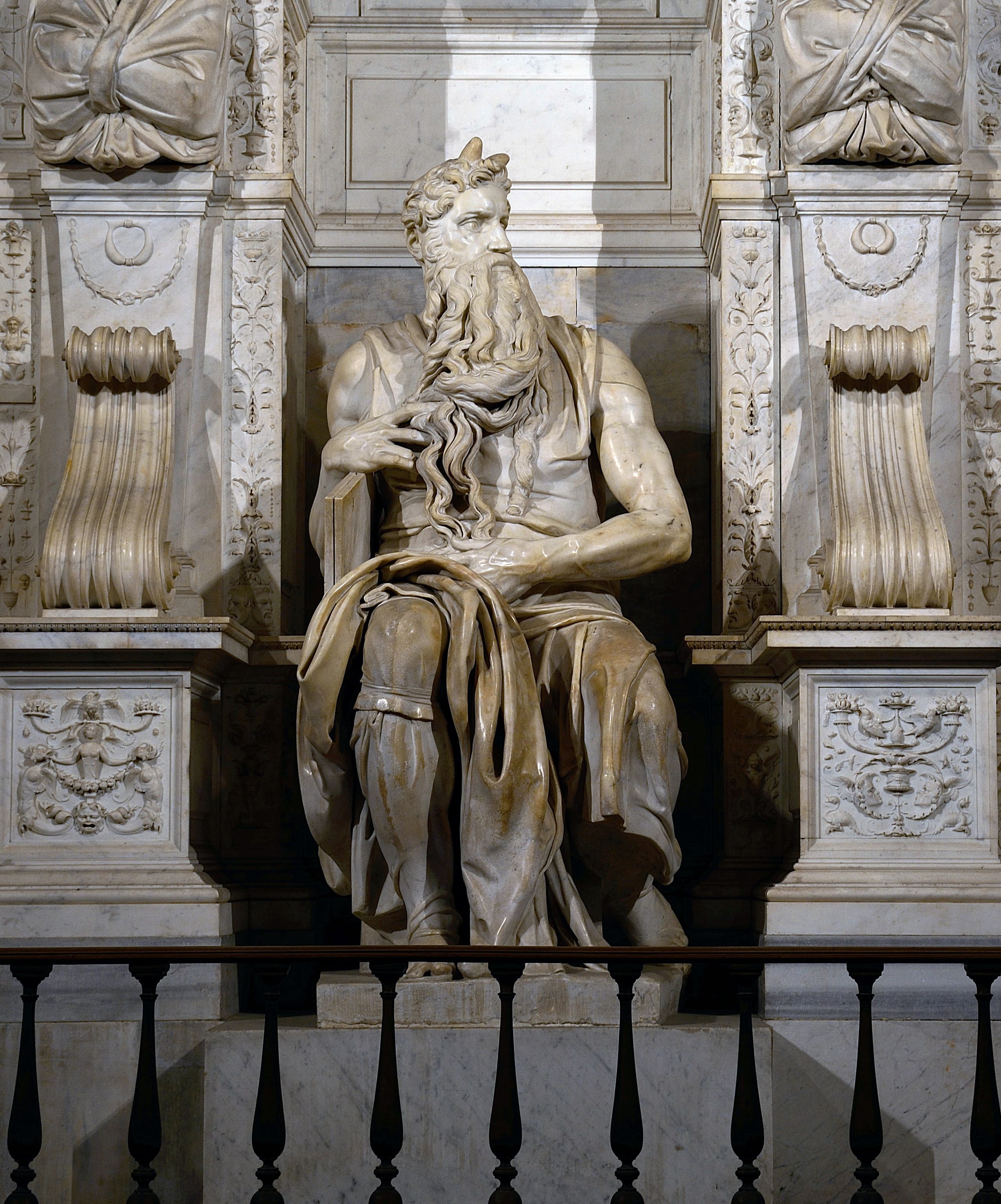
A seated figure, over two metres tall, turns his head as though interrupted. The carving is famous; the horns require explanation.
At a glance
- Artist
- Michelangelo
- Date
- Around 1513–1515
- Material
- Marble
- Height
- 235 centimetres
- Location
- San Pietro in Vincoli, Rome
Look closer
The horns
Two short protrusions rise from Moses's forehead, carved as smoothly as the rest of the head. They are not goat horns or devil horns — they taper to rounded points and sit symmetrically above the brow, more like the nubs of a young ram. Michelangelo was following the Vulgate, the Latin translation of the Bible used in his time, which described Moses with a face that was cornuta — horned. The Hebrew word in Exodus can mean either horned or radiant, and translators had chosen one reading over the other.
The turn of the head
Moses sits facing slightly to his right, but his head has turned sharply back over his left shoulder, chin raised. The pose suggests a sudden movement caught mid-action, as though he has heard something and twisted to look. His left arm is bent across his body, hand resting near his chest, fingers tangled in the long carved beard. The right arm is lowered, hand resting on what may be the tablets of the law, though the object is not fully distinct. The turn creates a dynamic tension in a seated figure — stillness interrupted.
The carving of the beard and hair
The beard flows in deep, looping channels, each strand undercut so that the marble catches shadow and light as separate filaments. The hair on Moses's head is similarly detailed, carved in thick waves that fall past the shoulders. Freud, writing in 1916, noted the technical achievement of this carving but argued that Michelangelo's intent went beyond showing skill — that the delicacy of the hair and the way Moses's fingers are buried in his beard were meant to provoke questions in the viewer about what the figure is doing and why.
The story
Michelangelo carved Moses for the tomb of Pope Julius II, a project commissioned in 1505. The tomb was planned as a large freestanding monument, and Moses was one of several figures intended for it. The sculpture was made sometime around 1513 to 1515, though the exact years are not certain. It now sits in the Basilica of San Pietro in Vincoli in Rome, where the much-reduced version of the tomb was eventually installed.
The figure is seated, massive in scale at 235 centimetres tall, and carved from a single block of marble. Moses is shown as an older man with a long beard, muscular arms, and a powerful torso visible beneath draped cloth. His head is turned sharply to the left, as though reacting to something outside the frame of the sculpture. His left hand is raised to his chest, fingers caught in the strands of his beard. His right hand rests lower, near what appears to be the stone tablets, though the object is not carved with enough detail to be certain.
The two horns rising from his forehead are the sculpture's most discussed feature. They are short, symmetrical, and carved as smoothly as the rest of the head. Michelangelo was working from the Vulgate, the Latin translation of the Bible standard in his period, which rendered a Hebrew word in Exodus as cornuta — horned. The same Hebrew word can mean radiant, and later translations chose that reading, but the Vulgate said horns, and so he carved them. Some scholars have argued that the use of horns in Christian art could carry antisemitic implications, while others hold that it was simply a convention based on the translation, with no further intent.
Freud published an interpretation of the sculpture in 1916, focusing on the emotional intensity he saw in the figure. He noted that Moses appears caught in a moment of inner conflict, his body tense, his hand gripping his beard as though restraining himself. Freud argued that the sculpture goes beyond technical skill to provoke curiosity — why the figure plays with his hair, why he is shown with both horns and flowing locks, why the pose suggests interrupted motion. Other interpretations have noted a sense of force in the figure, sometimes described as demonic, sometimes as a representation of divine revelation being processed by a human mind.
The carving itself is precise. The beard and hair are undercut deeply enough that individual strands are visible, and the folds of cloth across the torso are carved with attention to how fabric gathers and drapes over a body. The musculature of the arms and the veins on the hands are rendered in detail. The surface of the marble is polished smooth in some areas and left rougher in others, creating variation in how light strikes the stone.
Why it mattered then
Moses was carved for a papal tomb, a project that carried both political and spiritual weight. Julius II had commissioned Michelangelo to design a monument that would stand as a statement of his papacy, and Moses was intended as one of several figures representing prophets and virtues. The tomb project was scaled back repeatedly over decades, and the final version installed in San Pietro in Vincoli was much smaller than originally planned, but Moses remained central to it. The decision to show Moses with horns was not eccentric. It followed the text of the Vulgate, the authorised Latin translation of the Bible, and other artists had made the same choice in earlier centuries. The sculpture presented Moses as a figure of authority and power, seated as though enthroned, with the physical strength and intensity that Michelangelo brought to many of his figures. The turn of the head and the tension in the pose may have been intended to show Moses at a specific moment — perhaps hearing the Israelites worshipping the golden calf, or receiving the law — though the sculpture does not specify which.
Why it matters now
Moses remains one of the sculptures visitors to Rome seek out, and it is studied both for its technical achievement and for the interpretive questions it raises. The carving of the beard and hair is still cited as an example of what can be done with marble when the stone is cut deeply enough to separate individual elements and create the illusion of movement. The pose — a seated figure turning suddenly — has been analysed for how it conveys psychological tension without relying on action or narrative props. The horns continue to require explanation. Viewers who do not know the history of the Vulgate translation often assume they are symbolic or that Michelangelo was making a theological point. The sculpture has become a case study in how translation shapes representation, and how a single word choice can fix an image in stone that persists long after the translation has been revised. The question of whether the horns carried additional meaning beyond the text — whether they were neutral, or coded, or part of a broader pattern in Christian depictions of Jewish figures — remains debated, and the sculpture is referenced in those discussions. Freud's interpretation, whatever its accuracy, made Moses a subject in psychoanalytic writing and gave the sculpture a second life in that literature. The figure is now read both as a carved object and as a text that has accumulated layers of interpretation, each responding to what earlier viewers saw or thought they saw.
The surprising detail
The Hebrew word that the Vulgate translated as 'horned' is qaran, which comes from the root word for horn but can also mean to shine or emit rays of light. When Moses came down from the mountain after speaking with God, the text in Exodus says his face was qaran — either horned or radiant. Jerome, translating the Bible into Latin in the late fourth century, chose cornuta. That choice shaped how Moses was depicted in Christian art for over a thousand years. Later translations, working from the Hebrew directly, chose 'radiant' or 'shone', and the horns disappeared from newer images. Michelangelo's Moses is now one of the last prominent examples of the older tradition, carved just before the translation began to shift.
What is disputed
The exact years of the sculpture's carving are not certain; sources give a range around 1513 to 1515. The object Moses's right hand rests on is often described as the tablets of the law, but the carving does not make this explicit. Interpretations of what moment the sculpture depicts, and what the pose and expression are meant to convey, remain varied, and no single reading has displaced the others.
Remember this
Michelangelo gave Moses horns because the Vulgate said Moses had them — a translation choice that shaped the sculpture and then outlasted the translation itself.
Test yourself
Why does the turn of Moses's head matter to how the sculpture is read, beyond simply making the pose more dynamic?
Because the turn suggests that Moses is reacting to something outside the sculpture itself — something happening in the space around him, or in a narrative moment the viewer is meant to supply. A figure seated and facing forward would be self-contained, a portrait or an icon. A figure who has turned suddenly is interrupted, and that interruption implies a cause. Interpretations of the sculpture have proposed different causes: that Moses has heard the Israelites worshipping the golden calf, or that he is receiving divine instruction, or that he is restraining his own anger. The turn does not specify which, but it converts the sculpture from a static representation into a moment in time, and it makes the viewer ask what that moment is. That is why Freud and others focused on the pose — it is the mechanism by which the sculpture creates psychological tension.
Go deeper
Image: Livioandronico2013, CC BY-SA 4.0. Licence: CC BY-SA 4.0. Source.