III · THE WORK · ART HISTORY
Mesha Stele
▶ Listen · narrated
In 840 BC a king named Mesha recorded his rebellion and building works in stone. What survives is both the text and the violence done to it.
At a glance
- Maker
- Mesha, king of Moab
- Date
- 840 BC
- Material
- Basalt
- Discovered
- 1868, Dhiban
- Location
- Louvre, Room 303
Look closer
The text runs in horizontal lines
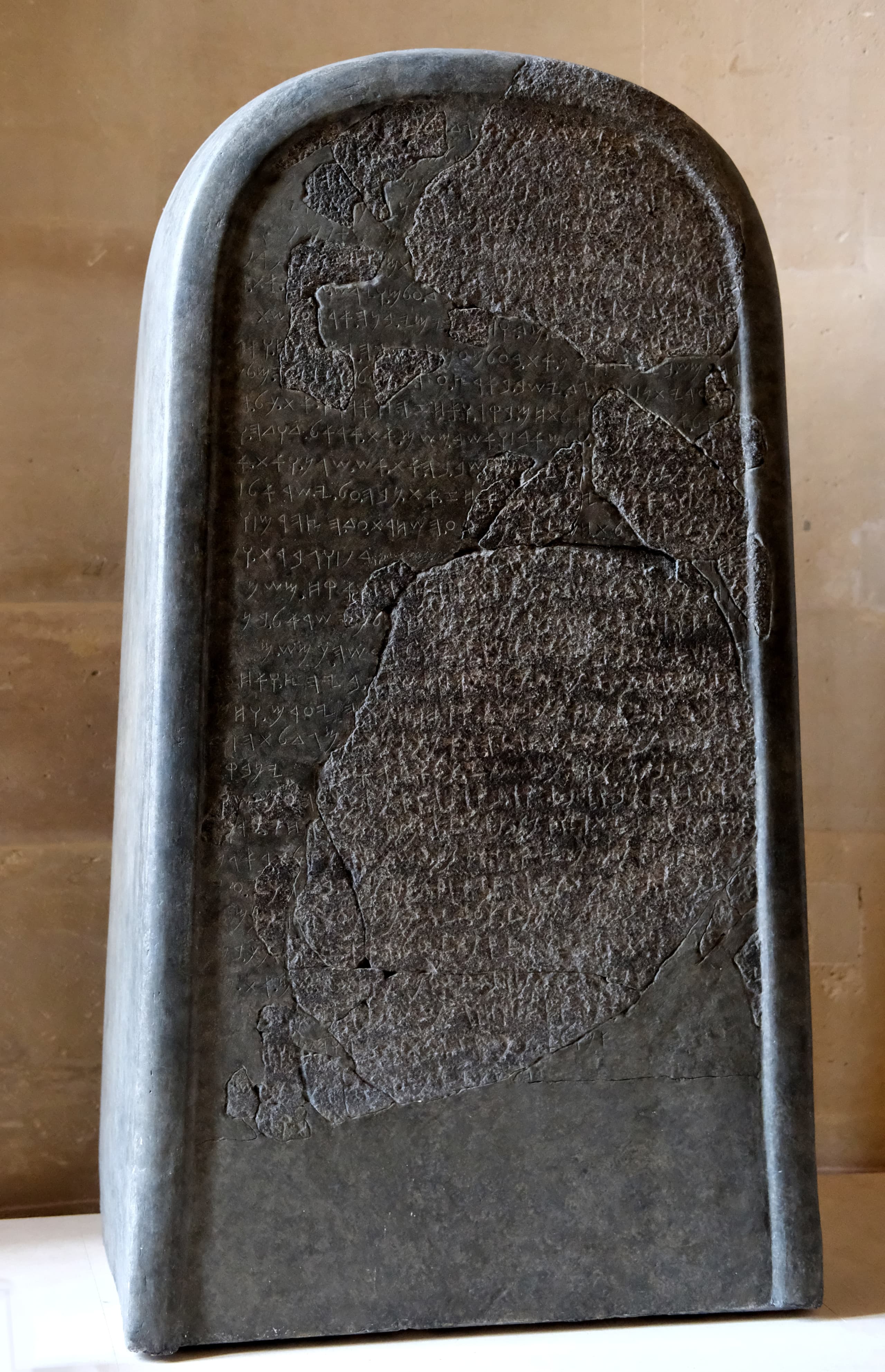
The inscription is carved in rows that read from right to left. The script is a variant of the Phoenician alphabet, closely related to the script used for early Hebrew. Each letter is cut into the surface of the basalt with enough depth that the text remains legible despite the stone's dark colour. The carving is methodical: the lines are evenly spaced, the letters consistent in size.
The stone is broken and reassembled
The stele you see is not a single piece of basalt. It is fragments fitted back together, with gaps filled in. The breaks run across the text in irregular lines. Some sections are original stone; others are reconstruction based on an impression made before the monument was destroyed. The surface shows both the ancient carving and the modern repair, and the difference is visible where the fragments meet.
Basalt holds detail but resists it
Basalt is a volcanic rock, fine-grained and very hard. It takes a sharp edge when carved, so the letters remain crisp, but it requires sustained effort to cut. The choice of basalt over limestone or sandstone — both softer and more common — suggests the text was meant to endure. The stone's black surface makes the carved lines harder to read unless light falls at an angle.
The story
The Mesha Stele is a block of basalt, one metre tall, sixty centimetres wide, thirty-seven centimetres thick, carved with thirty-four lines of text. The inscription records the words of Mesha, king of Moab, a kingdom located in what is now Jordan. The text is dated to around 840 BC. Mesha describes how Chemosh, the god of Moab, had been angry with his people and allowed them to be subjugated to the kingdom of Israel, but eventually Chemosh returned and enabled Mesha to throw off that rule and restore Moabite lands. The inscription also lists building projects Mesha undertook.
The stele was discovered intact in 1868 at Dhiban, the site of ancient Dibon, by Frederick Augustus Klein, an Anglican missionary. Charles Simon Clermont-Ganneau, an archaeologist working from the French consulate in Jerusalem, arranged for a local man to make a squeeze of the inscription — a papier-mâché impression pressed onto the stone to capture the text. That squeeze was completed before what happened next.
The next year, the stele was smashed into several fragments by the Bani Hamida tribe. The destruction is understood as an act of defiance against Ottoman authorities, who had pressured the Bedouins to hand over the stone so it could be given to Germany. Clermont-Ganneau later acquired the fragments and reassembled them, using the squeeze to guide the reconstruction. The monument now in the Louvre is that reassembly: original fragments held together with modern fill, informed by the impression made when the stone was still whole.
The text is written in the Moabite language, closely related to Hebrew, using a script variant of the Phoenician alphabet. It provides evidence for how Moabite was written and what it sounded like. The inscription parallels, with differences, an episode in the biblical Books of Kings, which also describes conflict between Moab and Israel. The stele names the kingdom of Israel — referred to as the House of Omri — and contains a reference to YHWH, the Israelite god. Scholars regard the stele as genuine and historical, though some have questioned whether the events described should be read as literal history or as a form of royal propaganda.
The monument has been in the Louvre since 1873, catalogued as AO 5066, in the Department of Near Eastern Antiquities. Jordan has requested its return since 2014.
Why it mattered then
The stele was a public monument. It was set up in a place where it could be read, and the text was written to be read — not by everyone, since literacy was limited, but by those who could read and by those who heard it read aloud. The inscription establishes Mesha's account of his reign: his victories, his building works, his relationship with his god. It records his version of events at a moment when the political relationship between Moab and Israel was contested. The choice to carve the text in stone, rather than write it on perishable material, indicates an intention for the words to last. Basalt is hard to work, but it does not erode easily. The monument was not portable; it was fixed in place, and its presence would have been a permanent assertion of Mesha's rule and Moab's independence. The text describes restoring cities, building infrastructure, and dedicating sites to Chemosh. These are not private reflections; they are claims made in public, in stone, in a script that linked Moab to the broader literate culture of the region.
Why it matters now
The stele is evidence for a language, a script, a kingdom and a moment in the politics of the southern Levant in the ninth century BC. It is a text from outside the biblical tradition that names figures and places also named in the Bible, and it provides a non-Israelite perspective on events the Bible describes. That makes it a rare point of comparison — not confirmation or contradiction, but a second account, written from the other side. The monument also records its own destruction and survival. The fact that it was smashed the year after its discovery, and that a squeeze had been made just in time, means the object we see now is both ancient and modern: original stone and reconstructed surface, text and repair. That history is part of what the stele is. It is a record of Mesha's reign, and also a record of what happened to that record — how it was found, fought over, broken and pieced back together. The request for its return, ongoing since 2014, is the latest chapter in that history.
The surprising detail
The stele was discovered intact and destroyed within a year. Frederick Augustus Klein found it whole in 1868. By the next year it had been smashed into fragments. The destruction was not accidental. The Bani Hamida tribe broke the stone deliberately, in response to pressure from Ottoman authorities who wanted to hand it over to Germany. The act was political: the stone had become a object of value and contention, and breaking it was a way to refuse the terms of that contest. What saved the text was the squeeze — the papier-mâché impression made by a local man on behalf of Charles Simon Clermont-Ganneau before the stone was destroyed. That impression, pressed onto the surface while the stele was still whole, became the guide for reassembling the fragments. The monument in the Louvre is the result: a reconstruction made possible because someone made a copy just in time.
What is disputed
The authenticity of the stele has been disputed, and some scholars have suggested the text is not historical but a form of royal propaganda or even a later composition. However, the stele itself is regarded as genuine and historical by the majority of biblical archaeologists. The interpretation of the events described — whether they should be read as literal history or as ideological narrative — remains a matter of scholarly debate.
Remember this
A king's account of his victories, carved in basalt, survived twenty-seven centuries intact and one year discovered.
Test yourself
The stele names the kingdom of Israel as the House of Omri. What does that phrasing tell you about how kingdoms were identified in this period?
It tells you that a kingdom could be named after a ruler rather than a place or a people. Omri was a king of Israel, and the phrase House of Omri identifies the kingdom by its royal dynasty — the line of rulers descended from or associated with Omri. This was a common way to refer to kingdoms in the ancient Near East: the ruling house stood in for the state. It also suggests that Omri's reign was significant enough that his name remained attached to the kingdom even under later rulers. The phrasing is political and dynastic, not geographic. It identifies Israel by who ruled it, not by where it was.
Go deeper
Image: Mbzt, CC BY-SA 4.0. Licence: CC BY-SA 4.0. Source.