I · THE OBJECT · BRITISH MUSEUM
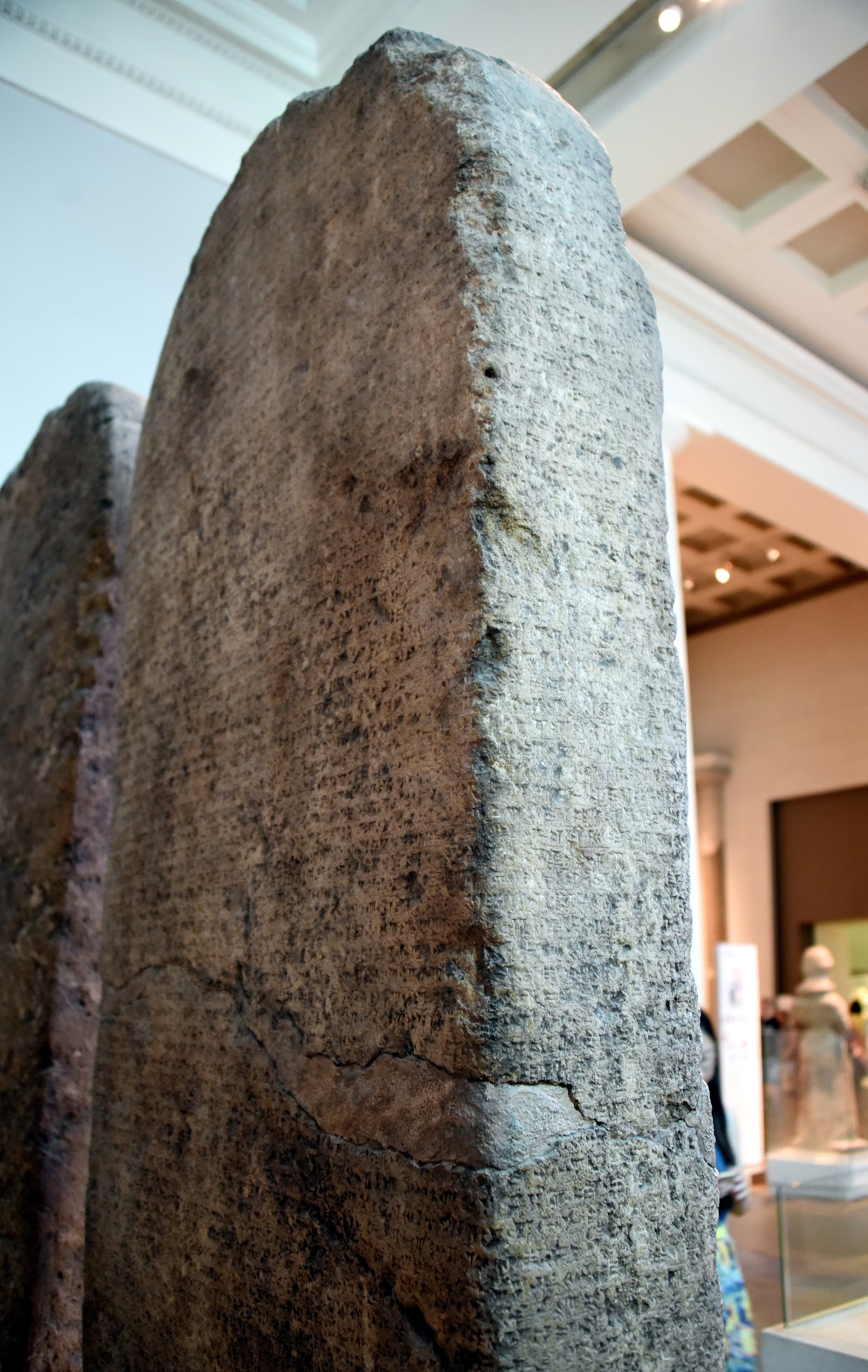
Kurkh Monoliths
▶ Listen · narrated
Two limestone monuments, eight centuries before Christ, recording victories in a script nobody could read until the nineteenth century — and then a name appeared that connected Assyria to Scripture.
At a glance
- Date
- c. 852 BC and 879 BC
- Material
- Limestone
- Dimensions
- 221 × 87 cm
- Discovery
- 1861, Üçtepe
- Museum number
- ME 118883
Look closer
Two monuments, two generations
The Kurkh Monoliths are a pair, not a single object. One records the reign of Ashurnasirpal II, the other his son Shalmaneser III. They were carved roughly a generation apart, around 879 BC and 852 BC, and both were found at the same site. Whether they stood together originally, or were moved to Kurkh later, is not recorded in the discovery accounts.
A list of enemies at Qarqar
The Shalmaneser III monolith describes a battle at a place called Qarqar. At the end of the description appears a list of the coalition forces that opposed the Assyrian army. The list names kings, kingdoms, and the size of their contingents — chariots, foot soldiers, camels. One entry reads 'A-ha-ab-bu Sir-ila-a-a', followed by a count of 2,000 chariots and 10,000 foot soldiers. That name, rendered in cuneiform, was read as Ahab, king of Israel.
A name in cuneiform, a problem in translation
The reading 'Israel' is disputed by some scholars. The term translated as 'Israel' appears here but does not appear elsewhere in Assyrian or Babylonian records, which refer to the same kingdom by a different phrase: the 'House of Omri', after its ruling dynasty. Whether the cuneiform signs spell 'Israel' or something else is a matter of interpretation, not settled fact.
The story
In 1861, John George Taylor, the British Consul-General stationed in the Ottoman Eyalet of Kurdistan, excavated two limestone stelae at a site called Kurkh, now known as Üçtepe Höyük, in what is today the Bismil district of Diyarbakır province in Turkey. Both monuments were carved with cuneiform inscriptions. Taylor donated them to the British Museum in 1863.
The inscriptions record the reigns of two Assyrian kings. One stela belongs to Ashurnasirpal II and dates to around 879 BC. The other, carved roughly a generation later around 852 BC, records the campaigns of his son, Shalmaneser III. Both are written in Akkadian cuneiform, the script and language of Assyrian royal inscriptions.
The Shalmaneser III monolith describes a military campaign that culminated in a battle at Qarqar. The inscription lists the forces arrayed against the Assyrian army: a coalition of kings and kingdoms, each entry naming the ruler, the region, and the size of the contingent — so many chariots, so many foot soldiers, so many camels. One entry in that list was read as 'A-ha-ab-bu Sir-ila-a-a', with 2,000 chariots and 10,000 foot soldiers.
That name, transliterated from cuneiform, was interpreted as Ahab, king of Israel. The Bible mentions Ahab, but until the Kurkh Monoliths were deciphered, no ancient record outside the Bible had been read as naming him. The inscription also mentions Arabs, and that reference has been described as the oldest document that mentions the Arabs — though whether it is the oldest depends on how other fragmentary or disputed inscriptions are dated and translated.
The reading 'Israel' is not without problems. Assyrian and Babylonian inscriptions usually refer to the northern kingdom by a different term: the 'House of Omri', after the dynasty that ruled it. The cuneiform signs translated as 'Israel' in the Kurkh Monolith appear here but not in other Assyrian records of the same kingdom, and some scholars argue the translation is uncertain. The name 'Ahab' is less disputed, but the identification of 'Sir-ila-a-a' as 'Israel' remains a matter of scholarly interpretation, not consensus.
The monoliths are carved from limestone, and the taller of the two measures 221 centimetres high and 87 centimetres wide. Both are now in the British Museum.
Why it mattered then
The monoliths were instruments of royal propaganda. Assyrian kings erected stelae to record their victories, their territorial reach, and the submission or defeat of their enemies. The inscriptions were written in cuneiform, a script that required training to read, and they were placed in locations where they asserted Assyrian authority — sometimes at the site of a battle, sometimes at a provincial centre, sometimes in a temple. The Shalmaneser III monolith records a coalition of kings who opposed Assyrian expansion. The list of forces at Qarqar is detailed: it names rulers, counts chariots and soldiers, and specifies camels. That level of detail suggests the inscription was meant to convey the scale of the opposition and, by implication, the scale of the Assyrian achievement in facing it. Whether the battle was a decisive victory, a stalemate, or something in between is not stated in the inscription, and the text does not describe the outcome in the way later Assyrian annals sometimes do. The stelae were carved in a period when Assyria was expanding westward, and the coalition at Qarqar represented a significant challenge to that expansion. The inclusion of a northern Israelite king in the coalition, if the reading is correct, places the kingdom in the political and military landscape of the mid-ninth century BC, allied with Aramaean and other Levantine powers against Assyrian encroachment.
Why it matters now
The Kurkh Monoliths matter now because they connect two bodies of evidence that rarely overlap: ancient royal inscriptions and the Bible. The Bible mentions Ahab, and the Kurkh Monolith was read as naming him too. That convergence made the monolith a reference point in debates about the historical reliability of biblical texts, and about the methods used to correlate archaeological evidence with scriptural accounts. The inscription also raises questions about translation and interpretation. The reading 'Israel' is disputed, and the fact that Assyrian records elsewhere use a different term for the same kingdom — the 'House of Omri' — complicates the identification. Scholars who work on cuneiform texts and those who work on biblical history do not always agree on how to resolve such ambiguities, and the Kurkh Monolith sits at the centre of that disagreement. The monoliths also illustrate a broader pattern in nineteenth-century archaeology: European consuls and diplomats excavating in Ottoman territories, removing objects, and donating them to museums in London, Paris, or Berlin. Taylor's excavation at Kurkh and his donation of the stelae to the British Museum in 1863 followed that pattern. The objects have remained in the British Museum since then, and their presence there is part of ongoing discussions about the provenance and ownership of archaeological material removed during that period.
The surprising detail
The Kurkh Monolith was deciphered as naming a figure from the Bible, and that reading made it a sensation in the mid-nineteenth century, when the decipherment of cuneiform was still recent and the relationship between Assyrian records and biblical history was a matter of intense interest. But the translation that produced the identification of Ahab is not as secure as it appeared. The term translated as 'Israel' does not appear in other Assyrian texts referring to the same kingdom, and some scholars argue the cuneiform signs could be read differently. The name 'Ahab' is less disputed, but the identification of the kingdom remains uncertain. What seemed like a clear corroboration turned out to be a case study in the difficulty of matching ancient texts to one another across languages and scripts.
What is disputed
The reading 'Israel' in the Shalmaneser III inscription is disputed. Assyrian and Babylonian records usually refer to the northern kingdom as the 'House of Omri', and the cuneiform signs translated as 'Israel' in the Kurkh Monolith do not appear in other Assyrian texts describing the same region. Some scholars argue the translation is uncertain, and that the identification of 'Sir-ila-a-a' as 'Israel' depends on assumptions about how the name would have been rendered in cuneiform. The name 'Ahab' is less disputed, but the kingdom he ruled is not as clearly identified as early translations suggested.
How it got here
John George Taylor excavated the monoliths at Kurkh (now Üçtepe) in 1861, while serving as British Consul-General in the Ottoman Eyalet of Kurdistan. He donated both stelae to the British Museum in 1863. The removal of archaeological material from Ottoman territories by European diplomats and archaeologists during the nineteenth century is now a subject of debate, and some scholars and governments have called for the return of objects taken under those circumstances. The British Museum holds that the monoliths were acquired legally under the laws in force at the time, and that they remain part of the museum's collection for study and public display.
Remember this
Two limestone stelae, a disputed reading, and a name that seemed to link Assyrian records to the Bible — but the link is less certain than it looked.
Test yourself
The Kurkh Monolith lists 2,000 chariots and 10,000 foot soldiers under a king whose name was read as Ahab. Why does that large chariot force make some historians cautious about taking the numbers literally?
Because 2,000 chariots is an enormous force, and the logistics required to field, maintain, and manoeuvre that many chariots in a single battle would have been extraordinary. Chariots were expensive, required trained horses and drivers, and were difficult to coordinate in large numbers. Some historians argue that Assyrian royal inscriptions often inflated enemy numbers to magnify the scale of the king's victory, and that the figures in the Qarqar list may be exaggerated for propaganda purposes. Others point out that the coalition included multiple kingdoms, so the total may represent a combined force rather than the contribution of a single ruler. Either way, the number is treated with caution, not as a straightforward census. The lesson generalises: ancient royal inscriptions were written to impress, and their figures need to be read in that context.
Go deeper
Image: Osama Shukir Muhammed Amin FRCP(Glasg), CC BY-SA 4.0. Licence: CC BY-SA 4.0. Source.