III · THE WORK · ART HISTORY
Sistine Madonna
▶ Listen · narrated
An altarpiece commissioned for one Italian church, moved to Dresden, taken to Moscow, then returned — and famous now mostly for the two small angels at the bottom.
At a glance
- Artist
- Raphael
- Date
- 1512
- Medium
- Oil paint on canvas
- Dimensions
- 269.5 × 201 cm
- Current location
- Gemäldegalerie Alte Meister, Dresden
Look closer
The Virgin's bare feet
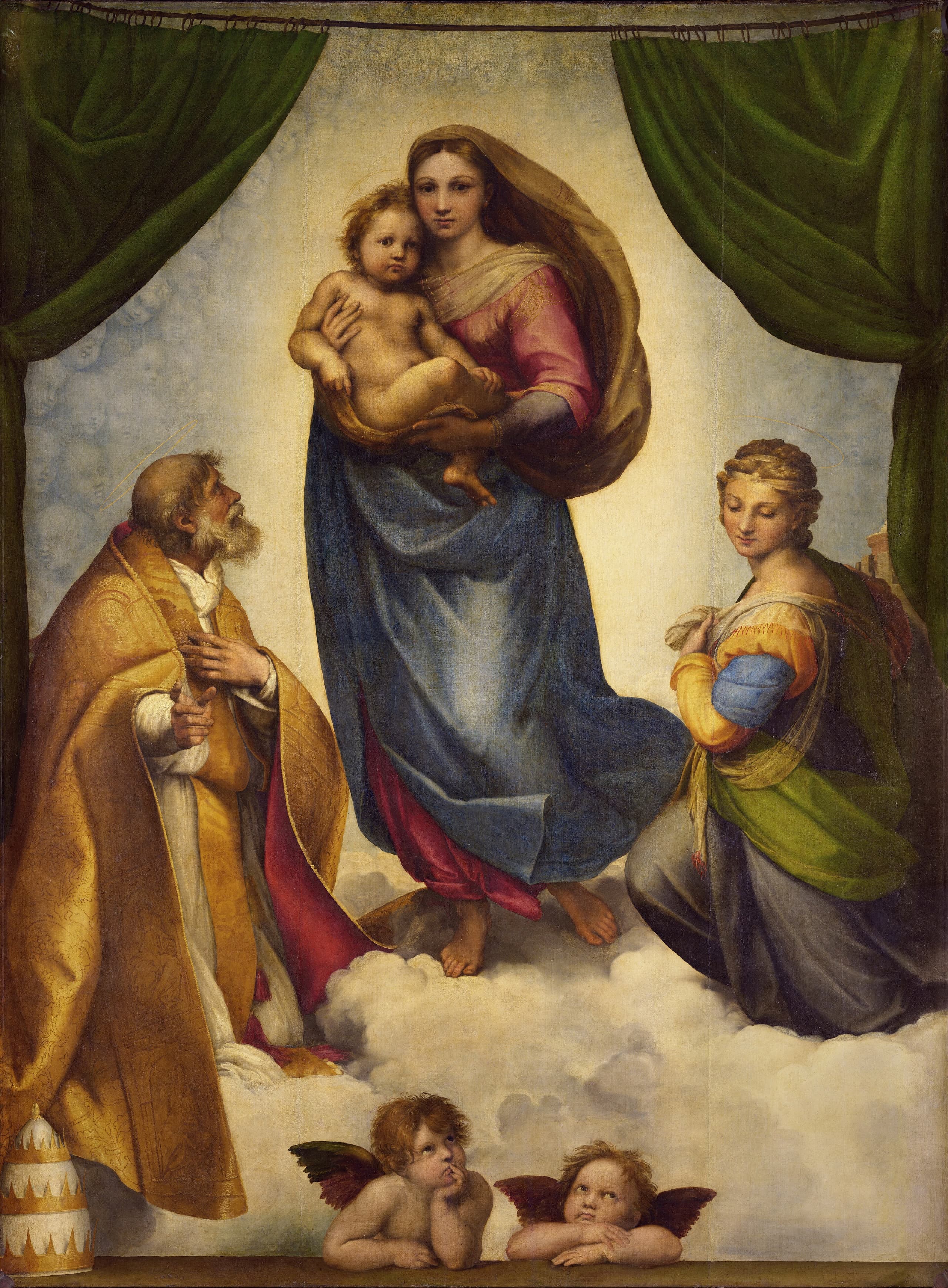
Mary stands on a mass of cloud, but her feet are painted at roughly the height of a standing viewer's head — not floating in a remote heaven but present, immediate, at the threshold between her world and ours. Her toes grip the cloud as though it were solid ground. Raphael has given her the weight and physical presence of a living woman, not the remote serenity of an icon painted on gold.
The curtain pulled aside
Green fabric is drawn back on both sides of the composition, as though we are looking through a gap in a stage curtain or a veil hung across a doorway. The device suggests that what we see is a vision being revealed rather than a scene we have simply walked up to. It also creates a frame within the frame, concentrating attention on the figures and the cloud they occupy.
Two cherubs at the bottom edge
Two infant angels rest their elbows on what appears to be a ledge at the base of the painting, chins in hands, gazing upward and outward. They are painted smaller than the main figures and placed at the very bottom of the canvas, so that they occupy a different zone — neither in the celestial cloud above nor entirely outside it. Their expressions are often described as bored or distracted, a contrast to the solemnity of the Virgin.
The story
Raphael painted this work in 1512. It was commissioned for the church of San Sisto in Piacenza, a city in northern Italy. The painting is usually called the Sistine Madonna, though it is also known as the Madonna di San Sisto — both names refer to that church and its dedication.
The composition shows Mary holding the infant Christ, standing on cloud and flanked by two saints. On the left is a figure in papal robes and tiara, on the right a woman looking downward. The two saints are not labelled in the painting itself, and their identities rest on convention rather than an inscription or documented instruction from the patron.
The painting is large — nearly two and three-quarter metres tall — and was made using oil paint on canvas. Canvas was less common than wooden panel for altarpieces at this date, but it was lighter and more practical for large works, and Raphael used it here. The surface is now in Dresden, in the collection called the Gemäldegalerie Alte Meister.
The work remained in Piacenza until the middle of the eighteenth century. In 1754 it was sold and moved to Dresden. That move placed it in a context where it was seen by a different audience — northern European artists, writers and travellers — and it became widely known through engravings and written descriptions.
After war in the twentieth century the painting was relocated to the Pushkin Museum of Fine Arts in Moscow, where it remained for a decade. It was then returned to Dresden, and it is there now. The relocations are a matter of record, but the painting's history includes gaps: the circumstances of its commission, the identity of any intermediaries, and the reasons for its sale in 1754 are not fully documented.
Why it mattered then
The painting was made as an altarpiece, which means it was intended to stand above or behind an altar in a church — a position that gave it a liturgical function, not simply a decorative one. Worshippers would have seen it during Mass, and its subject, the Virgin presenting the Christ child, was central to Catholic devotion in the early sixteenth century. Raphael was working in Rome in 1512, employed by Pope Julius II, the same pope who commissioned this painting for the church in Piacenza. The commission of a major altarpiece from Raphael, at that moment, was a statement of resources and ambition. It placed the church in Piacenza within a network of papal patronage and connected it to the most prominent painter then working in Rome. The painting's composition — Mary standing rather than enthroned, the curtain pulled aside, the saints flanking her in attitudes of reverence — suggests a vision being revealed to the viewer. That structure was not unique to Raphael, but he used it with particular clarity here. The bare feet, the direct gaze of the Virgin, and the physical weight given to the figures all work to make the scene feel present rather than remote, a quality that would have served the painting's devotional purpose.
Why it matters now
The painting is known now less for its original function than for its later reception. After it moved to Dresden in 1754, it was seen and written about by travellers and critics, and it became a reference point in discussions of religious art and of Raphael's work more broadly. That reputation was built in a context far from Piacenza and from the painting's first viewers. The two small angels at the bottom have acquired a separate fame. They appear on their own in reproductions, on postcards, in advertisements, and in contexts that have nothing to do with the rest of the composition. That fame is a modern phenomenon, and it has made them more widely recognised than the altarpiece they belong to. It is an odd outcome for a detail that occupies a small portion of the canvas, but it demonstrates how a painting's meaning and visibility can shift entirely depending on what is reproduced and circulated. The painting's moves — from Piacenza to Dresden, from Dresden to Moscow, then back to Dresden — are part of a larger history of artworks displaced by war, sale, or political change. It is now a centrepiece of the Dresden collection, and its presence there is part of the city's identity as a cultural centre. The painting survived, and its survival and return have given it a symbolic weight beyond its original purpose.
The surprising detail
The two small cherubs at the bottom of the painting — the ones resting their chins on the frame — have become famous independently of the rest of the composition. They are reproduced on their own, often without the Virgin or the saints above them, and they appear in contexts that have nothing to do with religious art. That fame is a modern development. There is no evidence that they were singled out for attention when the painting was made or in the centuries immediately following. Their current ubiquity is the result of twentieth-century reproduction and marketing, which isolated them from the altarpiece and turned them into a decorative motif. It is a strange reversal: a detail painted to occupy the lowest and smallest zone of a devotional image has become the most recognised part of it.
What is disputed
The identities of the two saints flanking the Virgin are not labelled in the painting. The figure on the left is usually identified based on the papal vestments and the church's dedication, and the figure on the right is usually identified based on her position and attributes typical in other works. These identifications rest on tradition and iconographic convention rather than on documentation from Raphael or the patron. The circumstances of the commission and the reasons for the painting's sale in 1754 are also not fully recorded.
Remember this
An altarpiece commissioned for a church in Piacenza, now famous for two small angels at the bottom who were never meant to be seen on their own.
Test yourself
The painting is made on canvas rather than wooden panel. Why might that choice have mattered for a work of this size and purpose?
Canvas is lighter than wood, which makes it more practical to transport and to handle during installation, particularly for a painting nearly three metres tall. Wooden panels of that size would have been extremely heavy and prone to warping or splitting. Canvas can also be rolled, though there is no record of this painting being rolled. The choice of support was a practical one, driven by the scale of the work and the need to move it into position in the church. It also reflects a broader shift in the sixteenth century toward canvas for large-scale works, particularly among painters working on commissions that required transport or installation in specific architectural settings.
Go deeper
Image: Raphael, Public domain. Licence: Public domain. Source.