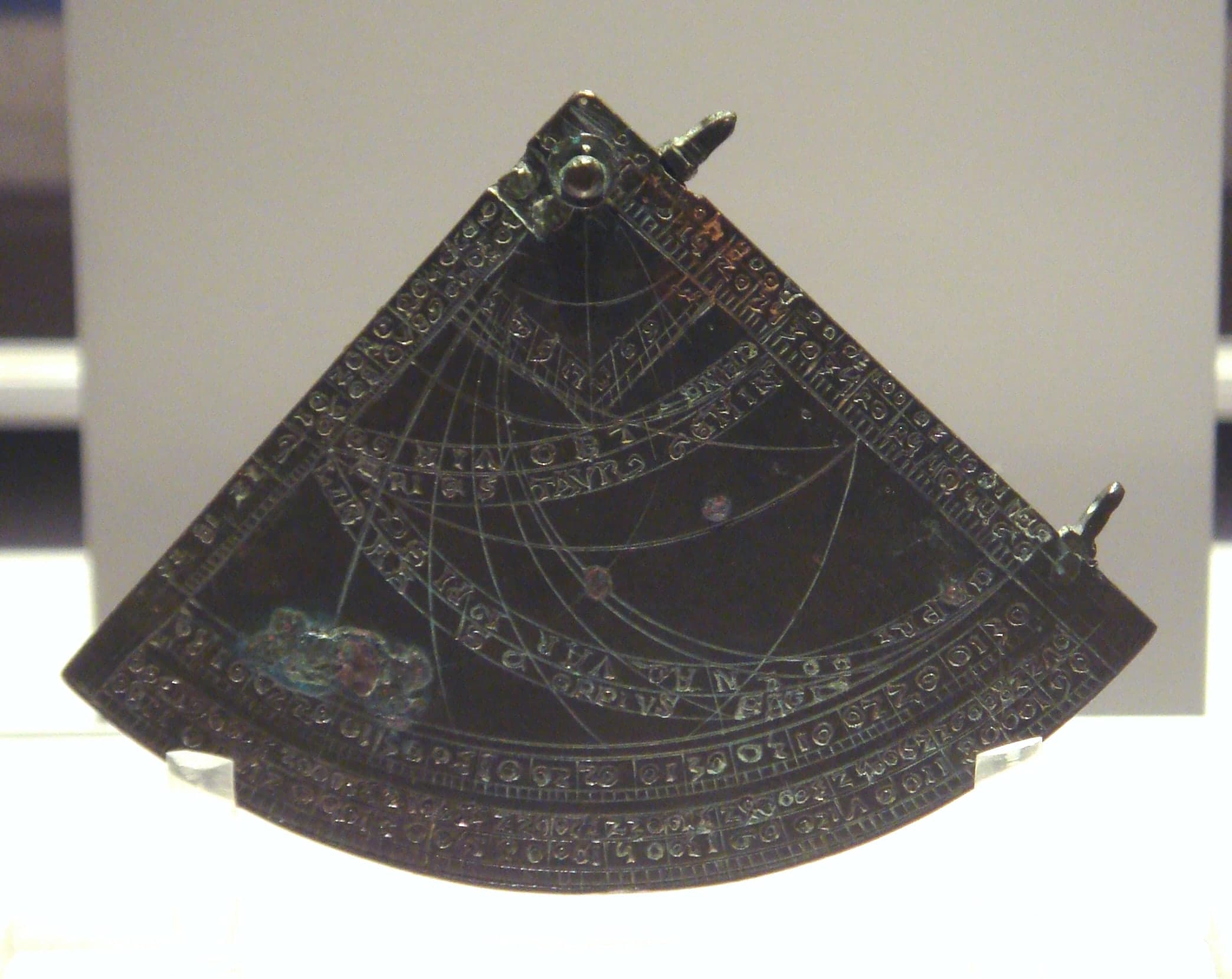
I · THE OBJECT · BRITISH MUSEUM
Canterbury Astrolabe Quadrant
▶ Listen · narrated
Most medieval instruments pass through families or collections. This one was buried in Canterbury soil, lost in 1388, and stayed there until builders dug a trench in 2005.
At a glance
- Date
- 1388
- Discovery
- Canterbury, 2005
- Material
- Brass
- Thickness
- 1.5 millimetres
- Museum number
- 2008,8017.1
Look closer
Thin enough to slip into a pouch
The quadrant is 1.5 millimetres thick — about the thickness of a penny. That thinness was deliberate: an astrolabe quadrant was meant to travel. A full astrolabe, circular and heavier, did the same calculations but needed more metal and more space. This instrument gave you a quarter of the circle and a quarter of the weight, at the cost of some precision. For a scholar moving between towns, or a pilgrim checking the hour for prayer, that trade made sense.
Engraved for a specific latitude
The curves and lines incised into the brass are not decorative. They are a calculating grid, and the grid only works at the latitude the instrument was made for. Each astrolabe quadrant was calibrated to a particular place — or rather, to a band of places sharing the same latitude. This one was engraved for Canterbury. Carry it north or south by more than a degree or two and the readings drift. The instrument assumes you are standing where it was designed for you to stand.
A date scratched into the metal
The year 1388 is engraved on the quadrant itself. That date is unusually precise for a medieval instrument. Many survive without any date at all, and others carry only the maker's mark or a patron's name. Here the year is stated plainly, which means we know when it was made and, by subtraction, that it lay in the ground for six hundred and seventeen years before it was found.
The story
An astrolabe quadrant is a device for reading the sky. Hold it vertically, sight the sun or a known star through the holes along one edge, and the instrument tells you the time and your latitude — the distance north or south of the equator. It does this through geometry: the height of a star above the horizon changes predictably with the hour and the season, and the curves engraved on the brass encode those changes for a given location.
The full name describes its shape and ancestry. An astrolabe is a circular instrument, and a quadrant is a quarter of that circle. The quadrant keeps the calculating power but uses far less metal, which made it cheaper and lighter to carry. A scholar or a traveller could slip this into a pouch.
This particular quadrant was made in 1388 and engraved for Canterbury's latitude. It was found in 2005 during an archaeological dig at a site called the House of Agnes, a building in Canterbury. The dig was not looking for scientific instruments — those almost never turn up in the ground. They are valuable, intricate, and made of metal that can be melted down or repaired, so they tend to stay in circulation or get handed down through families. Finding one buried is unusual.
Who owned it is not recorded, but the instrument itself suggests some possibilities. It was made for Canterbury, and Canterbury in the late fourteenth century was a major pilgrimage destination. Scholars, clergy, and educated laypeople travelled there regularly. The quadrant is small, portable, and precisely made, which points to someone who needed to calculate time and position while moving between places — perhaps a university scholar, a friar, or a pilgrim with enough learning to use it.
How it ended up in the ground is also unrecorded. It may have been lost, or it may have been buried deliberately, though there is no evidence either way. What is clear is that it stayed there for six centuries.
After it was found, the quadrant went to auction in 2007. The British Museum bid but was outbid. An export ban was then imposed, which prevented the instrument from leaving the country while a UK buyer was sought. The museum acquired it in 2008, with funds from The British Museum Friends, the National Heritage Memorial Fund, and The Art Fund. The total cost was £350,000.
Why it mattered then
In 1388, an astrolabe quadrant was a tool for people who needed to know the time without a clock. Mechanical clocks existed but were rare, expensive, and fixed in place — usually in a church tower. If you were travelling, or living somewhere without a public clock, you told time by the sun and stars, and an instrument like this made that possible with some accuracy. It also mattered for religious observance. The canonical hours — the times set for prayer in monastic and clerical life — were tied to the movement of the sun, and calculating them correctly required either a clock or an instrument that could read the sky. A quadrant did that, and it did it in your hand. For scholars, the instrument had a further use: it demonstrated that you could compress complex astronomical knowledge into a portable brass plate. The curves engraved on the surface encoded tables, calculations, and geometric relationships that would otherwise require parchment, ink, and a fair amount of space. The quadrant was a kind of analog computer, and owning one marked you as someone who understood how the heavens moved.
Why it matters now
The Canterbury Astrolabe Quadrant matters now for two reasons. One is what it tells us about the survival of medieval science. Most of what we know about medieval instruments comes from manuscripts — descriptions, diagrams, treatises on how to make and use them. Actual instruments are far rarer, because metal gets reused and small valuable objects get lost or melted down. This quadrant survived by accident, buried in the ground, and that makes it evidence of a different kind: not what people wrote about instruments, but what they carried. The second reason is the find itself. Scientific instruments are not supposed to turn up in archaeological digs. They turn up in attics, in museum basements, in the inventories of old collections. The fact that this one was dug out of the ground in Canterbury, at a known site, with a known date on it, gives it a context that most instruments lack. We know where it was, and we know it was there in the late fourteenth century, and that combination is rare enough to matter.
The surprising detail
After the quadrant was found, it went to auction and the British Museum was outbid. The museum then succeeded in having an export ban imposed, which kept the instrument in the country while funds were raised. The eventual purchase in 2008 cost £350,000, with contributions from three sources: £175,000 from The British Museum Friends, £125,000 from the National Heritage Memorial Fund, and £50,000 from The Art Fund. The process took a year, and the instrument spent that year in legal and financial limbo, neither leaving the country nor entering the collection.
What is disputed
The identity of the owner is not recorded, and the circumstances of how the quadrant ended up buried are unknown. It may have been lost accidentally or buried deliberately, but there is no evidence to support either account. The site where it was found, the House of Agnes, was a building in Canterbury, but the specific context of the find within that site is not detailed in the available records.
Remember this
A pocket calculator for the stars, thin as a coin, lost in Canterbury and found six centuries later.
Test yourself
An astrolabe quadrant was calibrated for a specific latitude. What happens if you carry it to a different latitude and try to use it?
The readings become inaccurate. The curves engraved on the quadrant encode the relationship between a star's height above the horizon and the time of day, but that relationship changes as you move north or south. At Canterbury's latitude, a star at a given height might indicate one hour; fifty miles north, the same height indicates a different hour. The instrument assumes you are standing where it was designed for. Move far enough away and the error becomes large enough to notice. This was not a flaw — it was a trade-off. A full astrolabe could be adjusted for different latitudes by swapping plates, but a quadrant was simpler, cheaper, and lighter because it was made for one place.
Go deeper
- Canterbury Astrolabe Quadrant · Wikipedia
- Canterbury Astrolabe Quadrant — Wikidata · Wikidata
- Canterbury Astrolabe Quadrant — collection record · britishmuseum.org
Image: PHGCOM, CC BY-SA 3.0. Licence: CC BY-SA 3.0. Source.