I · THE OBJECT · BRITISH MUSEUM
Euphorbos plate
▶ Listen · narrated
This plate painted a scene from the Iliad when Homer's poems were still being assembled, and it named its figures in an alphabet Rome had not yet borrowed.
At a glance
- Inventory number
- 1860.4-4.1
- Diameter
- 38 centimetres
- Material
- Ceramic
- Style
- Wild Goat Style
- Findspot
- Kameiros
Look closer
The names are written on the plate
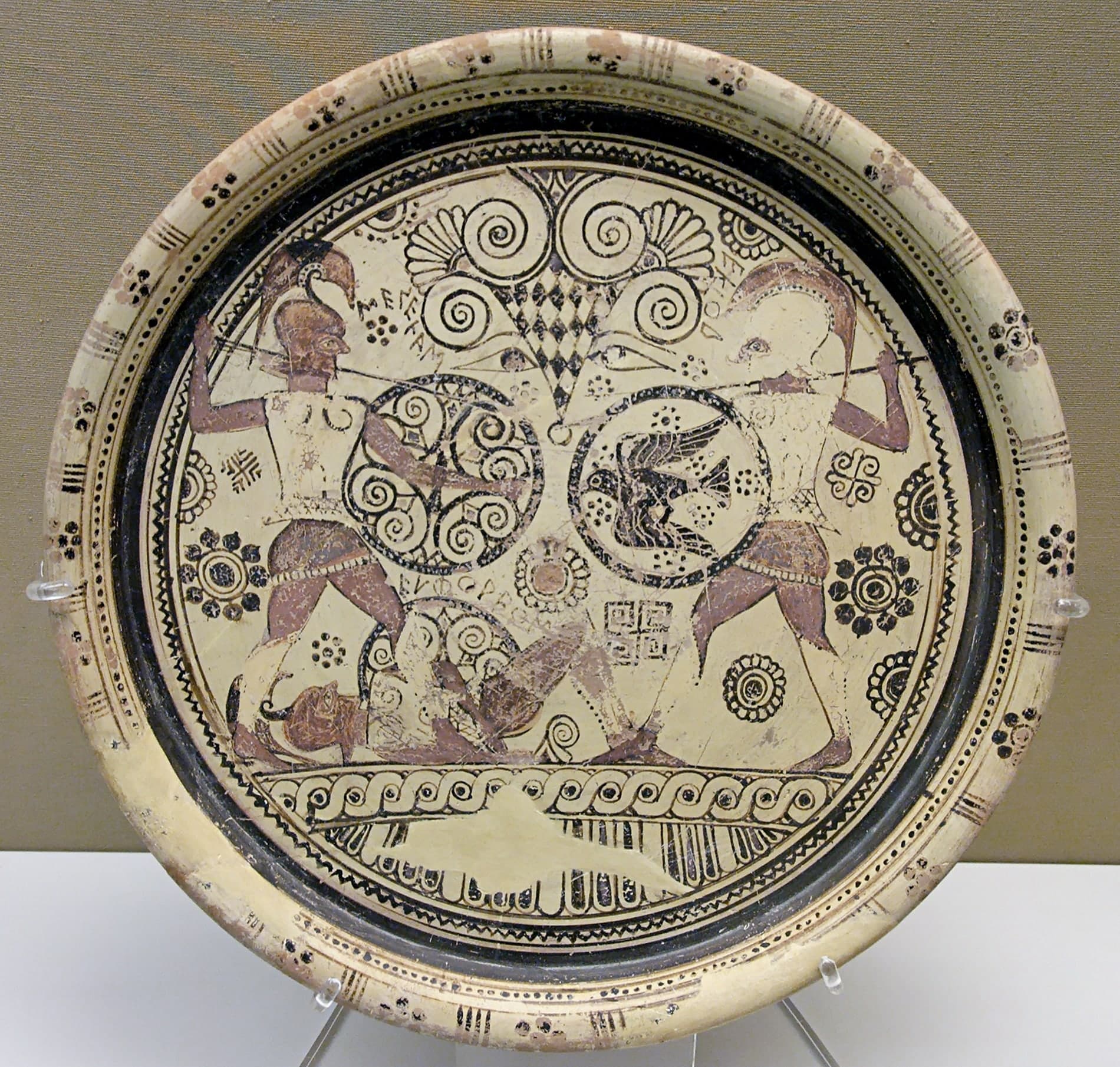
The three figures are labelled. The warrior on the left is identified as Menelaos, the one on the right as Hector, and the fallen figure between them as Euphorbos. The letters run beside each figure, painted onto the ceramic surface. This practice — naming the people in a painted scene — appears on Greek pottery, but not on every piece. The plate assumes a viewer who can read, and who knows the story well enough that a name is sufficient to place the moment.
Wild Goat Style refers to the decoration, not the subject
The plate belongs to what scholars call the Wild Goat Style, named for the animal friezes that typically appear on pottery of this type and period. The style is associated with workshops in the eastern Greek world, and the Euphorbos plate was made on Rhodes. Most plates in this style show rows of animals — goats, deer, birds — in repeating bands. The Euphorbos plate is unusual within the category because it depicts a mythological scene instead.
The scene is from book seventeen of the Iliad
The moment shown is the fight over the body of Patroklos, after Euphorbos has been killed by Menelaos. Hector arrives to prevent Menelaos from taking the armour. Patroklos had worn Achilles' armour into battle and been killed; Euphorbos wounded him before Hector delivered the final blow. The plate does not show Patroklos — it shows Euphorbos dead on the ground, with the two warriors who will fight over Patroklos standing above him. The choice to depict Euphorbos rather than Patroklos is not explained by the object itself.
The story
The plate is ceramic, thirty-eight centimetres across, painted with a scene of armed combat. Two warriors face each other over a fallen body. The figure on the left holds a spear and a round shield; the one on the right is similarly armed. The body between them lies horizontal, a spear beneath it. All three figures are labelled in painted letters: Menelaos on the left, Hector on the right, Euphorbos on the ground.
The scene is from the Iliad, and the moment is specific. Euphorbos, a Trojan warrior, has just been killed by Menelaos during the fight over the body of Patroklos. Hector now arrives to challenge Menelaos and prevent him from stripping the armour from Euphorbos. The fight is part of a larger struggle: Patroklos, wearing Achilles' armour, had been killed after Euphorbos wounded him and Hector struck the final blow. The armour Menelaos wants to take is not Euphorbos' own, but Achilles', worn by Patroklos and taken by Hector after Patroklos fell.
The plate was made around 600 BC, on Rhodes. It belongs to a type known as Rhodian plates, named for the island where most examples were produced. The decoration is in the Wild Goat Style, a term that refers to the animal friezes common on pottery of this kind — rows of goats, deer, and birds arranged in bands around the vessel. The Euphorbos plate does not follow that pattern. It shows a mythological scene instead, which is unusual for the type. The style is dated to the middle phase of the Wild Goat tradition, a period of pottery production in the eastern Greek world during the seventh and sixth centuries BC.
The plate was found at Kameiros, a site on Rhodes, by Alfred Biliotti and Auguste Salzmann. The circumstances of the excavation are recorded in the museum's acquisition records, which note the find in 1860. The plate entered the British Museum's collection the same year, and it has remained there since. Its inventory number is 1860.4-4.1.
The scene painted on the plate assumes knowledge of the Iliad. A viewer seeing Menelaos, Hector, and Euphorbos would recognise the moment from book seventeen, the fight for Patroklos' body. The choice to label the figures suggests the painter expected an audience familiar with the story but wanted to fix the identification beyond doubt. Whether the plate was made for use — to hold food, for instance — or for display is not recorded. Its size and decoration suggest it could have served either purpose, or both.
Why it mattered then
The plate was made when the Iliad was not yet a fixed text in the sense we would recognise. Around 600 BC, the poems attributed to Homer were still being performed, recited, and shaped by oral tradition. Writing was used in the Greek world, but it had only recently been adopted, and the alphabet itself was a borrowing from the Phoenicians, adapted for Greek sounds within the previous two centuries. The plate shows that the stories were already widely known and considered worth depicting on objects made for private ownership or display. The decision to paint a mythological scene rather than the animal friezes typical of the Wild Goat Style suggests that the story carried weight — enough to justify the departure from convention. The labelling of the figures indicates that reading was part of the culture that produced and used the plate, even if literacy was not universal. The plate was made on Rhodes, a centre of trade and pottery production in the eastern Greek world, and Kameiros, where it was found, was a significant settlement on the island. The plate fits into a material culture in which Homeric scenes were beginning to appear on pottery, textiles, and other objects, but the corpus of such images was still small compared to what would follow in later centuries.
Why it matters now
The plate is a document of how the Iliad was received in its earliest traceable period. It shows that the story of Patroklos, Euphorbos, and the fight over the body was known and considered worth painting by 600 BC, which is roughly contemporary with the earliest estimates for when the poems were written down. The plate does not prove that the text existed in fixed form, but it does prove that the narrative was circulating and recognisable. The choice of Euphorbos as the central fallen figure is unusual. In the Iliad, Euphorbos is a minor character; the fight is over Patroklos, and Patroklos is the figure of emotional weight. The plate shows Euphorbos instead, which may reflect a version of the story that emphasised different details, or it may simply reflect the moment the painter chose to depict: the instant after Euphorbos falls, before the struggle for Patroklos resumes. The discrepancy between the text and the image is a reminder that visual and textual traditions do not always align, and that scenes from myth could be adapted to fit the space and purpose of an object. The plate is also a witness to the spread of literacy. The painted names are not decorative; they are functional labels, meant to be read. That assumes a viewer who could read Greek, and who would recognise the significance of the names even if the scene itself were not immediately clear. The plate is part of a broader shift in which writing moved from administrative and commemorative functions into everyday and decorative contexts, a shift that would eventually produce the explosion of inscribed objects in the classical Greek world.
The surprising detail
The plate names Euphorbos, not Patroklos, as the fallen warrior. In the Iliad, the fight is over Patroklos, who has just been killed wearing Achilles' armour. Euphorbos wounded Patroklos before Hector delivered the final blow, and Menelaos then killed Euphorbos in revenge. The scene on the plate shows Menelaos standing over Euphorbos' body as Hector arrives — a moment from the larger battle, but not the emotional centre of the narrative. Why the painter chose to depict Euphorbos rather than Patroklos is not explained by the object, and no ancient commentary survives to clarify it. It may reflect a detail of the story that mattered in visual tradition but not in the text, or it may simply be the moment that fit the composition. The plate reminds us that the Iliad existed in performance and image as well as in writing, and that those versions did not always emphasise the same moments.
How it got here
The plate was excavated at Kameiros on Rhodes by Alfred Biliotti and Auguste Salzmann in 1860 and acquired by the British Museum the same year. Kameiros was part of the Ottoman Empire at the time of excavation; Rhodes became part of Greece in 1947. The British Museum's acquisition followed the standard practices of the period, in which archaeological finds were divided between excavators, local authorities, and foreign institutions. There is no recorded claim for the return of the plate, but its acquisition predates modern frameworks for cultural property and repatriation.
Remember this
A plate painted with a scene from the Iliad, made when the poems were still taking shape, and it named its figures in letters meant to be read.
Test yourself
The plate shows Euphorbos dead on the ground, not Patroklos, even though the fight is over Patroklos' body. What does that choice tell us about how mythological scenes were adapted for objects?
It tells us that visual tradition could select moments from a story that were not the emotional centre of the narrative. The fight over Patroklos is the heart of the episode in the Iliad, but the plate shows the instant after Menelaos kills Euphorbos, before the struggle for Patroklos resumes. The painter may have chosen the moment because it fit the composition, or because Euphorbos' death was a detail that mattered in oral or visual retellings, even if it was secondary in the text. The discrepancy is a reminder that images and texts do not always emphasise the same parts of a story, and that objects like this plate were not illustrations of a fixed text but independent engagements with a shared tradition.
Go deeper
Image: Public domain. Licence: Public domain. Source.