III · THE WORK · ART HISTORY
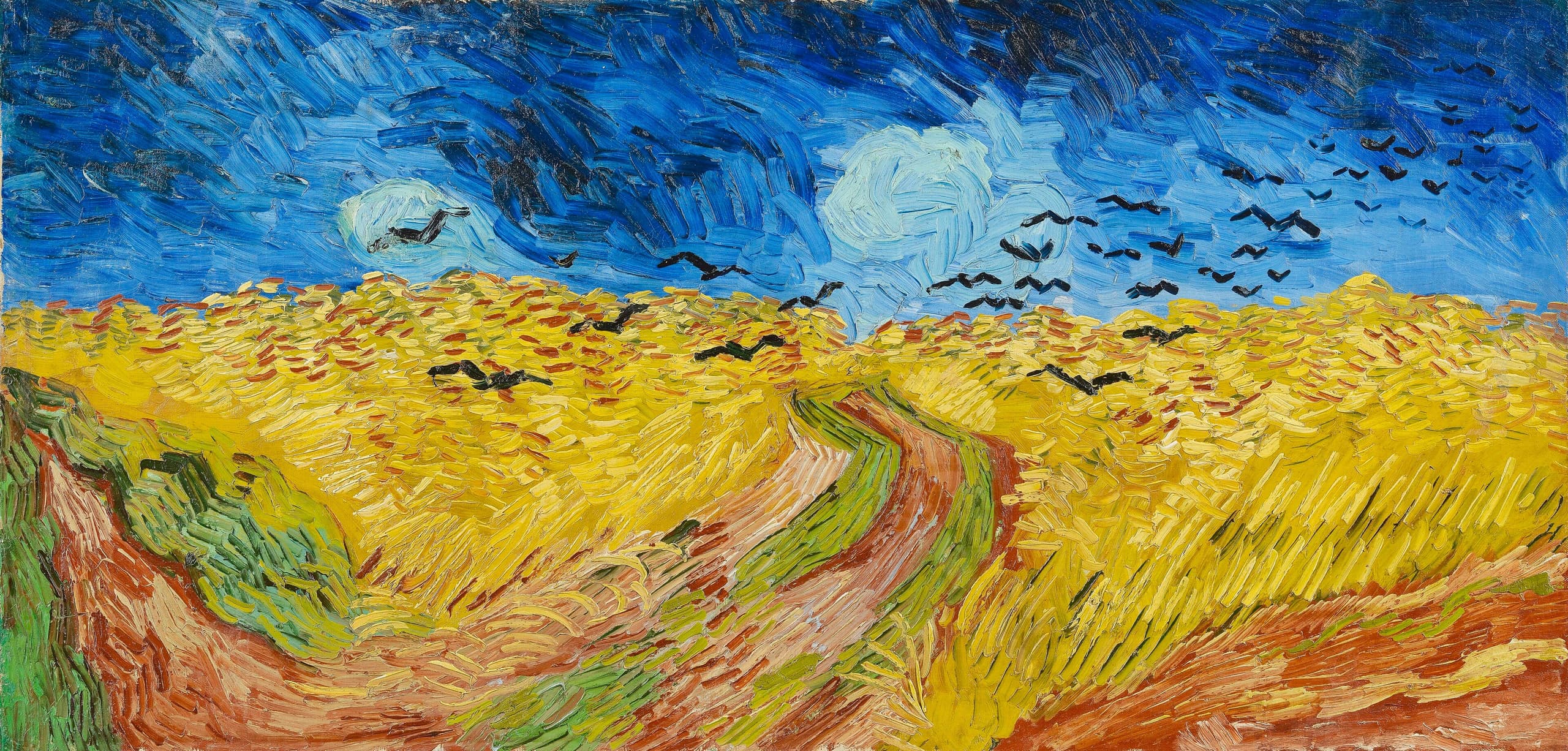
Wheatfield with Crows
▶ Listen · narrated
The painting shows a field split by three diverging paths under a darkening sky. It was made in the final weeks of Van Gogh's life, but not at the moment tradition assigned to it.
At a glance
- Artist
- Vincent van Gogh
- Date
- July 1890
- Medium
- Oil paint on canvas
- Dimensions
- 50.2 × 10³ centimetres
- Collection
- Van Gogh Museum, Amsterdam
Look closer
Three paths that do not meet
The field is divided by three dirt tracks. One runs straight toward the viewer from the centre. The other two fork away to the left and right, disappearing into the wheat. None of them connects to the others within the frame. The composition offers three directions and no destination — a structure that has invited biographical reading but which is, before anything else, a spatial decision about how to organise a horizontal canvas.
The sky as surface
The upper third of the painting is dark blue and grey, worked in thick, short strokes that move in multiple directions. The paint sits visibly on the canvas rather than describing a smooth atmospheric space. Where storm clouds in an earlier tradition would recede into depth, here they assert themselves as built matter — pigment applied with a loaded brush, each mark recording a separate gesture.
Crows rendered as marks
Black birds scatter across the upper portion of the field and into the sky. They are not drawn in detail. Each is a few flicked strokes of black paint, enough to register as a bird in flight but not enough to describe feathers or wings. The crows function as marks in the composition — dark accents against the yellow and blue — as much as they function as creatures.
The story
Wheatfield with Crows is an oil painting on canvas measuring just over half a metre tall and slightly more than a metre wide. It was made in July 1890. The painting shows a wheat field under a dark sky, with three earth paths dividing the foreground and black birds — crows — scattered across the upper portion of the composition.
The field itself is rendered in thick strokes of yellow, green and ochre. The wheat is not depicted as individual stalks but as a mass of directional brushwork, each stroke following the contour of the field or the implied wind moving through it. The paint is applied heavily enough that the texture of the brushwork is visible, and the surface reads as constructed rather than illusionistic.
The sky occupies roughly the upper third of the canvas. It is worked in dark blue and grey, with areas of lighter blue breaking through. The paint is applied in short, dense strokes that move in different directions, creating a surface that is as physically assertive as the field below it. There is no gradation into atmospheric distance. The sky is a built thing, made of paint.
The three paths are the compositional anchor. One runs from the bottom edge of the canvas straight back into the centre of the field. The other two diverge from the foreground, one moving left and one right, both vanishing into the wheat before they reach the horizon. The paths do not meet within the frame, and none of them leads to a visible destination. The structure creates a sense of divergence — three directions offered, none resolved.
The crows are painted as quick, dark marks. They are scattered across the field and into the lower portion of the sky, each bird rendered with a few strokes of black paint. They do not describe anatomical detail. They function as accents — dark shapes against the yellow of the wheat and the blue of the sky — and as indicators of movement, implying flight and direction without specifying it.
The painting has been widely reproduced and widely interpreted. For decades it was commonly described as Van Gogh's final painting, an association strengthened by a 1956 biographical film that depicted him painting it immediately before his death. The evidence does not support this. Van Gogh's letters suggest the painting was completed in July 1890, and other paintings were made after it. Scholars have identified at least one other work, a painting of harvested wheat, that must have come later. The association between this painting and the end of Van Gogh's life is a tradition, not a chronology.
What the painting does record is a moment in July 1890, in a field near Auvers, when Van Gogh was working in a particular way: building a landscape out of visible, directional marks, constructing space and weather and movement as problems of surface and stroke. The work is part of the group of paintings he made in the final weeks of his life, but it is not the conclusion of that group. It is one painting among several, made in the same month, using the same methods.
Why it mattered then
In July 1890, Van Gogh was living in Auvers-sur-Oise, a town northwest of Paris, and working steadily. The paintings he made that month are characterised by a particular intensity of surface — thick paint, directional brushwork, compositions that assert the physical presence of the canvas rather than creating an illusion of depth. Wheatfield with Crows belongs to this group. It is a landscape painting, a genre Van Gogh had worked in throughout his career, but it is built using methods that foreground the act of painting itself: the stroke as a unit of construction, the surface as a field of accumulated marks. The painting was made at a moment when Van Gogh was working quickly and producing a substantial number of canvases. The evidence of his letters and the surviving works suggests he was painting multiple landscapes in the same period, often returning to similar motifs — fields, gardens, buildings — and exploring variations in composition and handling. Wheatfield with Crows is one of these variations. It takes a subject he had painted before and organises it around a specific structural problem: how to divide a horizontal field into three diverging paths without resolving them into a single destination. The result is a composition that creates tension through its refusal of resolution, a spatial structure that offers movement but not arrival.
Why it matters now
Wheatfield with Crows is held by the Van Gogh Museum in Amsterdam and remains one of the most reproduced and discussed paintings in the collection. Its visibility is partly due to its association with Van Gogh's death — an association that persists even though the chronology does not support it. The painting has been read as a statement about despair, about endings, about the artist's state of mind, and those readings have shaped how it is seen and remembered. What the painting also offers, independent of that biographical overlay, is a record of a particular way of building a landscape. The surface is dense with information about how it was made: the direction of the brush, the thickness of the paint, the sequence of marks. It is a painting that does not conceal its construction. The sky is not an illusion of atmosphere; it is a field of blue and grey strokes. The wheat is not a description of individual plants; it is a mass of directional marks that together suggest growth and wind and light. The composition — three paths, no resolution — has invited symbolic reading, but it also functions as a spatial problem. How do you organise a horizontal canvas so that it creates movement without directing the viewer to a single vanishing point? Van Gogh's solution was to offer three paths and leave them unresolved, creating a structure that is open rather than closed, divergent rather than convergent. That compositional decision is what the painting demonstrates, regardless of what it has been made to symbolise.
The surprising detail
For decades, Wheatfield with Crows was described as Van Gogh's final painting, and that claim was reinforced by its appearance in a 1956 biographical film that showed the artist painting it immediately before his death. The evidence does not support this. Letters and the dates on other paintings indicate that Van Gogh completed this work in July 1890, and that he painted several other canvases after it. At least one painting of harvested wheat has been identified as coming later. The association between this painting and the end of Van Gogh's life is a narrative rather than a fact, but it has shaped how the painting is seen and remembered.
What is disputed
The chronology of Van Gogh's final paintings is not fully settled. The evidence of letters suggests Wheatfield with Crows was completed in July 1890, and that other works came after it. At least one scholar has identified a painting of harvested wheat as a later work. The claim that this was Van Gogh's final painting is not supported by the available evidence, but it remains a persistent tradition.
Remember this
The painting was made in July 1890, but not at the moment tradition placed it. What it records is a field, a sky, and three paths that do not meet.
Test yourself
The composition shows three paths that diverge without meeting or leading to a visible destination. Setting aside symbolic interpretations, what spatial problem does this structure solve for a horizontal landscape painting?
It creates movement and depth without relying on a single vanishing point. A traditional landscape with one central path would draw the viewer's eye to a fixed point on the horizon, creating a stable, resolved composition. By forking the paths and leaving them unresolved, Van Gogh distributes the viewer's attention across the width of the canvas rather than concentrating it at the centre. The composition becomes open rather than closed — it suggests multiple directions and multiple ways of moving through the space, which activates the horizontal format and prevents the painting from collapsing into a single focal point. The structure is divergent by design, and that divergence is what makes the composition work as a field rather than as a tunnel.
Go deeper
Image: Vincent van Gogh, Public domain. Licence: Public domain. Source.