I · THE OBJECT · BRITISH MUSEUM
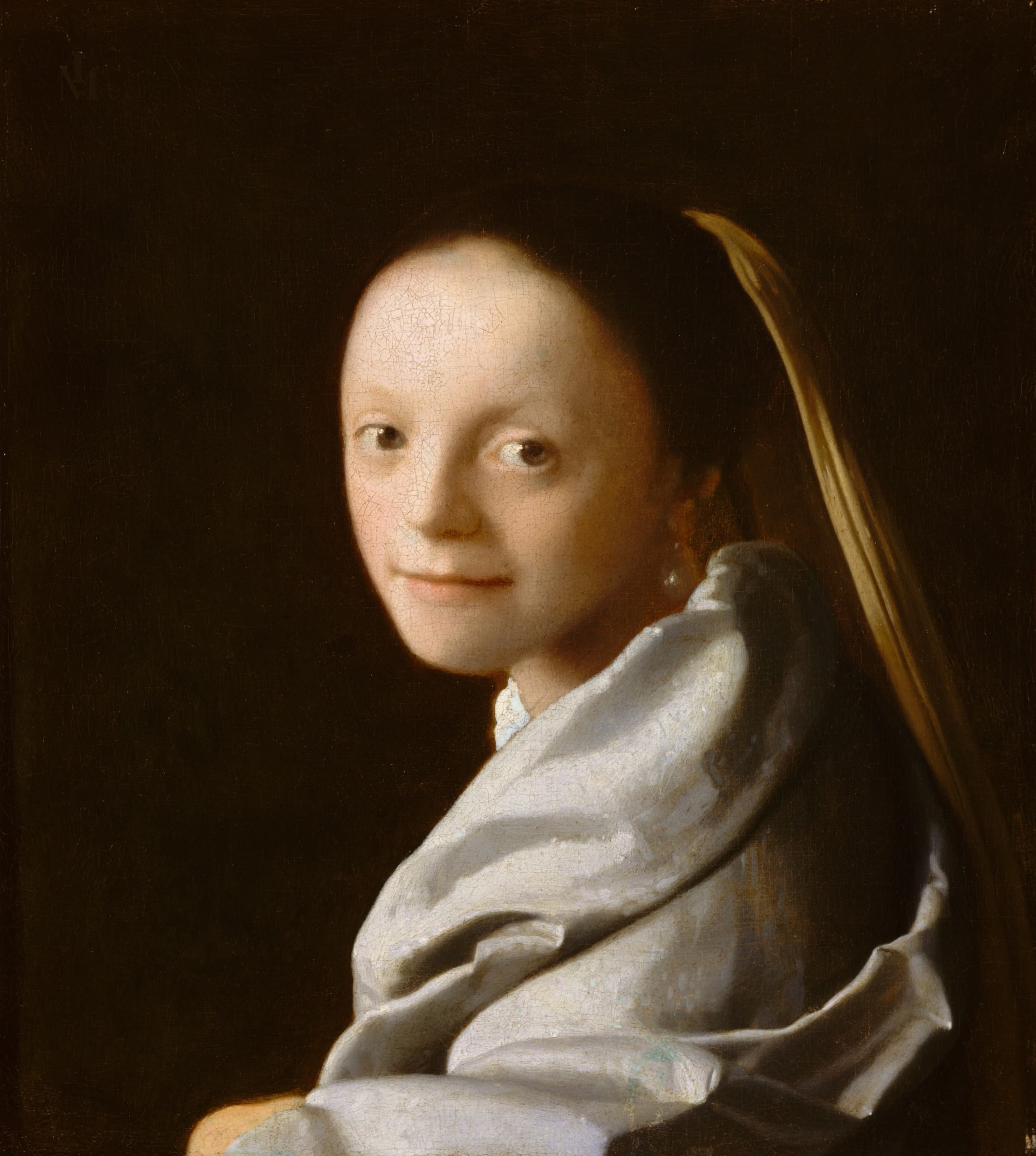
Portrait of a Young Woman
▶ Listen · narrated
Most Renaissance panel paintings began as drawings, but the drawings were working documents, not kept. This silverpoint study survived, though the painted portrait it prepared for did not.
At a glance
- Artist
- Rogier van der Weyden
- Date
- c. 1430–1440
- Material
- Silverpoint on paper
- Dimensions
- 16.6 × 11.6 cm
- Museum number
- 1874,0808.2266
Look closer
Silverpoint requires commitment
The drawing is made with a silver stylus on prepared paper — paper coated with a ground that lets the metal leave a mark. The technique gives a fine, pale line that cannot be erased. Every stroke stays visible, so the draughtsman had to work with certainty. The delicacy you see is not a stylistic choice alone; it is partly the constraint of the medium itself, which rewards control and punishes hesitation.
The headscarf is pinned, not tied
The woman wears a headscarf fixed to her hair with pins, visible as small points where the fabric is secured. The arrangement is specific enough to suggest real observation rather than a generic formula. Whether this indicates her social position, marital status, or simply personal dress is not recorded, and scholars have not established her identity or class from the clothing alone.
A study, not a finished work
The drawing is understood as a preparatory study for a painted portrait, now lost. The evidence for this is comparative: other portraits by van der Weyden show similar poses and compositions, and drawings of this kind typically served as working documents in a painter's workshop. The finished painting would have added colour, background, and possibly symbolic objects. What survives here is the structural work — the mapping of the face.
The story
This is a drawing of a young woman's head and shoulders, made with a silver stylus on paper that had been prepared with a coating to take the mark. The artist was Rogier van der Weyden, a painter working in the southern Netherlands in the mid-fifteenth century. The woman's identity is not known, nor is her social position certain from the clothing she wears.
The drawing has been dated variously to the 1430s or to around 1440–1445. That range reflects the difficulty of dating works on paper when no external record — a commission document, a letter, an inventory — survives to anchor them. Stylistic comparison with van der Weyden's painted panels can narrow the window, but it cannot close it entirely.
Silverpoint is a demanding medium. A silver rod, sharpened to a point, is drawn across paper or parchment that has been coated with a fine ground — often a mixture of bone ash and glue, sometimes tinted. The metal deposits a faint trace, grey or slightly warm in tone, which cannot be rubbed out. There is no erasing in silverpoint, only working around a mistake or starting again. The method rewards a steady hand and penalises uncertainty.
The woman wears a headscarf pinned to her hair. The pins are visible as small marks where the fabric is secured. Her gaze is directed slightly away from the viewer, and the modelling of her face is built up with fine, parallel strokes that describe the curve of the cheek and the shadow under the jaw. The drawing is not finished in the sense of being filled in everywhere; parts of the paper remain bare, and the focus is on structure rather than detail.
It is presumed to be a study for a painted portrait, now lost. The presumption rests on practice: drawings of this kind were working documents in a painter's workshop, made to establish the pose, the proportions, and the fall of light before the panel was prepared and the paint mixed. A similar portrait, showing a woman in comparable dress and pose, survives in Berlin, and it is likely that the lost painting resembled it — a half-length figure, sober in dress, set against a plain background.
Why the painting is lost and the drawing survived is not recorded. Paintings were valuable objects, commissioned and owned, and their survival depended on care, inheritance, and luck. Drawings were expendable workshop material, and most were discarded once the painting was done. That this one was kept suggests someone valued it, but the chain of ownership before it entered the British Museum in 1874 is not fully documented.
Why it mattered then
A drawing like this was a tool, not an end in itself. In a painter's workshop in the 1430s or 1440s, it served to fix the arrangement of a face before the more costly and irreversible work of painting began. Panel painting required preparation — wood had to be seasoned, joined, and primed, pigments ground and mixed with oil — and mistakes were expensive. A silverpoint study let the painter test the composition, adjust the proportions, and settle on the tilt of the head without committing to the final surface. Portraiture in this period was a transaction between a sitter, or a patron acting for them, and a painter who had to balance likeness with decorum. The sitter needed to be recognisable, but also presented in a way that signalled status, piety, or respectability. A preparatory drawing was where that balance could be worked out, away from the sitter's gaze and without the pressure of a panel already underway. Whether the sitter ever saw this drawing is not known, but it is unlikely. Workshop drawings were internal documents, not presentation pieces.
Why it matters now
This drawing matters now because so few like it survive. Most preparatory work from fifteenth-century Netherlandish workshops was discarded once the painting was finished, and what remains is a fraction of what was made. The drawings that do survive — and van der Weyden's are rare — show how a painting was thought through before it was executed, and they reveal a different kind of attention from the finished panel. The silverpoint line is exploratory, structural, concerned with getting the geometry right before colour and symbolism entered the picture. It also matters because it preserves a face that the painted portrait does not. The painting is lost, and without this drawing the woman would be entirely unrecorded. Whether she was wealthy, whether she commissioned the portrait herself or was painted at someone else's request, whether the portrait hung in a house or a guild hall — none of that is known. But the drawing keeps her visible, and it does so in a medium that shows the painter's hand more directly than oil on panel ever could. The hesitations, the corrections, the decision about where to stop — all of that remains legible in a way that a finished painting conceals.
The surprising detail
The drawing entered the British Museum's collection in 1874, but the circumstances of its acquisition before that point are not fully documented. It is one of a small number of drawings attributed to van der Weyden that survive at all, and the fact that it was preserved when most workshop studies were not suggests that someone, at some point, recognised it as worth keeping — though whether that recognition came in the fifteenth century or much later is unclear.
What is disputed
The date of the drawing is uncertain and has been given variously as c. 1430s or c. 1440–1445. The woman's identity and social class have not been established. The drawing is presumed to be a study for a painted portrait, now lost, but no documentary evidence links it to a specific commission or finished work.
Remember this
A study for a lost painting, made in a medium that does not forgive mistakes — and kept when most workshop drawings were thrown away.
Test yourself
Why does the survival of this drawing, rather than the painted portrait it prepared for, tell us something about how value was assigned to different kinds of art objects over time?
Because the drawing was working material, not a finished commission, and its survival suggests that at some point someone valued it for reasons other than its original function. Paintings were owned, displayed, inherited, and cared for as valuable property. Drawings were expendable workshop documents, usually discarded once they had served their purpose. That this study was kept implies a shift in how it was seen — perhaps as evidence of the artist's hand, or as a record of a lost work, or simply as an object worth preserving in its own right. The fact that the painting is gone and the drawing remains inverts the original hierarchy: the preparatory sketch has outlasted the thing it was preparing for.
Go deeper
- Portrait of a Young Woman (van der Weyden) · Wikipedia
- Portrait of a Young Woman — Wikidata · Wikidata
Image: Johannes Vermeer, Public domain. Licence: Public domain. Source.