I · THE OBJECT · BRITISH MUSEUM
Rongorongo text J
▶ Listen · narrated
This carved wooden crescent carries just two glyphs. That makes it the most tantalising fragment in a corpus that has defeated every attempt at decipherment for a century and a half.
At a glance
- Material
- Wood
- Form
- Reimiro (crescent-shaped pectoral ornament)
- Script
- Rongorongo
- Length
- Two glyphs
Look closer
A crescent meant to be worn
The object is a reimiro, a crescent-shaped wooden pectoral that would have been worn on the chest, probably by someone of rank. The form itself is distinctive to the island. The two glyphs are carved into the wood, making this both an ornament and a text. Whether the inscription was added when the reimiro was made, or carved onto an existing ornament, is not recorded.
Two glyphs, and nothing more
Text J consists of two glyphs. That brevity makes it difficult for decipherment work: there is no pattern to detect, no repeated sequence to compare with longer texts, no internal structure to analyse. It survives as evidence that the script existed and was used on objects of this kind, but it offers little to someone trying to read it.
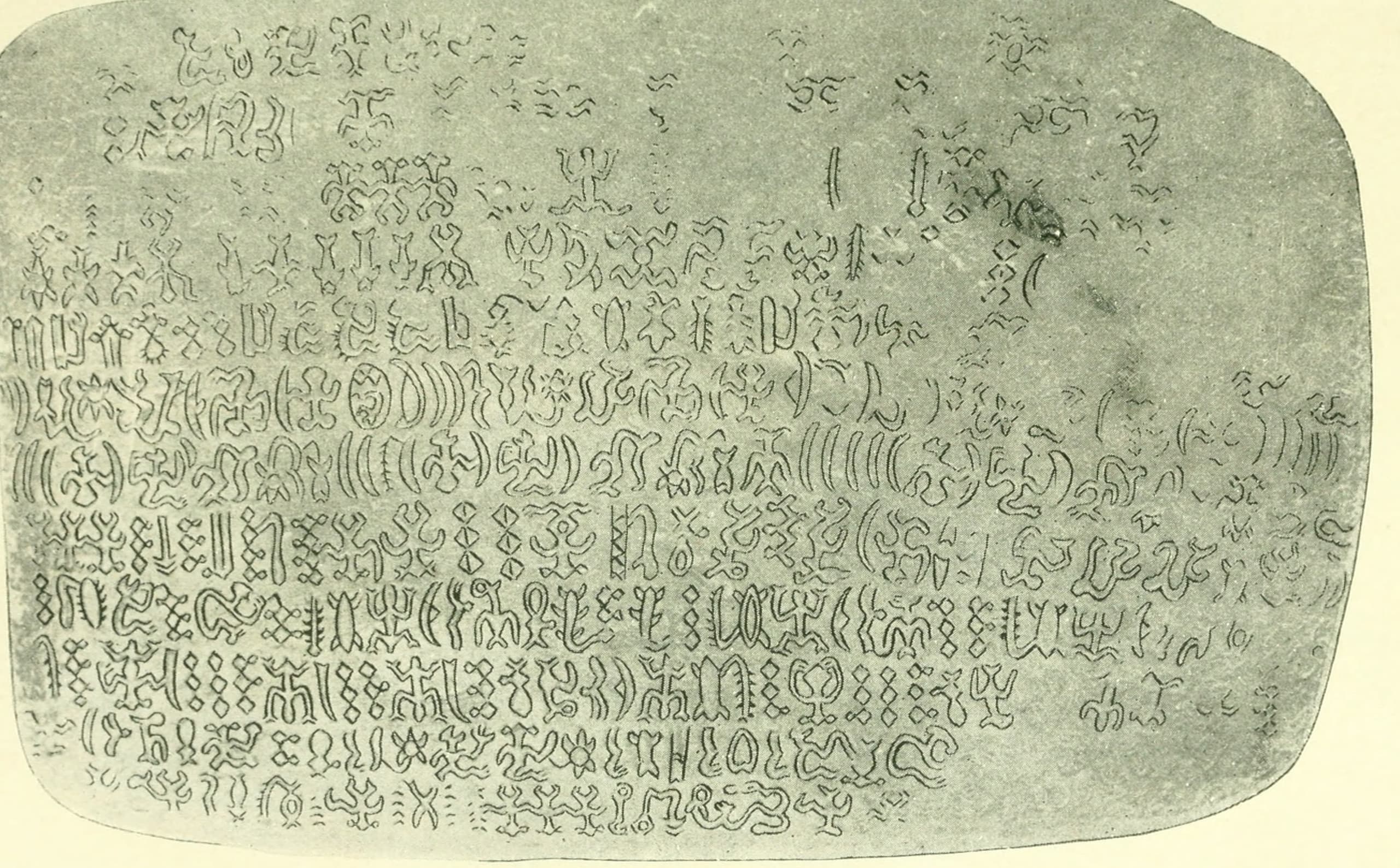
London reimiro 1
The British Museum holds two inscribed reimiro, and this is the larger. It is catalogued as text J in the standard rongorongo corpus — a naming system that runs through the alphabet and assigns a letter to each known text. The corpus includes tablets, staffs, and a few other wooden objects. Text J sits at an extreme: a minimal inscription on a prestige form.
The story
Rongorongo is a script that no one can read. It appears on two dozen wooden objects that survive from the island, carved in neat lines of stylised glyphs that depict human figures, birds, plants, fish, and geometric forms. The script was still in use when Europeans arrived in the eighteenth century, but within a few generations the knowledge of how to read it was lost. What remains is a small collection of inscribed wood, and no key.
Text J is a reimiro, a crescent-shaped wooden pectoral ornament, and it carries just two glyphs. The reimiro form itself is characteristic of the island: a shallow crescent with two pointed ends, worn across the chest and associated with status. Some reimiro are plain; this one is inscribed. The two glyphs are carved into the wood in the same compact, angular style seen on the longer rongorongo tablets, but there is no surrounding text, no second line, no context.
That makes text J difficult for anyone trying to decipher the script. Decipherment depends on pattern: repeated sequences, internal structure, comparison across texts. Two glyphs offer little of that. The longer tablets in the corpus — some carry hundreds of glyphs arranged in lines that reverse direction with each row, a format called reverse boustrophedon — give scholars something to work with, even if the work has not yet succeeded. Text J does not. It is evidence that rongorongo was used on objects of this kind, and that the script appeared in contexts beyond the wooden tablets that make up most of the corpus, but it contributes little to the effort to read the writing itself.
The script remains undeciphered. Proposals have been made — that it records genealogies, that it is mnemonic rather than linguistic, that it encodes chants — but none has convinced the wider scholarly community. The problem is partly the size of the corpus: two dozen texts is a small sample, and many are fragmentary or damaged. It is also that no bilingual text has been found. Without a parallel in a known language, and without enough text to detect robust patterns, rongorongo stays locked.
Text J, as the briefest of the surviving texts, represents an extreme case of that problem. It is a fragment of a fragment, evidence that the script existed but offering little help in reading it. The two glyphs sit on the wood, carved with care, their meaning as opaque now as it was when the last person who could read them died.
Why it mattered then
The reimiro form suggests that text J was an object of status, and the presence of the inscription suggests that the ability to read rongorongo — or the display of text itself — carried meaning in the island's society. Not all reimiro are inscribed, so the addition of glyphs was a choice. Whether those two glyphs named the wearer, recorded a title, invoked protection, or served some other purpose is not known, but the decision to carve them implies that the script had a role in marking identity or authority. The wooden tablets that make up most of the rongorongo corpus were described by early visitors as sacred objects, kept by specialists and recited in ritual contexts. If that account is accurate, then text J may represent a different use of the script: not recitation, but display. The brevity of the inscription does not diminish its likely significance in its own moment; it may instead mark a context where two glyphs were sufficient, because the object itself carried the weight.
Why it matters now
Text J matters now because it is part of a corpus of two dozen objects. Every inscription is evidence. Even a two-glyph inscription contributes to the record of where the script appeared and in what forms. The fact that text J is a reimiro, not a tablet, shows that rongorongo was not confined to one type of object or one kind of use. That information does not unlock the script, but it shapes the questions scholars can ask about it. It also matters as a reminder of how much has been lost. If two glyphs survive on this crescent, how many inscribed objects did not survive? The corpus that remains is not a representative sample; it is what happened to endure. Text J, brief as it is, is part of that fragile survival, and it will remain part of the evidence base for as long as rongorongo resists decipherment — which may be indefinitely.
The surprising detail
Text J is the shortest text in the rongorongo corpus. The British Museum also holds a second inscribed reimiro, catalogued separately as text K. The two are sometimes referred to as London reimiro 1 and London reimiro 2. The existence of two inscribed crescents in the same collection suggests that the practice of carving glyphs onto reimiro occurred more than once, but the small number of surviving examples — just these two are recorded — makes it impossible to say how common the practice was. It may have been rare, or it may be that most inscribed reimiro were lost, burned, or discarded before anyone thought to preserve them.
What is disputed
The circumstances under which text J entered the British Museum's collection are not detailed in the available records. The provenance of many rongorongo objects is poorly documented, and in some cases the route by which they left the island and reached European collections is not known. This applies to text J: the record confirms that it is in the museum's collection, but the history of how it arrived there is not supplied.
How it got here
The history of how text J left the island and entered the British Museum's collection is not recorded in the available material. Many rongorongo objects were collected in the nineteenth century, a period when the island's population had collapsed following disease, enslavement raids, and conversion pressures that led to the destruction of many wooden objects considered pagan. Some texts were given to missionaries, others were taken by visitors, and still others were sold. The lack of provenance information for text J means that the specific circumstances of its removal from the island, and whether it was given, sold, or taken, are not known. Discussions about the repatriation of rongorongo texts to the island have taken place, but no details of claims specific to text J are provided in the available sources.
Remember this
Two glyphs on a wooden crescent: the briefest text in a script that no one can read, and a reminder that some silences may be permanent.
Test yourself
Why does the brevity of text J make it particularly unhelpful for efforts to decipher rongorongo?
Because decipherment depends on detecting patterns, and two glyphs offer little pattern to detect. Longer texts allow scholars to look for repeated sequences, structural regularities, or statistical distributions — the kinds of internal evidence that can suggest how a script works even without a bilingual key. Text J provides almost none of that. It confirms that rongorongo was used on reimiro, but it contributes little to the work of reading the script itself. The lesson generalises: in cryptanalysis and decipherment alike, the size of the sample determines what questions can even be asked.
Go deeper
Image: Internet Archive Book Images, No restrictions. Licence: No restrictions. Source.